
Over the course of 2024, the four quantum pure plays gained an average of 1,063 percent. Then the following year, on January 8, 2025, the day after Jensen Huang made a shocking remark at CES, saying useful quantum computers were 15 years away on the early side and 30 years on the late side, Rigetti dropped 45.4 percent in a single session [1]. Hamamatsu Photonics rose 2.4 percent that same day. From then until now the pure plays are down about 5 percent on average, while the component and metrology layer beneath them is up 129 percent. Most of that 129 percent, though, was built by AI. This piece is an investment map that reprices the quantum supply chain AI has been covering up, across 23 listed companies and five axes. And for each of the 23 names I measured how much of a quantum stock it actually is, two different ways, instead of eyeballing it. One is the single-day move on that January day. The other is a quantum beta over the last 64 trading sessions. As far as I know, nobody has published these numbers name by name. With the US and China accelerating the race for quantum supremacy as the thing that comes after AI, and since May 2026, when the US Commerce Department attached equity conditions to funding for nine quantum companies, I think the downside in this industry has changed shape.
TL;DR
The Defiance Quantum ETF rose 54.9 percent over the past year while the median of the four quantum pure plays was negative. Most of the return came from outside the obvious quantum stocks.
On September 8, 2026, the US Commerce Department turned the first three May letters of intent into definitive agreements, putting $100 million each into D-Wave, Rigetti, and Quantinuum while taking equity stakes. Six of the nine remain pending.
I measured “quantum purity” across 23 listed companies two ways: the Jensen shock and a 64-session quantum factor beta. Only nine show statistically significant quantum sensitivity.
The highest-ranked company on this map is not a quantum pure play. Strip out optical interconnect, the signature axis of my own framework, and the same company still ranks first.
Government capital lowers financing risk, not technology risk. It can keep funding from drying up. It cannot make the quantum computer work.
Contents
Two eras: 1,063 percent and minus 5 percent
Why I am the one drawing this map
Background one: qubits, errors, and logical qubits
Background two: five platform branches
The farther you go, the more light wins
The government attached conditions
Three frameworks
23 companies and who works with whom
The five axes
Rankings, and quantum purity
The lag between tiers, and what I have not confirmed
Catalyst calendar: the next 12 months
Group mapping and hidden cards
Company cards
Scenarios
Where this framework breaks
Watchlist: private and adjacent
Closing
References and sources
1. Two eras: 1,063 percent and minus 5 percent
Over 2024, Quantum Computing Inc (QUBT) rose 1,713 percent, Rigetti (RGTI) 1,449 percent, D-Wave (QBTS) 855 percent, and IonQ (IONQ) 237 percent. Simple average across the four: 1,063 percent. More than a tenbagger.
In the same year Coherent rose 118 percent, Tower Semiconductor 69 percent, FormFactor 5 percent, MKS and Keysight 1 percent each, while GlobalFoundries fell 29 percent and Hamamatsu fell 39 percent. Average across those seven: 18 percent.
Look only at 2024 and the answer seems obvious. If you want to invest in quantum, buy quantum companies. Why would you buy component makers.
But I think that rally was mostly hype with nothing inside it. Prices ran ten times over, to levels the revenue and product scale of the time could not explain. What changed that year was attention, not technology. Which is why one sentence from Jensen was enough to break it.
At the CES Q and A on January 7, 2025, Jensen Huang said this. “We are probably five or six orders of magnitude off. If you said 15 years for very useful quantum computers, that would probably be on the early side. If you said 30, it is probably on the late side. If you picked 20, a whole bunch of us would believe it” [2]. The next day Rigetti fell 45.4 percent, Quantum Computing Inc 43.3 percent, IonQ 39.0 percent, and D-Wave 36.1 percent [1][3].
That same day the tech names held up: Coherent fell only 3.9 percent, Keysight only 0.7 percent, and Hamamatsu Photonics actually rose 2.4 percent [3].
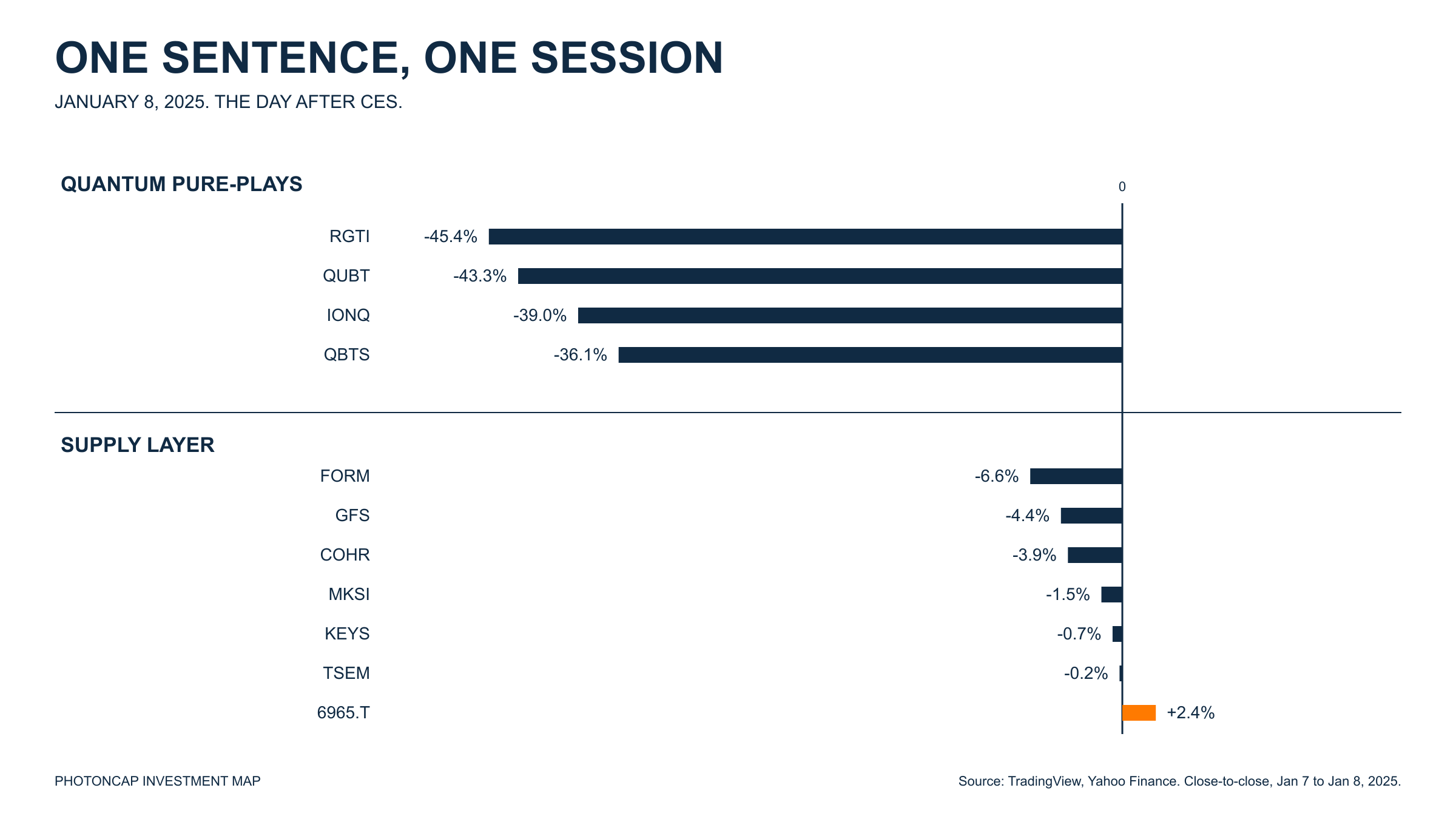
Single-session moves on January 8, 2025, four quantum pure plays versus seven component-layer names
One sentence from one person took 45 percent off some assets in a day, and other assets in the same industry went up on that same sentence. What that difference is, is where this piece starts.
That one-day move gets used again later. As a ruler for how much of a quantum stock a given name really is. This was the largest quantum sentiment shock on record, so how far a company moved that day is its quantum purity. The broad market barely moved: SMH, the semiconductor ETF, was down 0.7 percent. Meaning it was not a day when the whole market sold off.
Look at what came after that day and the direction flips. From January 7, 2025, the day before CES, through September 4, 2026, the four pure plays are down 5 percent on average. Over the same window the seven component and metrology names are up 129 percent. Tower Semiconductor 329 percent, Coherent 189 percent, MKS 131 percent [3].
Cut it to the last year alone and the picture holds. IonQ minus 4.1 percent, Rigetti minus 0.2 percent, D-Wave plus 7.2 percent, Quantum Computing Inc minus 45.2 percent. Average across the four is minus 10.6 percent, median minus 2.2 percent. IBM is flat too at minus 4.3 percent. The seven component and metrology names, meanwhile, are up 156.1 percent on average, 161.4 percent at the median [3]. Those seven are the ones just counted: Coherent, Tower, FormFactor, MKS, Keysight, GlobalFoundries and Hamamatsu. AXT is excluded because the InP cycle is what drives it.
One more number belongs here. Over that same year, the Defiance Quantum ETF (QTUM) rose 54.9 percent [3]. Which means that while a quantum ETF was up 55 percent, the median quantum pure play was down. So where did that 55 percent come from. As you would guess, the answer was outside the pure plays.
Something has to be said honestly here. The real driver that pushed the component layer into triple digits is, surprisingly, not quantum but AI. What took Coherent up 189 percent was optical demand from AI datacenters, and what took Tower up 329 percent is the same cycle. Quantum revenue at these companies is small enough that it does not get broken out in filings.
So this is as far as the data proves anything. Assets tied only to quantum expectations collapsed on one sentence, and assets whose revenue turns on a different cycle held up. The next question, which is where the quantum exposure at these companies turns into actual orders, is what this map is trying to answer.
Let me flag one exception up front. Not every pure play broke together. D-Wave is up 74 percent since CES and still sits 48 percent above its March 2025 high [3]. There was an acquisition this year that changed what the company is, and first-half bookings grew sharply. That bookings number has a few things worth picking apart, though. I get into it in the company card behind the paywall.
2. Why I am the one drawing this map
This is the sixth in the investment map series. I have drawn glass substrates, LEO satellites, submarine cable, defense sensors, and humanoids. This one is quantum.
This one is a different animal from the previous five. Those five were cycles where revenue was already turning. Glass substrate pilot lines were going in. Submarine cable had 13 billion dollars of orders on the table. Quantum is not like that. A good share of the companies on this map have no product and effectively no revenue.
Which is why nobody draws this map. It is hard.
I wonder if there is anyone other than PhotonCap who can cover this. Someone fluent not just in optics but in semiconductors, in quantum, and in metrology and packaging, all of it. How many people have designed a semiconductor, laid it out, actually built one, and then measured it. I mean someone who has done all of it. Quantum is the same story. On X, on Substack, across the various online communities, I have not seen anyone other than me covering quantum at anything above trader level.
There is a reason all five of those are needed. Take a quantum computer apart and you find a chip built on a semiconductor process, optics that get light into and out of that chip, equipment that cools it or holds it in vacuum, and metrology that reads out what is happening inside. And in the end it has to go through packaging to become a product. Someone who knows only one of those layers cannot see which of the other four is the bottleneck. And from an investment standpoint, the bottleneck is exactly where the money turns first.
For readers who want to invest in quantum but get stuck at what a qubit even is, I am starting from background. Sections 3 and 4 are for people seeing quantum for the first time, so if you already know this, skip to section 5.
3. Background one: qubits, errors, and logical qubits
The computers we use calculate with 0 or 1. Switch off is 0, switch on is 1. We call it a bit.
A qubit is a switch that can sit somewhere between on and off. It holds a probability of being 0 and a probability of being 1 at the same time, and settles into one of the two at the moment you read it. Physics calls that state superposition.
Every qubit you add doubles the state space you can represent. At 300 qubits that space exceeds the number of atoms in the universe. 2 to the 300th is about 2.04 times 10 to the 90th. There is a common misunderstanding here, though. You cannot read that whole space at once. The moment you measure, it collapses to a single answer. The real advantage comes from specific algorithms that use interference to raise the probability of the answer you want. Molecular bonding calculations and integer factorization are that kind of case.
The problem is that this superposition breaks very easily in practice.
A vibration, a temperature swing, a cosmic ray passing through, and the qubit loses its state. This is called decoherence. How you defend against it differs by platform. For superconducting and some spin qubits, cooling to millikelvin is the core of it. For trapped ions and neutral atoms, ultra-high vacuum and laser control are the core. Photonic runs at room temperature but lives or dies on optical loss and detection. Even with all of that, the best qubits today get it wrong somewhere between one time in a thousand and one time in ten thousand.
One in a thousand sounds fine? A single useful calculation involves billions of operations. The probability of never making a single error is the per-operation success probability of 999/1000 multiplied by itself as many times as there are operations. At a billion operations that is (999/1000) to the billionth power, which is essentially zero. At one error per thousand, the calculation turns to garbage long before an answer comes out.
This is where error correction enters.
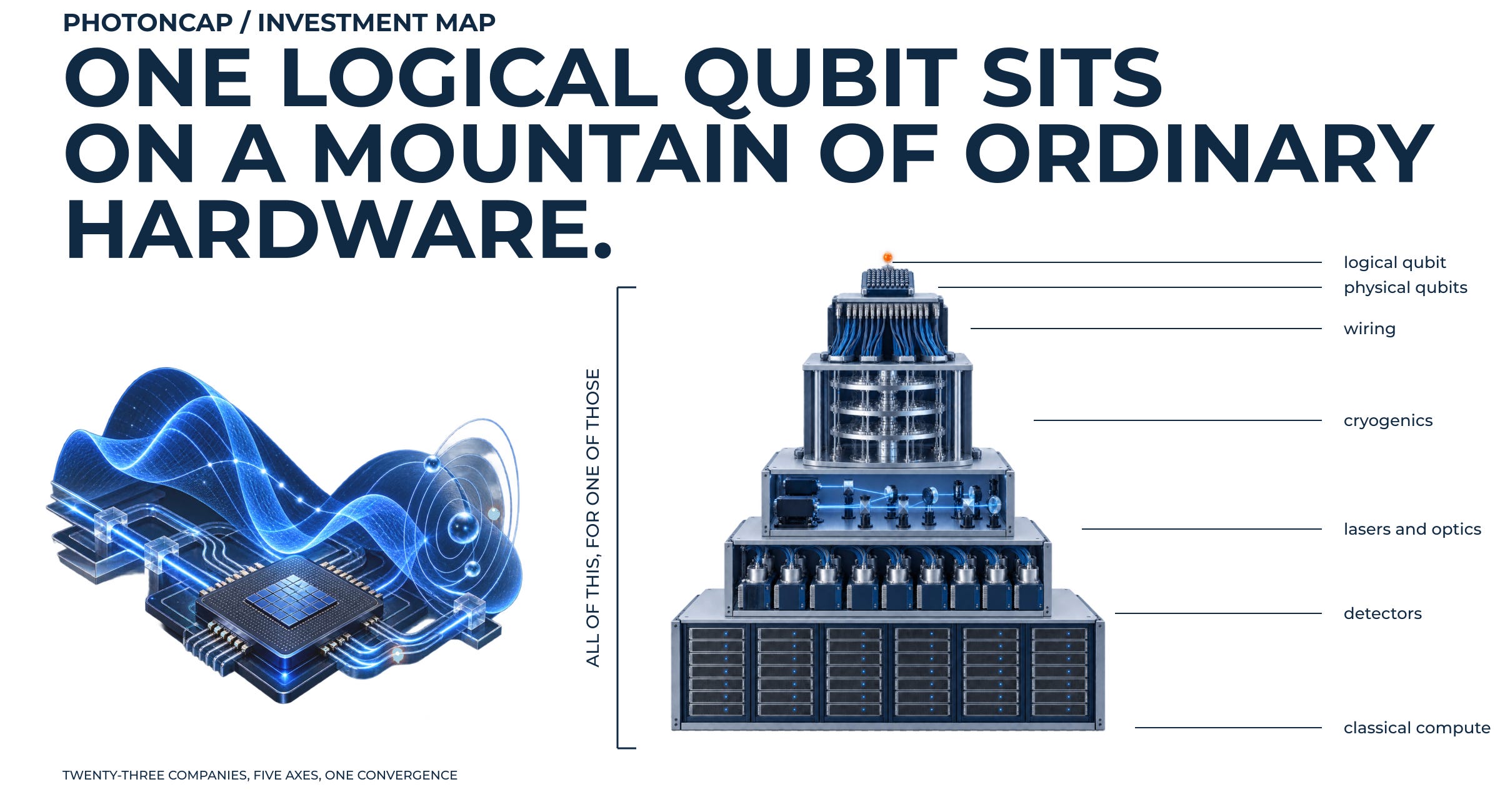
The idea itself is simple. Bundle a set of unreliable qubits together and use them as one reliable qubit. The physically existing qubits are physical qubits, and the logical unit you build by bundling many of them is a logical qubit. They keep checking each other so the wrong one can be found and fixed.
The cost is large. It depends on the scheme and on qubit quality, but one logical qubit takes hundreds to thousands of physical qubits. So when you see an announcement that says a company built a 1,000 qubit machine, the first thing to check is whether that is physical or logical. It is about three orders of magnitude of difference.
Here is the part that matters to an investor. To increase logical qubits you have to multiply physical qubits, and when physical qubits go up, the equipment that cools or confines them, the wiring that connects them, the control channels that drive them, and the detectors that read them all go up together. Add one qubit and that much hardware really does get added alongside it. So the moment error correction genuinely starts working, money flows to the objects around the qubit.
There is a further condition: that checking has to happen in real time. You have to find and fix the error before the qubit loses its state, so the verdict has to land faster than the error correction cycle of that platform. That verdict is called decoding, and it is a classical computer’s job. How much time you get differs by platform. Superconducting is already in the regime where microseconds are the constraint, while trapped ion readout itself runs hundreds of microseconds to milliseconds, so the margin is different. Either way it means a fast enough classical computer has to sit next to the quantum computer.
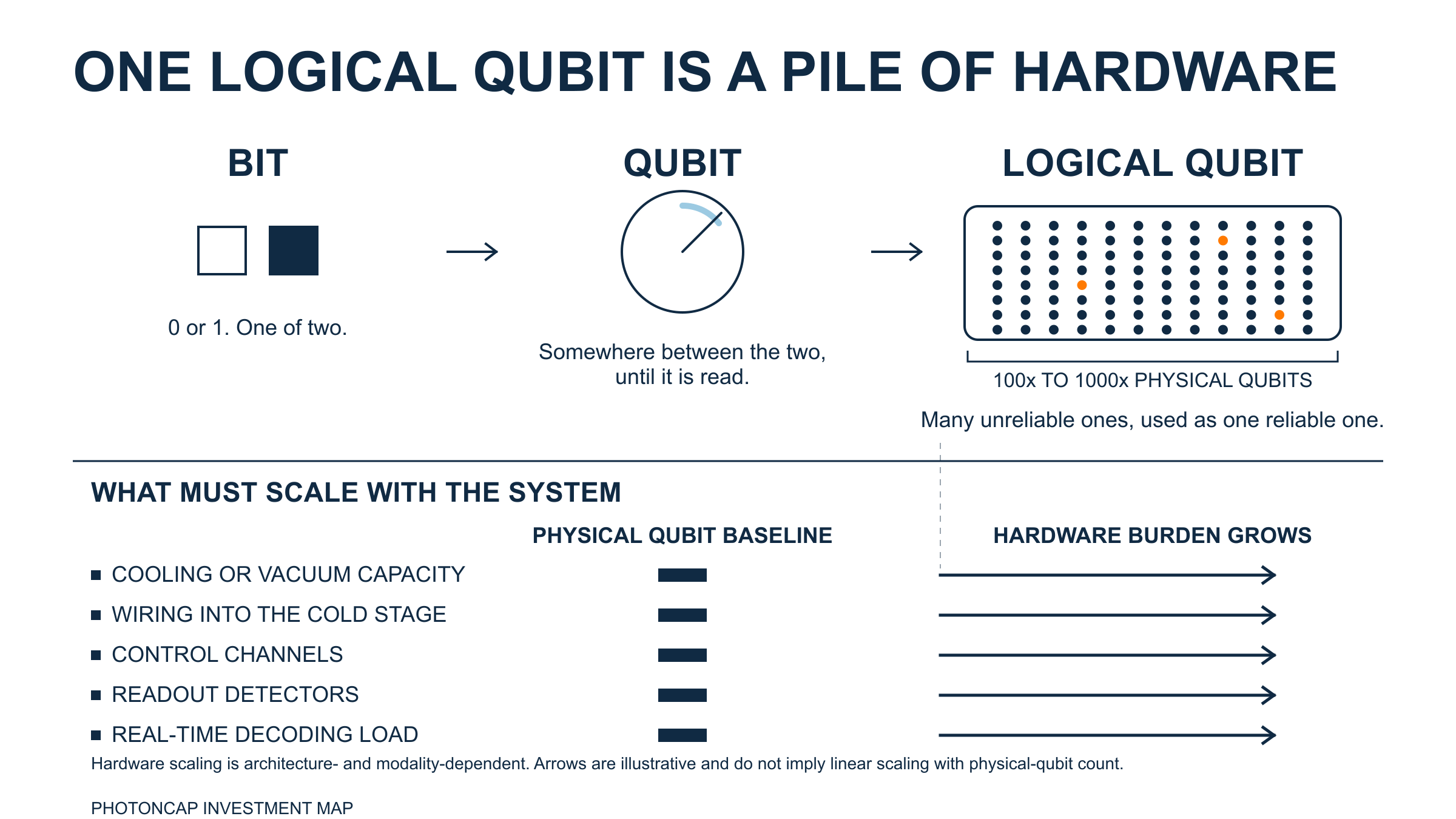
From bits to qubits to logical qubits, and the cooling, wiring, control channels, detectors, and decoding load that multiply alongside one added logical qubit
4. Background two: five platform branches
The camps split on what you make the qubit out of. Based on what is investable in listed markets and what current government programs fund, this piece centers on five branches.
Superconducting. Run current through a circuit chilled to very low temperature to make a qubit. It is also the best known quantum platform. Google, IBM, and Rigetti are here. It reuses semiconductor processes so it is familiar to build, and gate speeds are fast. In exchange it has to be cooled to millikelvin, so a dilution refrigerator is mandatory, and every qubit needs wiring running into the fridge, so wiring saturates before qubit count does. What this camp can and cannot do is something I worked through using Google’s case in Google Quantum AI says it can break Bitcoin in 9 minutes. Should we actually worry?.
Trapped ion. Levitate ions in a vacuum chamber with electromagnetic fields and manipulate them with lasers. IonQ, the bellwether among the quantum pure plays, is here, and so is Quantinuum. Gate fidelity is high and there is no device-to-device variation, because you are using atoms that nature made. In exchange it is slow. And there is a limit on how many ions fit in one trap, so scaling means splitting into modules. You read an ion’s current state by counting the faint fluorescence it emits, and the photomultiplier tubes used for that come back in section 13.
Neutral atom. Pick up chargeless atoms one at a time with optical tweezers made of laser beams and arrange them. QuEra, Atom Computing, and Infleqtion are here, and Auratomic, which took Bezos money, is here too. The strength is that the array can be reconfigured freely. And this approach is structurally a pile of lasers. Holding the qubit, manipulating it, and reading it are all done with light. Infleqtion built revenue in quantum sensing before quantum computing, and I covered that structure in Infleqtion and Quantum Sensing: The Quantum Reality That Arrived Before Computing. It was private then and is now listed as INFQ.
Photonic. Use particles of light themselves as the qubit. Among listed companies there is Xanadu, and among private ones PsiQuantum. The strengths are that it runs at room temperature and can use silicon photonics processes directly. In exchange photons are easy to lose. Loss is the biggest wall for this camp. I went into this in detail on Xanadu in The 1% Loss Wall (Part 1): Where Xanadu ($XNDU) Really Stands, Through the Lens of Three Nature Papers.
Silicon spin. Use the spin direction of a single electron inside silicon as the qubit. Diraq, Quantum Motion, EeroQ, and Silicon Quantum Computing are here. The biggest strength is that it can use existing semiconductor fabs almost as they are. Qubit counts are still low. And in this camp, Diraq and Quantum Motion and EeroQ all use the same process at the same foundry. Which one comes out in section 8.
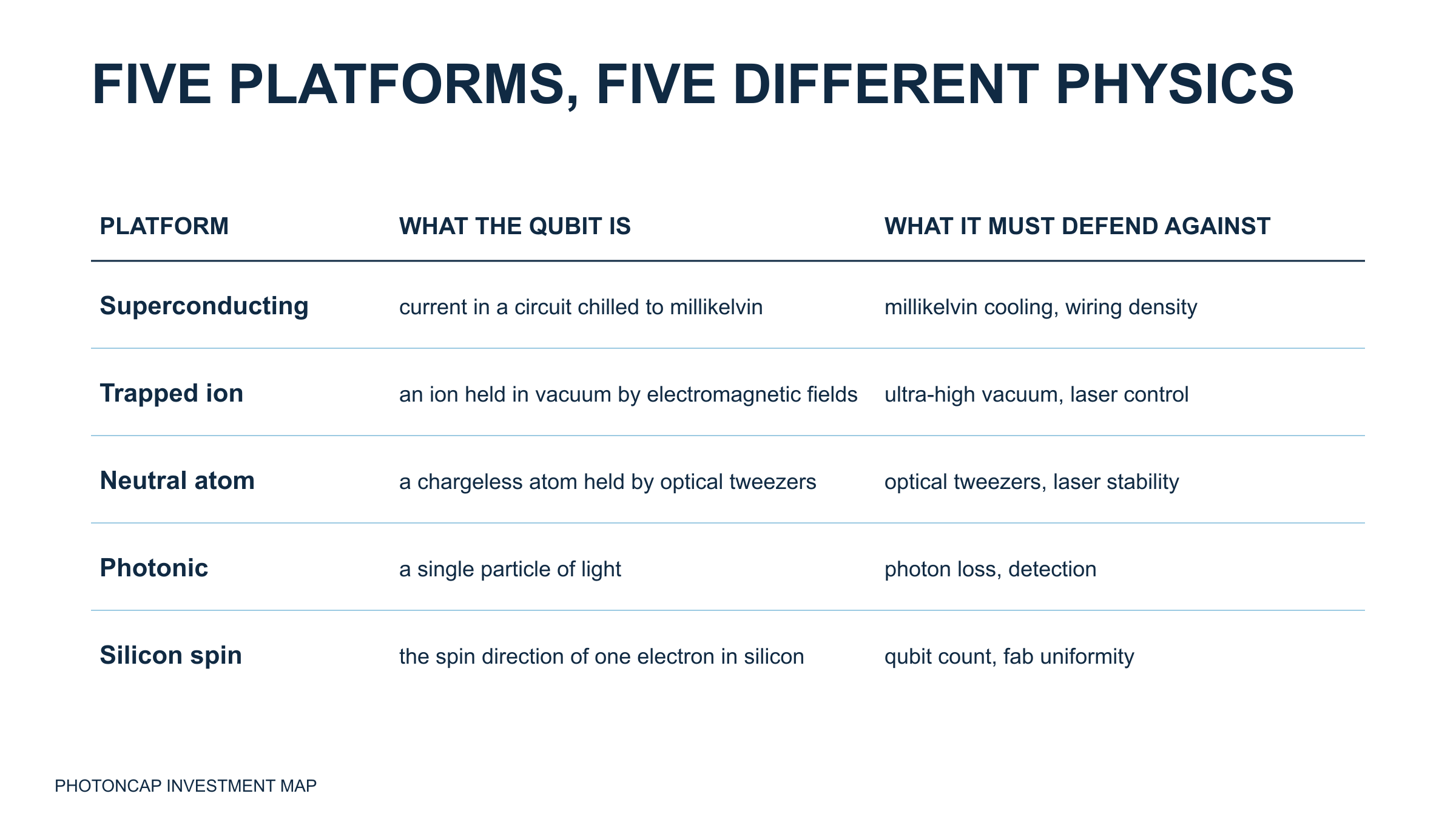
Five platforms compared, representative companies and the physical condition each camp has to defend against
Five branches, five different physics. So nobody knows who wins right now. If someone says it with confidence, here is something I can say with confidence. That someone does not know.
This is the core difficulty of quantum investing. If you cannot pick the winning modality, how do you pick a stock.
5. The farther you go, the more light wins
Half the answer is already in an earlier piece. My subscribers already know this one, in fact.
Whichever of the five branches you take, meaningfully increasing qubit count means going past the limit of one chip, one fridge, or one trap. Which means splitting into modules, and then reconnecting the modules you split.
What you connect them with is decided by distance. Modules close together inside a fridge can be linked with superconducting wiring and microwave, and there are demonstrations of cryogenic microwave links between separate fridges. But the moment distance grows and the path has to cross a room-temperature section, microwave gets sharply worse. At the scale of rack to rack and room to room, conversion into telecom-band light is the best-validated scaling path so far. More precisely than saying light is the only answer: as distance grows, the scalability of optical conversion wins.
Trapped ion links modules with photons. Neutral atom does the same. For the photonic camp light is the qubit to begin with, so there is nothing to argue. Even in superconducting systems, conversion from microwave to photons for long-distance transport is under active research.
I took this argument apart layer by layer in Superconducting or Trapped Ion, They All Buy the Same Light. Four layers, source and conversion and transport and routing and detection, down to who sits in each.
The conclusion there was to stop waiting for a modality winner and look at the component and foundry layer first. Here is what happened in the three months since.
In April 2026, IonQ announced it had linked two independent commercial trapped ion systems through photonic entanglement. By the company’s own account it is the first case of commercial quantum computers connected by photons [4]. And on July 31, 2026, IonQ closed its 1.8 billion dollar acquisition of SkyWater Technology [5][19]. A trapped ion quantum company bought an entire US semiconductor foundry. In January it also acquired Skyloom, a free-space optical communications company. And Lightsynq, which does quantum memory and photonic interconnect for linking quantum processors, closed earlier than either of those, in June 2025. More than 20 patents and applications covering quantum memory and interconnect came with it [37].
Why would a trapped ion company buy a foundry, an optical comms company, and a quantum memory and interconnect company. Its own qubits are ions floating in vacuum.
Because once you split into modules you have to reconnect them, reconnecting takes light, and someone has to build the chips that handle light. Hand that to someone else and someone else holds the bottleneck.
There is one more layer on top of this. Look at the 11 companies that made Stage 2 of DARPA QBI and you find Photonic Inc, which DARPA itself describes as “optically-linked silicon spin qubits” [6]. Even the silicon spin camp has optical linking baked into its architectural premise.
6. The government attached conditions
On May 21, 2026, the US Commerce Department announced it had signed letters of intent with nine quantum companies totaling 2.013 billion dollars [7]. One billion to IBM, 375 million to GlobalFoundries. Atom Computing, D-Wave, Infleqtion, PsiQuantum, and Quantinuum get 100 million each, Rigetti up to 100 million, and Diraq up to 38 million, the one name at a different order of magnitude.
The conditions matter more than the amounts. The announcement says this. “The Department will take a minority, non-controlling equity stake in each company as a condition of receiving funds, in order to increase returns for the American taxpayer.”
Give funding, take equity. That is an investment structure.

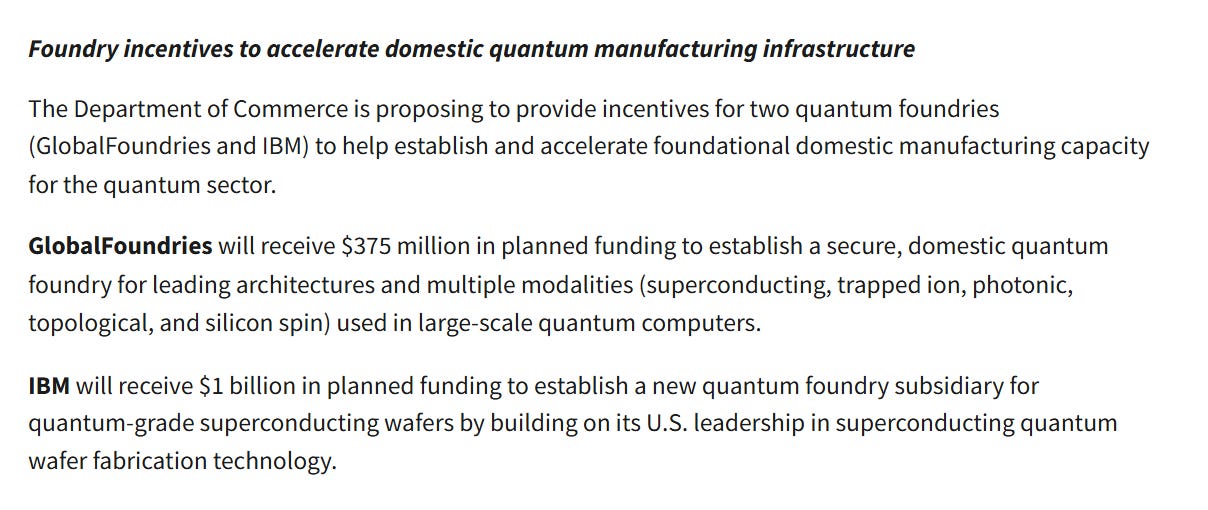
The equity-stake condition sentence in the US Commerce announcement
What Commerce announced is a letter of intent, and the equity is a condition of receiving funds. The announcement contains no confirmation that equity has been taken in all nine. Only one company has disclosed a percentage: GlobalFoundries, which put about 1 percent in its own release [21]. The other eight have to be confirmed at definitive agreements in the fourth quarter. Commerce is aiming to close them then.
Then, right before I filed this, the first three closed. On September 8, 2026, D-Wave and Rigetti and Quantinuum each signed a definitive agreement worth 100 million dollars [38][39][40]. Three deals, 300 million dollars, and Commerce takes a minority non-controlling equity stake in each as a condition of the funding. This is the first case of a letter of intent turning into actual money and an actual stake.
The stated uses differ. D-Wave said it will put the money toward a 100,000-qubit annealing system and a 10,000-qubit gate model system designed to carry 100 logical qubits through more than a million operations [38]. Rigetti committed to three things: compressing readout electronics into a miniaturized package, expanding cryogenic capacity through a new cryostat architecture, and building fabrication capability for high-connectivity chip architectures [39]. Neither is about the qubit itself. Both are about what surrounds the qubit. Section 3 said money flows to the objects around the qubit once error correction starts working. This time that move happened through government funding rather than acquisitions.
Quantinuum’s award names two more companies. GlobalFoundries is named as the fab that will make its next-generation ion traps and control electronics on 300mm wafers, and Monarch Quantum is named for the lasers and optical components [40]. The first name comes back behind the paywall. The second one is on the watchlist.
The other six are still pending. So the verification of this axis is only half done.
Even so, I think a government putting money down with equity as the condition is a hard floor. But the floor sits under financing, not under the share price. That is the answer to the question of why you should not exclude companies with no product and no revenue. The US has no option to give up quantum in its technology competition with China, so capital keeps coming in.
What that floor actually buys you has to be kept straight, though. A government stake raises financing availability and signals government technical validation. It does not guarantee continued listing, or solvency, or the absence of further dilution. Do not blur that distinction.
And this is not just Commerce. In June 2026 the Department of Energy launched Quantum Genesis with a stated goal of building and deploying a scientifically useful fault-tolerant quantum computer by 2028 [8]. DARPA QBI is running 11 companies in Stage 2 with Stage 3 validation to follow. The National Quantum Initiative Reauthorization Act (H.R. 8462) passed the House Science Committee in April 2026 and went to the floor [33]. It is not law yet.
The other side is symmetric. China’s 15th Five-Year Plan put quantum near the top of its future industries list. Origin Quantum raised close to 3 billion yuan in a July 2026 pre-IPO round led by China North Industries Group [18]. A state-owned defense conglomerate put money into a quantum computing company. I covered this shape in The Real Quantum Race: NVIDIA, NQI, and China’s State Capital.
Overlay the nine Commerce names with the 11 DARPA QBI names and something interesting falls out. Only four companies appear on both lists. Which four, and what that means for scoring, is behind the paywall.
7. Three frameworks
That is as far as the picture goes on public information alone.
The market looks at quantum through ordinary financial metrics. Revenue, growth, valuation. In an industry where revenue is effectively zero, those metrics distinguish nothing. You cannot line up five companies with zero revenue and compare P/E ratios.
So this cycle needs its own scorecard. Behind the paywall I apply three frameworks to all 23 companies at once.
The GVM score. Five axes, one to five points each. The axes are government anchor, modality neutrality, physical bottleneck, revenue substance, and convergence proximity. That last axis is this map’s signature, and it measures how tightly a company is attached to the two convergence axes, optical interconnect and real-time decoding. This axis is graded on evidence tier. Having your name in a press release, giving a supporting quote, and actually shipping parts or running a joint demonstration do not get the same score. No primary source, no points.
Phase weighting. Adding the five axes straight up fails to reflect the current phase. In a stretch where revenue does not mean much yet, the revenue substance axis has to weigh less and government anchor, modality neutrality, and convergence proximity have to weigh more. Apply the weights and the ranking changes.
The catalyst calendar. Trigger events scheduled in the next 12 months, placed on a time axis. Each row is marked as a fixed government date, a company-stated target, or my estimate.
And quantum purity. This is the part of this piece I put the most work into. The obvious objection is that Google and IBM and a foundry are not quantum companies, so scoring them on quantum axes alone cannot be right. So I measured how much of a quantum stock each name actually is, two different ways, and published it as its own column. There is plenty of writing that hand-waves at quantum exposure. I have yet to see anyone measure it as a number and attach it name by name. Overlay this column on the ranking table and investment character splits four ways, and it explains why the two hidden cards come out of the quadrant they come out of.
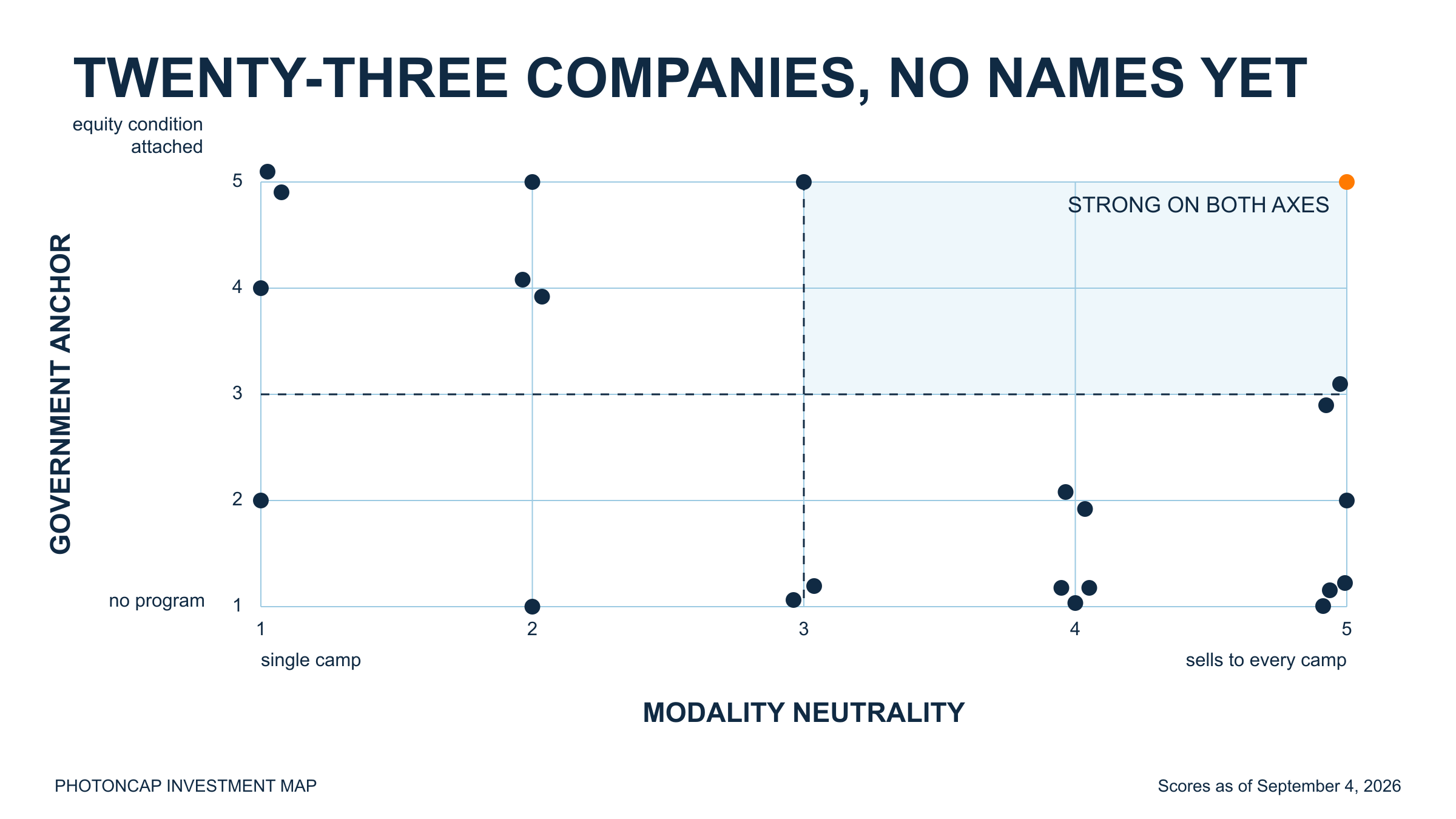
Quantum value chain positioning matrix, vertical axis government capital anchor strength, horizontal axis modality neutrality, company names withheld
Behind the paywall: all 23 companies identified, the foundry and component supply wiring diagram, market cap and returns by tier, the five-axis scorecard, the weighted ranking, group mapping, two hidden cards, the 12-month calendar, scenarios, and monitoring points. Five ownership changes in 2026 alone reshaped this map. One of them is an event where the listed exposure to the hardest physical bottleneck in this industry disappeared entirely, and another happened in late August and actually changed the rankings in this piece.
