
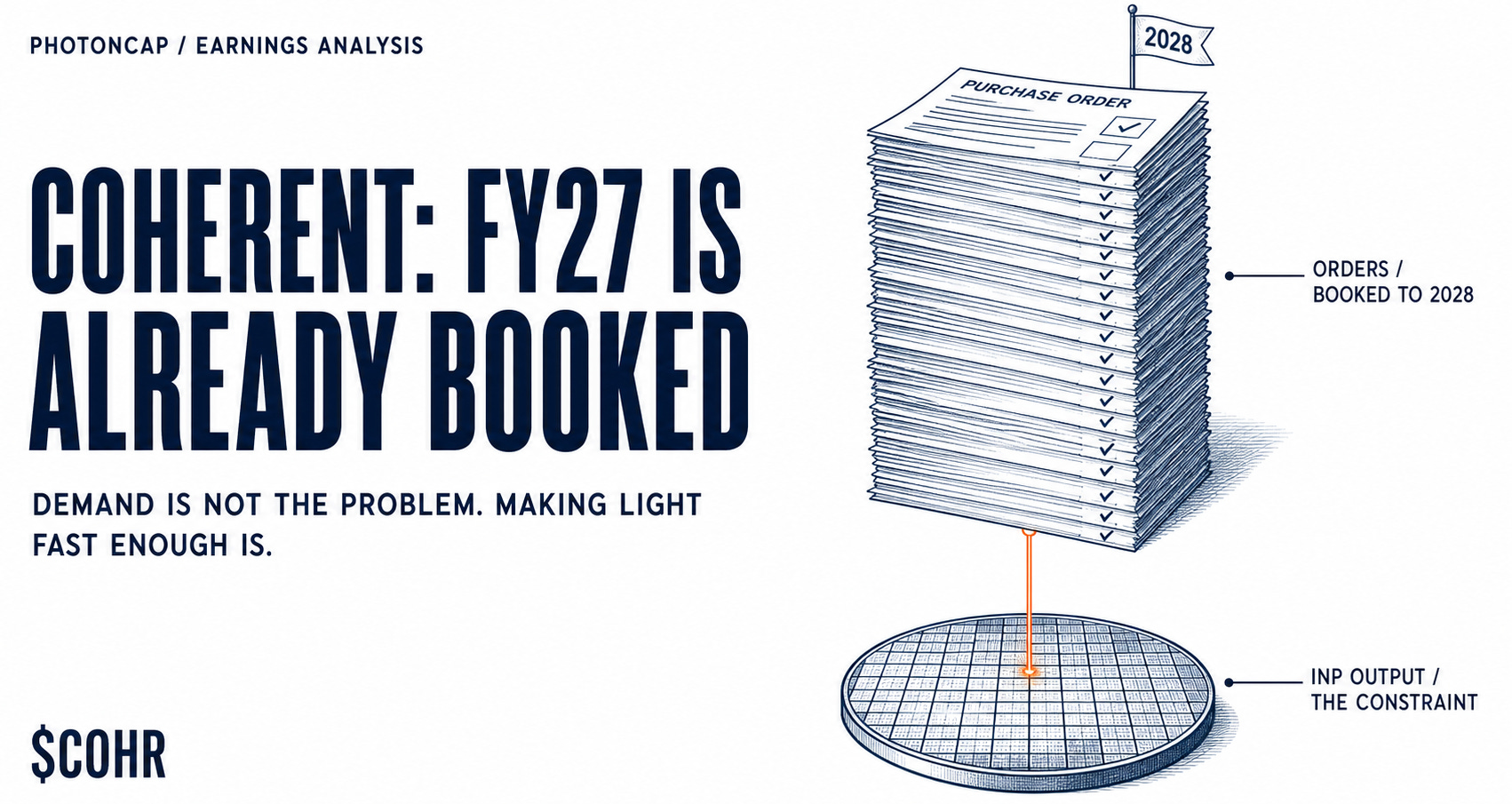
TL;DR
Coherent’s FQ4 2026 revenue, released after the close on August 12, came in at $2.05B. That lands almost exactly at the top of the guidance range given three months ago, and non-GAAP EPS of $1.74 went past the top end ($1.72) [1].
Guidance for the next quarter is $2.2B to $2.4B in revenue, roughly +12% QoQ at the midpoint. And yet the stock, up nearly 9% in the session right before the release on the 12th, gave the entire rally back with an 8% drop on the 13th, the first trading day after [1][3].
My read is this. The real news from this call is between the lines of the transcript. Where the bottleneck has moved, what six-inch does to margins, and what the company is worried about instead of demand. The direction is in the body.
Contents
August 12: A Top-of-the-Guide Quarter and a Post-Earnings Reversal
The constraint has already moved upstream from the module
Six-inch InP is a capacity story and a margin story at the same time
(Paywall) What kind of debate is CPO versus NPO for Coherent?
How far up the network does OCS go?
What does Coherent sell into scale-across?
What the FY27 order book says
Where to check the return on CapEx
Checking the Last Call: The Six Items I Flagged in May
Conclusion: These Dates Will Do the Judging
1. August 12: A Top-of-the-Guide Quarter and a Post-Earnings Reversal
Results touched the top of the guide, EPS went through it, and the stock still fell 8% the next day. That is this Coherent quarter in one line.
Coherent reported FQ4 2026 results (quarter ended June 30) after the close on August 12. Revenue came in at $2.05B, up 34% year over year on a reported basis [1]. The guidance range the company had given three months earlier was $1.91B to $2.05B, so this lands almost exactly at the top end. I go through the item-by-item guidance comparison in section 9.
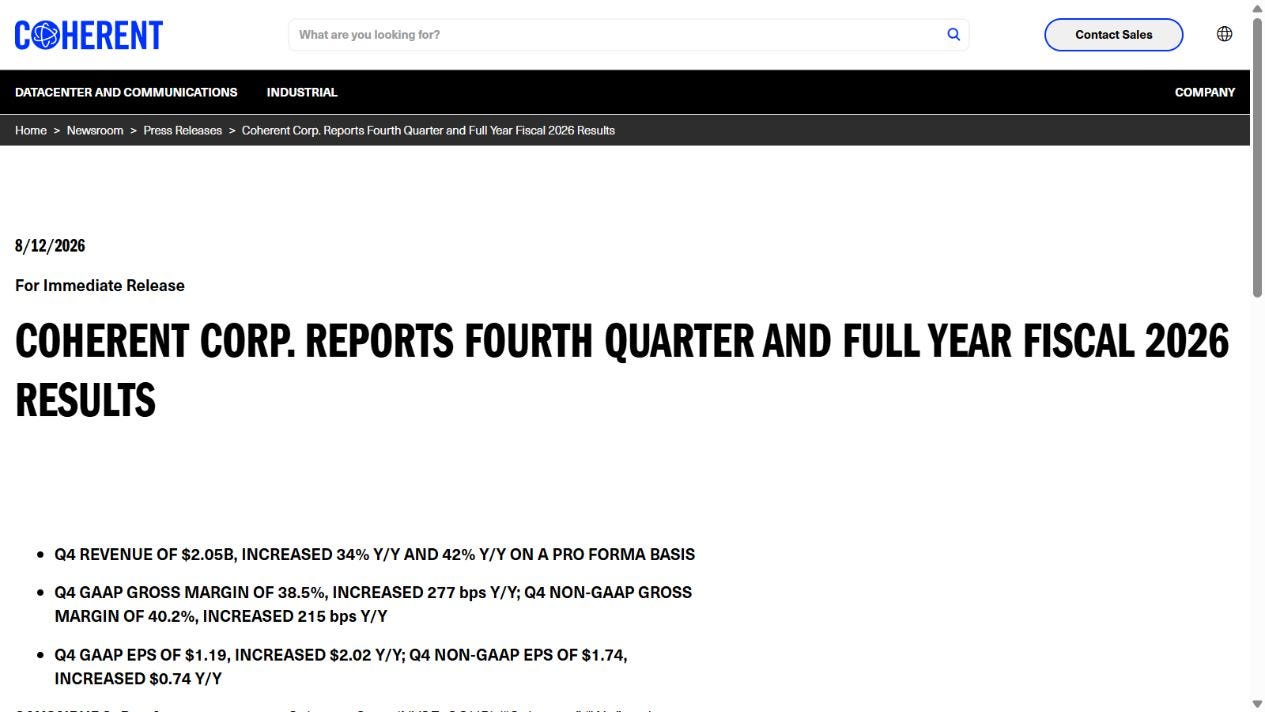
Profitability came along with it. Non-GAAP gross margin of 40.2%, EPS of $1.74 up 74% year over year, and for the full year, FY2026 revenue of $7.12B at +22.5% [1]. The segment mix tells you where this growth comes from: Datacenter & Communications did $1.6B-plus in Q4, up close to 60% year over year and now around 80% of the total, while Industrial slipped backward to the $430M level [1]. The AI data center side is carrying the whole company.
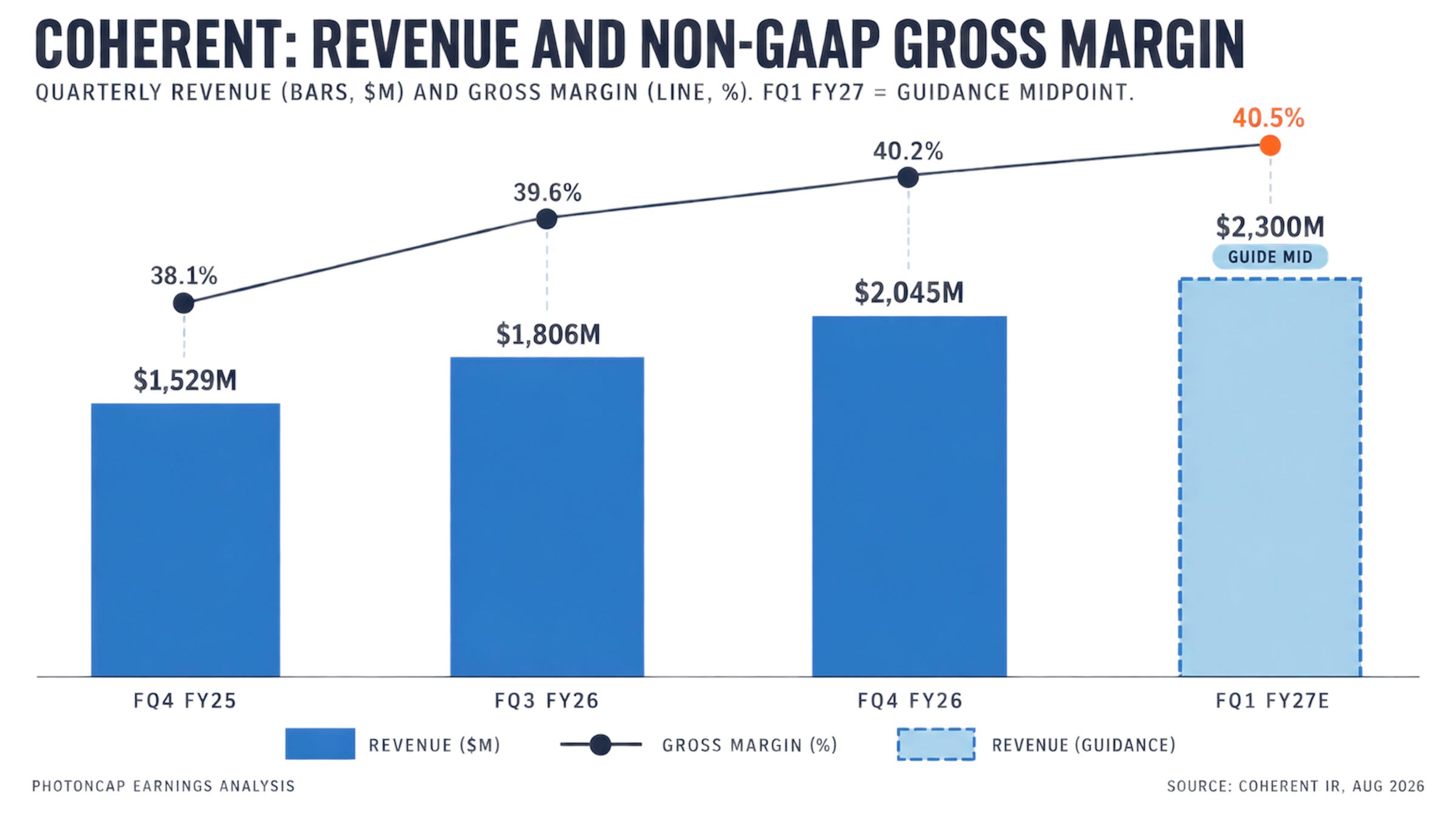
Quarterly revenue and non-GAAP gross margin from FQ4 2025 through FQ1 2027 guidance
Guidance is strong too. FQ1 2027 revenue of $2.2B to $2.4B, non-GAAP gross margin of 39.5-41.5%, EPS of $1.85-2.05 [1]. At the midpoint, that is another quarter of 12%-plus sequential growth.
And yet the stock moved in an interesting way. Shares rose nearly 9% to around $356 in the regular session on August 12, right before the release, then closed the first post-earnings session on the 13th down 8% at $327.23, giving the entire rally back (as of the 2026-08-13 close) [3]. After touching the top of the guide and calling for another quarter of double-digit growth, why did it fall? There are about three candidates. Expectations already loaded into a stock trading at close to four times its 52-week low [3], the cash burden of an aggressive buildout, or simply a bar that had formed above the guidance. The second candidate is one you can check directly against the CapEx and cash-flow numbers later in this piece.
The public takeaway was just one thing, the InP bottleneck. But reading the transcript from start to finish, this call carries a few bigger changes underneath. And the gap between the headline numbers and the post-earnings reaction is filled by exactly these lines between the lines. So here they are.
2. The constraint has already moved upstream from the module
On this call, Coherent stated flatly that transceiver assembly and test capacity are not constraints today. The biggest constraint is InP production [2].
Honestly, this is where I paused. It was hard to agree with, and it made me think twice. I have long viewed test as the single biggest bottleneck in optical devices. I have published quite a few articles on test (The 100-Second Bottleneck Behind NVIDIA CPO: 7 Companies That Own the 4-Stage Test Stack, The Three Pillars of SiPh Wafer Test: What AEHR, FORM, and KEYS Actually Do), and I hold quite a few of the related stocks too. Why PIC test is harder than EIC test, and how large its share is at the package level, is something I also touched on in [PC101] Lecture 4: The Last Millimeter: Who Builds It. CPO Packaging Value Chain and Next-Gen Applications (Part 2). So why did Coherent point at InP, and specifically production, instead of test?
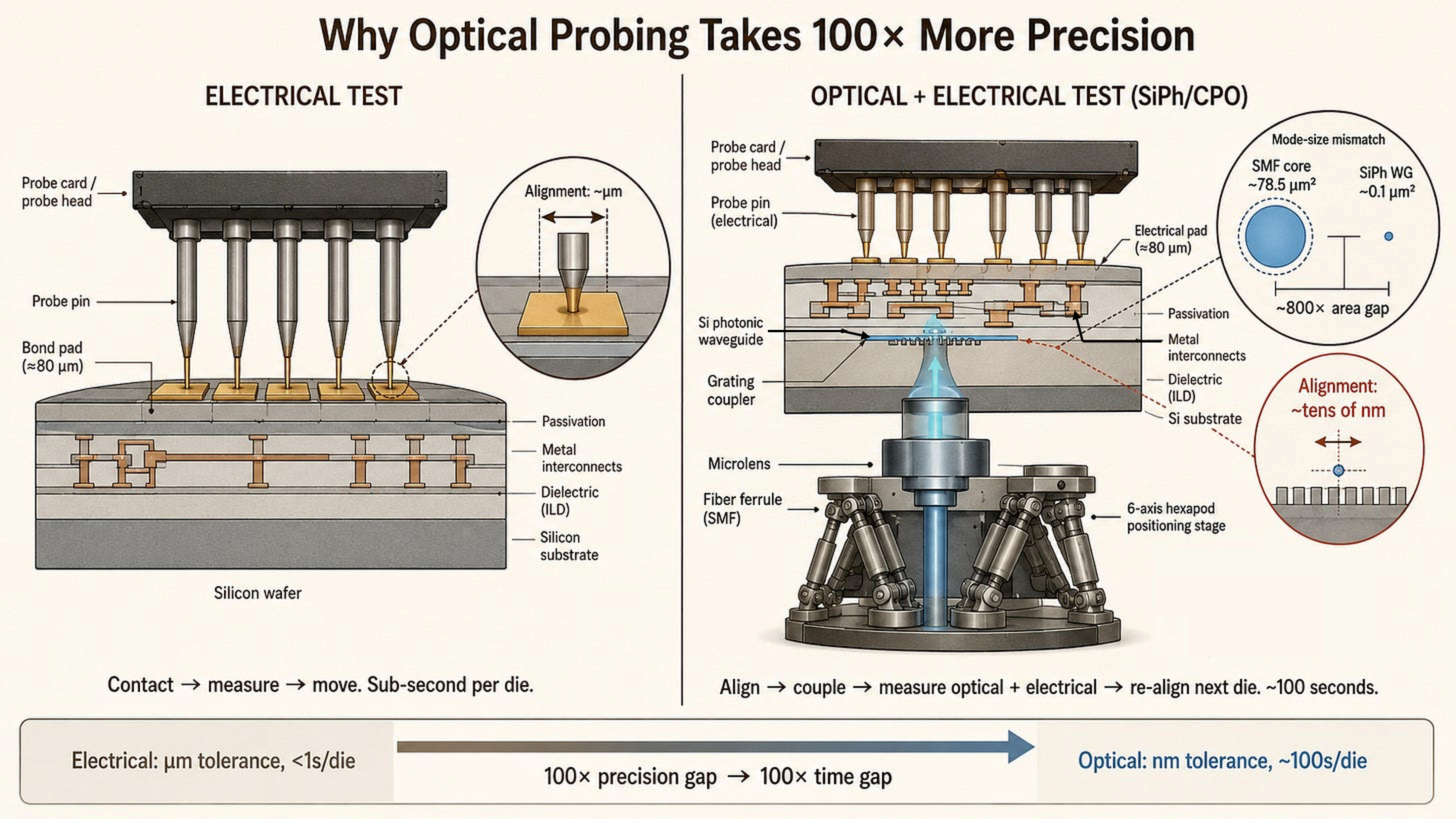
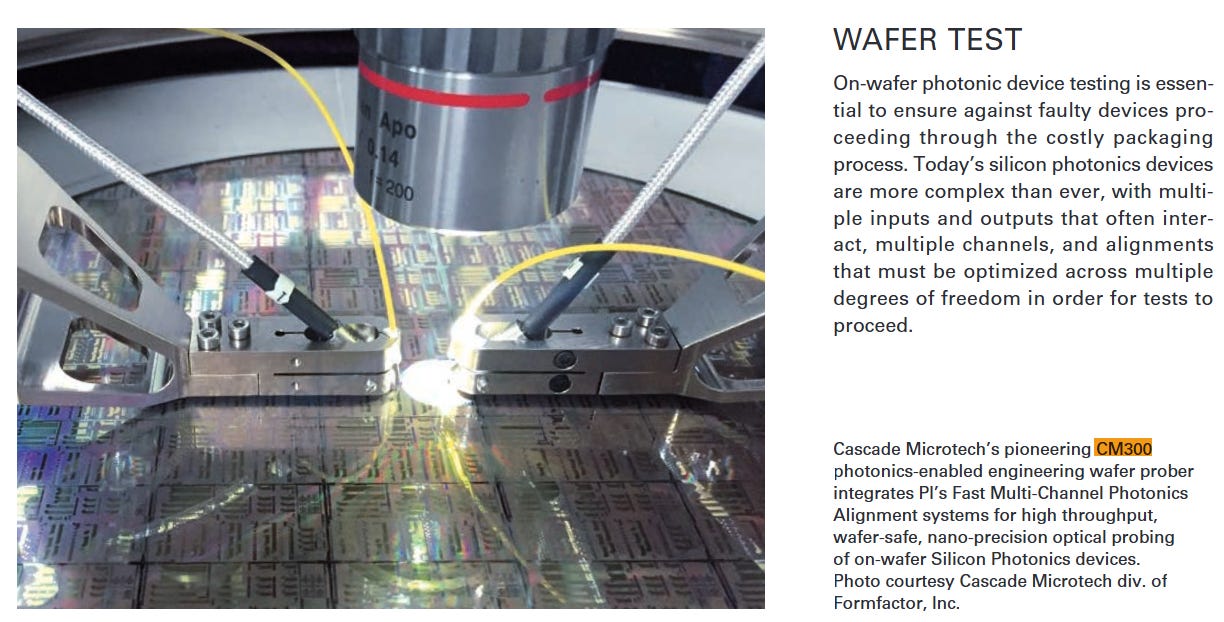
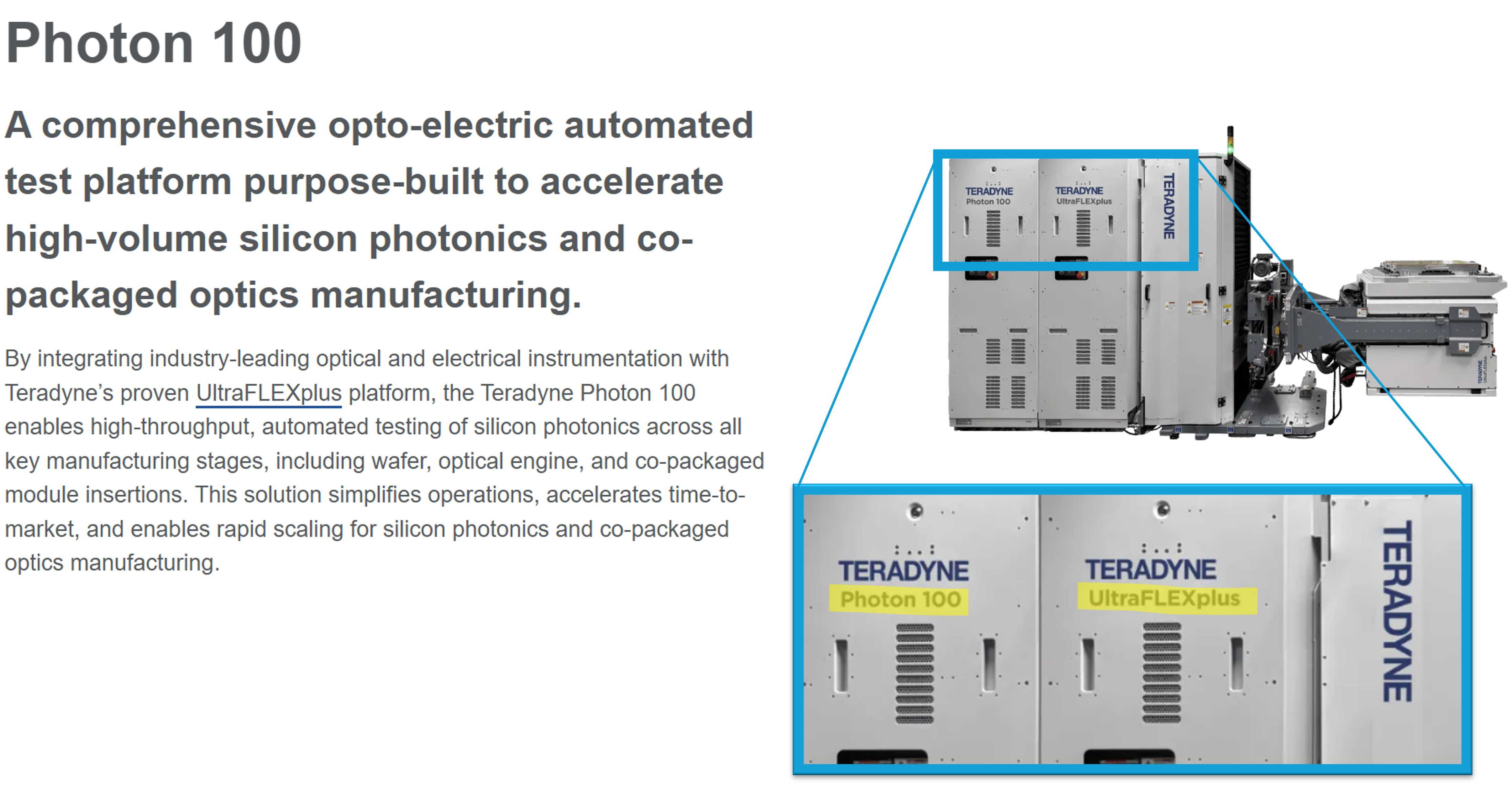
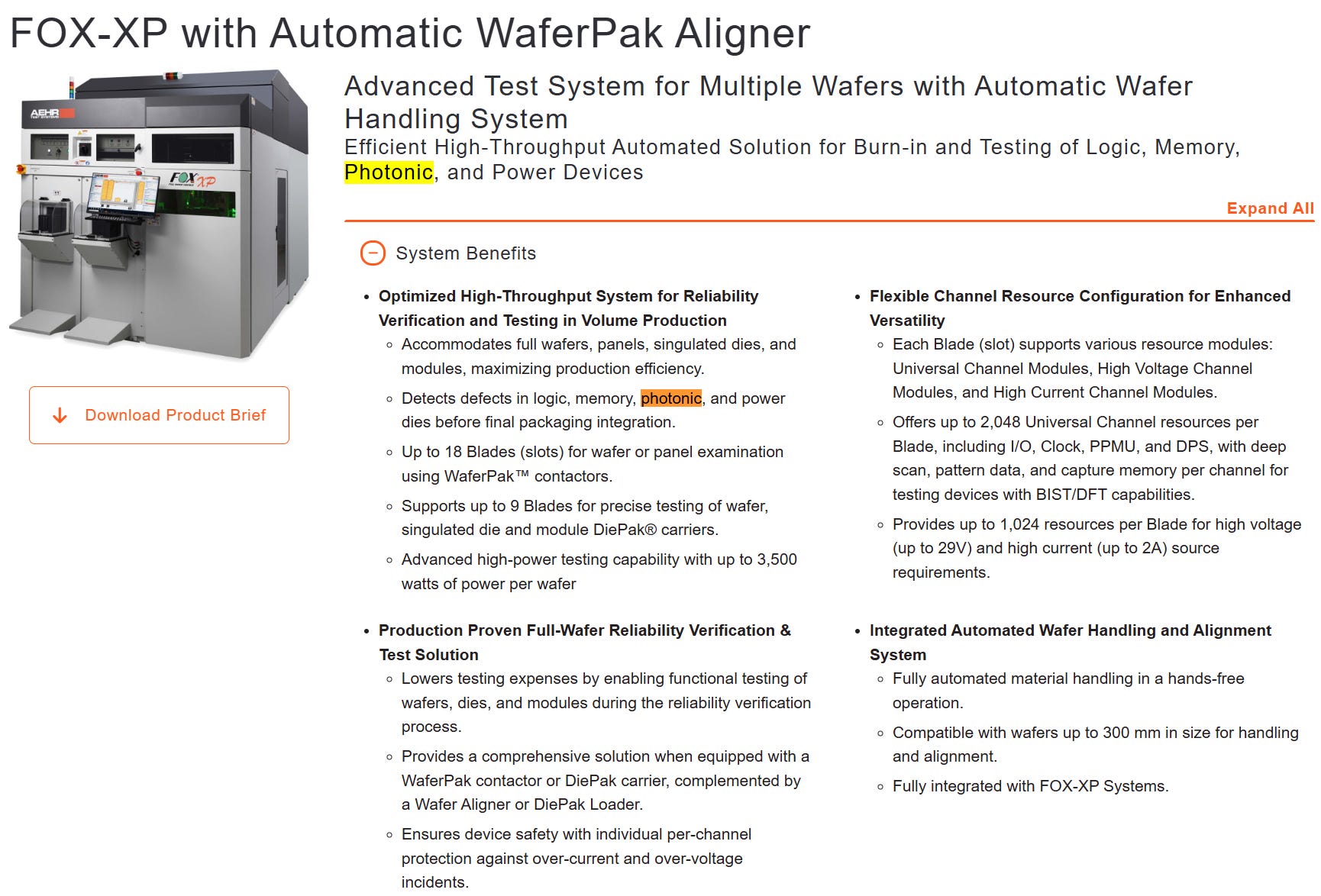
I still think InP is critical and close to irreplaceable. But here is how I read that line: the InP bottleneck right now is simply that severe.
The numbers back it up. June-quarter InP laser output grew about 80% year over year, and the company’s own 800G and 1.6T transceiver demand is effectively absorbing all of it [2]. Everything made goes straight into its own modules, which is why the optical supply chain’s scarcity is getting harder to understand by counting transceiver units. You have to look past module assembly to EMLs, CW lasers, and below them, InP wafer and substrate capacity.
And this is not just Coherent’s story. On the Lumentum call the day before Coherent’s report, the same direction showed up: EMLs are still shipping behind demand, and on high-power lasers supply has fallen even further behind as demand accelerated [7]. Two reports one day apart are pointing at the same upstream layer. I put the Lumentum side together separately in Lumentum’s First $1B Quarter: FQ4 2026 Earnings Analysis.
I went deeper into that upstream bottleneck recently in AXT and Lumentum’s Prepayment Deal: The InP Substrate LTA Chain. Expanding fab capacity and securing InP substrate you can actually use are two different problems.
3. Six-inch InP is a capacity story and a margin story at the same time
Coherent’s move to six-inch is not only about a bigger wafer adding production capacity. The CFO’s phrasing was clear.
“Four times, but it’s at half the cost.” [2]
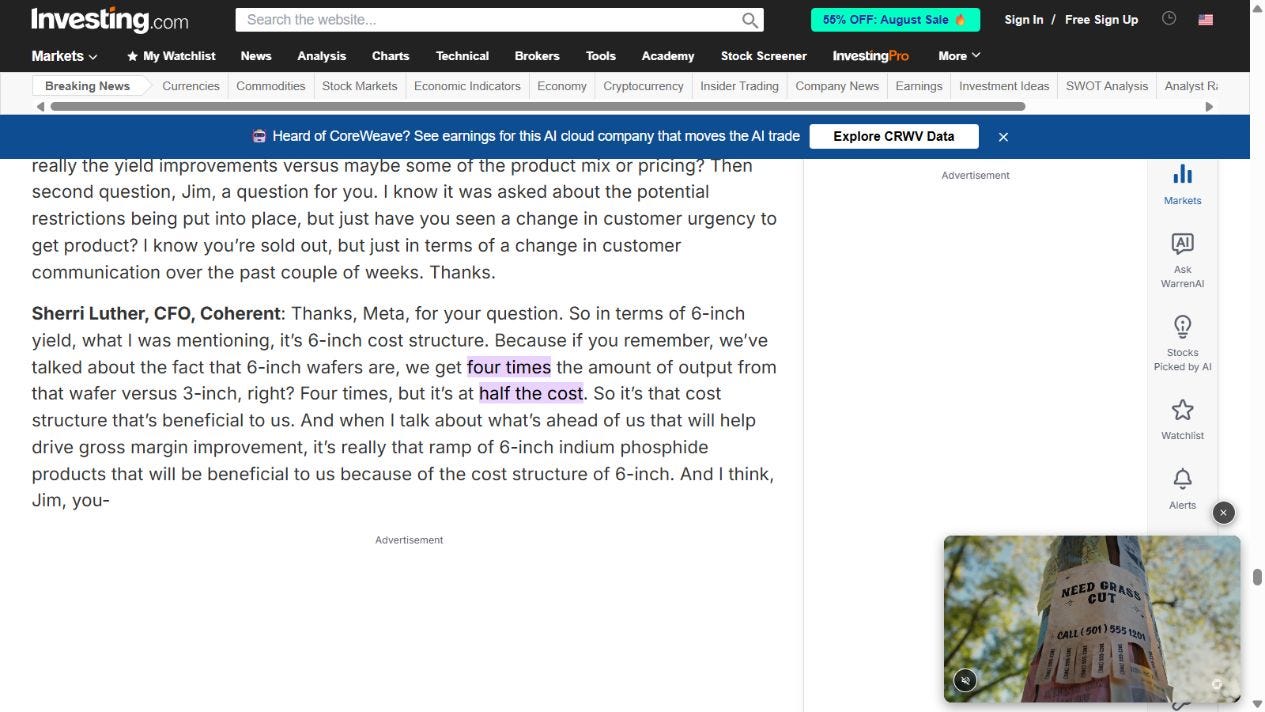
Spelled out, a six-inch wafer yields about four times as many devices as three-inch, at around half the cost per device [2]. The more interesting part is that yields for EMLs, CW lasers, and photodiodes are all already higher on six-inch than on three-inch [2]. Normally, when you move to a larger wafer diameter you lose yield first before you gain anything, and this line says they are already past that stage. So as InP capacity grows, transceiver shipments can rise while the cost of the most critical component inside them comes down at the same time.
I had already flagged this as a core monitoring point in the previous-quarter piece, $20B+ New SAM on Top of +27% Pro Forma Revenue: The Quarter Coherent Crossed from Transceiver Player to Platform, and this call made the six-inch margin thesis considerably sharper than back then. In other words, in this cycle, volume growth and margin expansion do not necessarily have to move in opposite directions.
That is the supply side of the transcript. What stayed with me longer, though, were the demand-side lines: the company’s answer to the market’s CPO-delay worry, and the CEO’s description of the FY27 order book. If the next day’s 8% drop missed something, it is probably here.
