People often discuss where the bottlenecks lie. Whether it’s the GPU, memory, or optics. As AI agents gained prominence, the importance of the CPU came to the fore, followed by concerns regarding power supply and land availability. There was also a time when Indium Phosphide (InP) substrates attracted significant attention.
A prime example is AXT, a company that saw tremendous growth this year, with its stock price climbing to around $120. Although the price has recently dropped significantly driven by the Leopold liquidation event and concerns over China-related risks I would like to take a closer look at this stock.
TL;DR
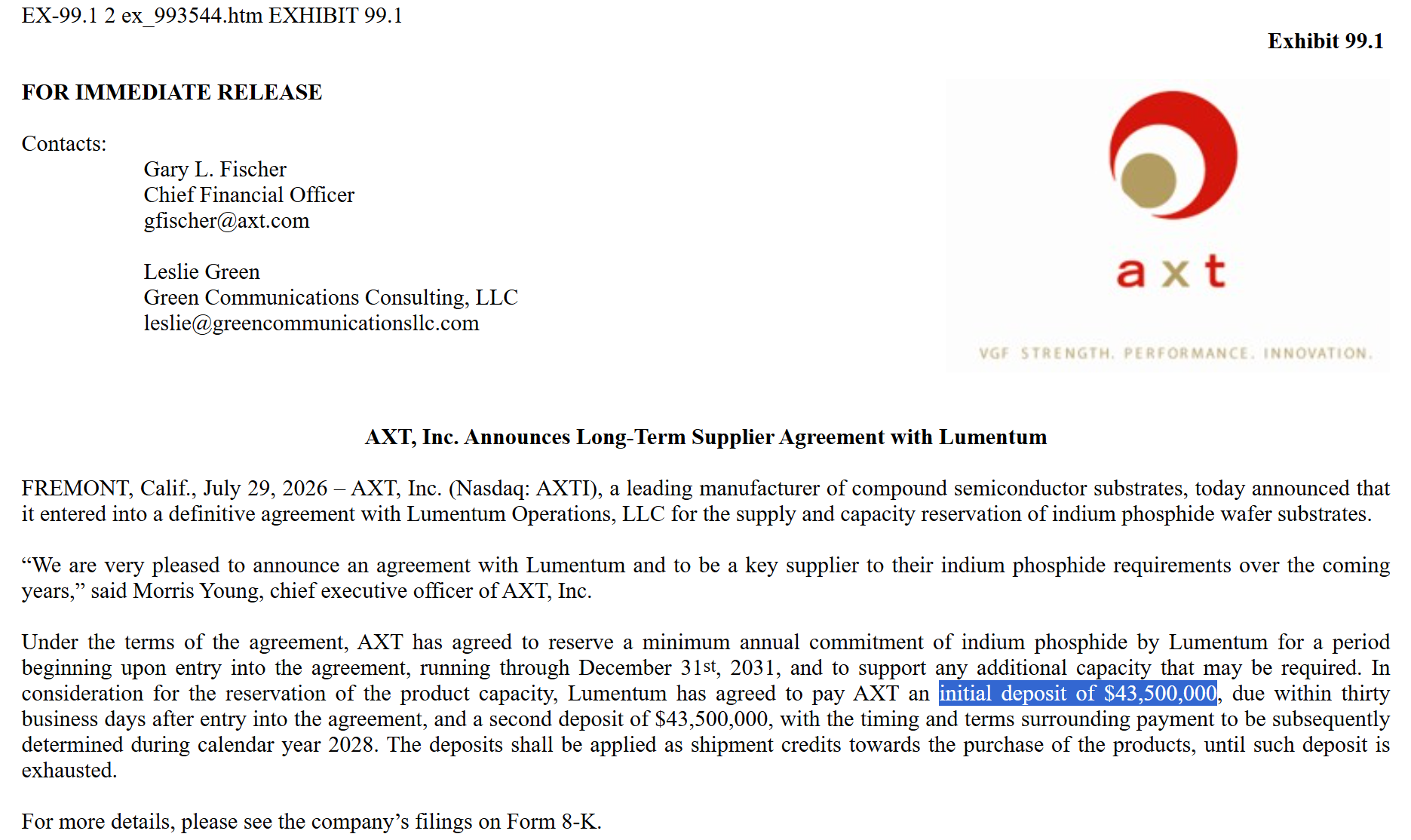
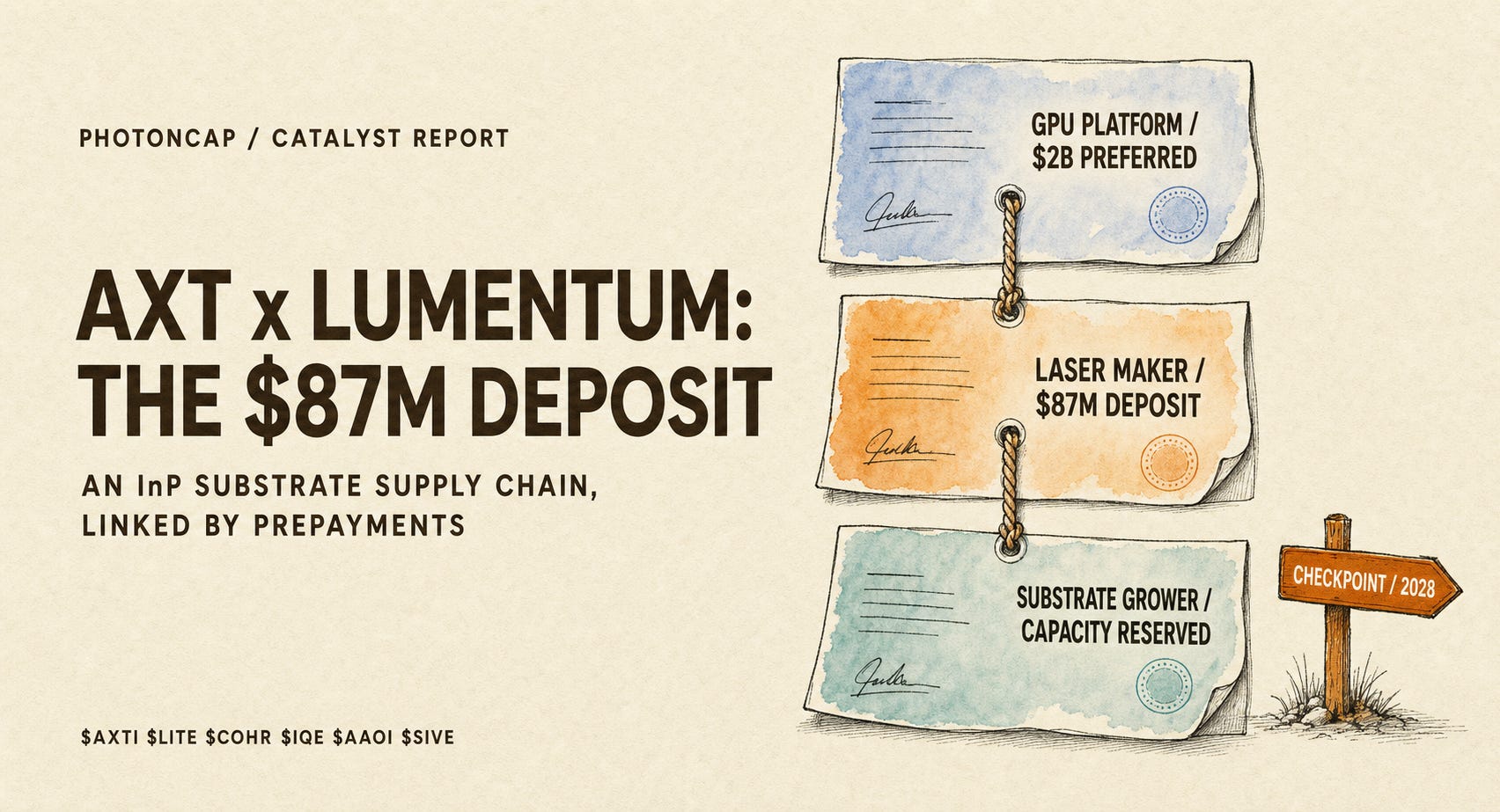
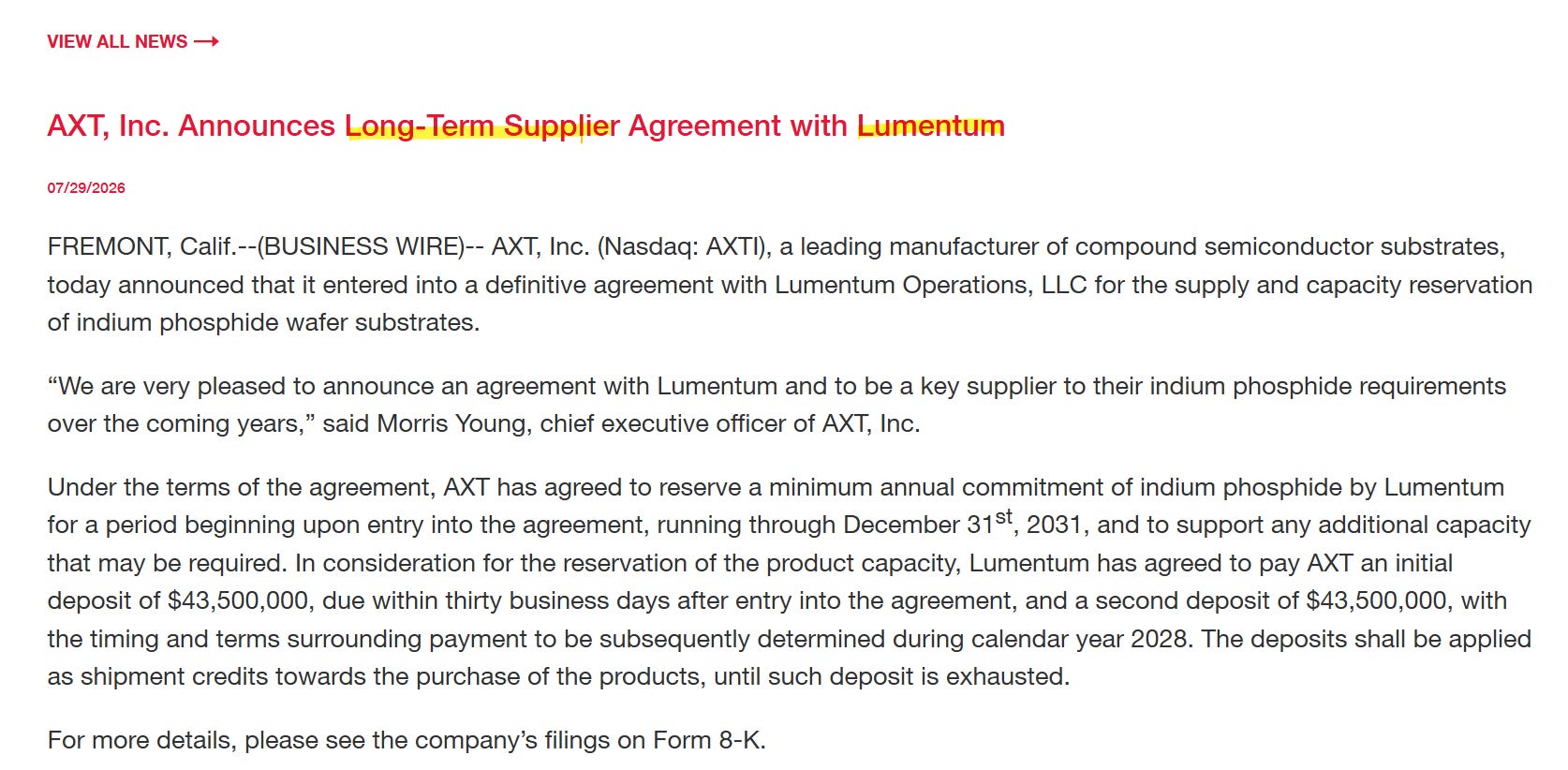
On July 29, AXT announced a long-term InP substrate supply agreement with Lumentum. A $43.5M deposit lands in cash within a month, another payment of the same size is scheduled for 2028, and capacity is reserved through the end of 2031.
Lumentum is a company running no fewer than five InP fabs. That means it needs a lot of InP substrates, and this time it decided to buy them prepaid.
The same week, Lumentum’s CEO said in a public forum that the InP shortage will get worse than what we see in memory. The words and the money came out in the same week.
To note just the direction up front, I read this contract as evidence of the InP substrate shortage in the optics market, and at the same time I see it as the start button on the cycle clock. The checkpoint dates to monitor, and the reasoning behind them, are laid out one by one later in the piece.
Contents
July 29
The Structure of the $87M Deposit
Who Actually Makes the Substrate
The LTA Chain
Deposit Economics and the Expansion Race
The 1060nm Detour
Up and Down the Chain: Layer by Layer
Conclusion and the Dates to Check
1. July 29
On July 29, AXT (NASDAQ: AXTI) announced a long-term supply agreement with Lumentum (NASDAQ: LITE) [1]. It covers InP substrates, that is, the indium phosphide wafers that light-emitting laser chips are built on, supplying them through the end of 2031 and reserving a minimum annual capacity for Lumentum. In return, Lumentum pays a $43.5M deposit in cash within 30 business days of signing, and will put in the same amount once more sometime during 2028 [1]. $87M in total.
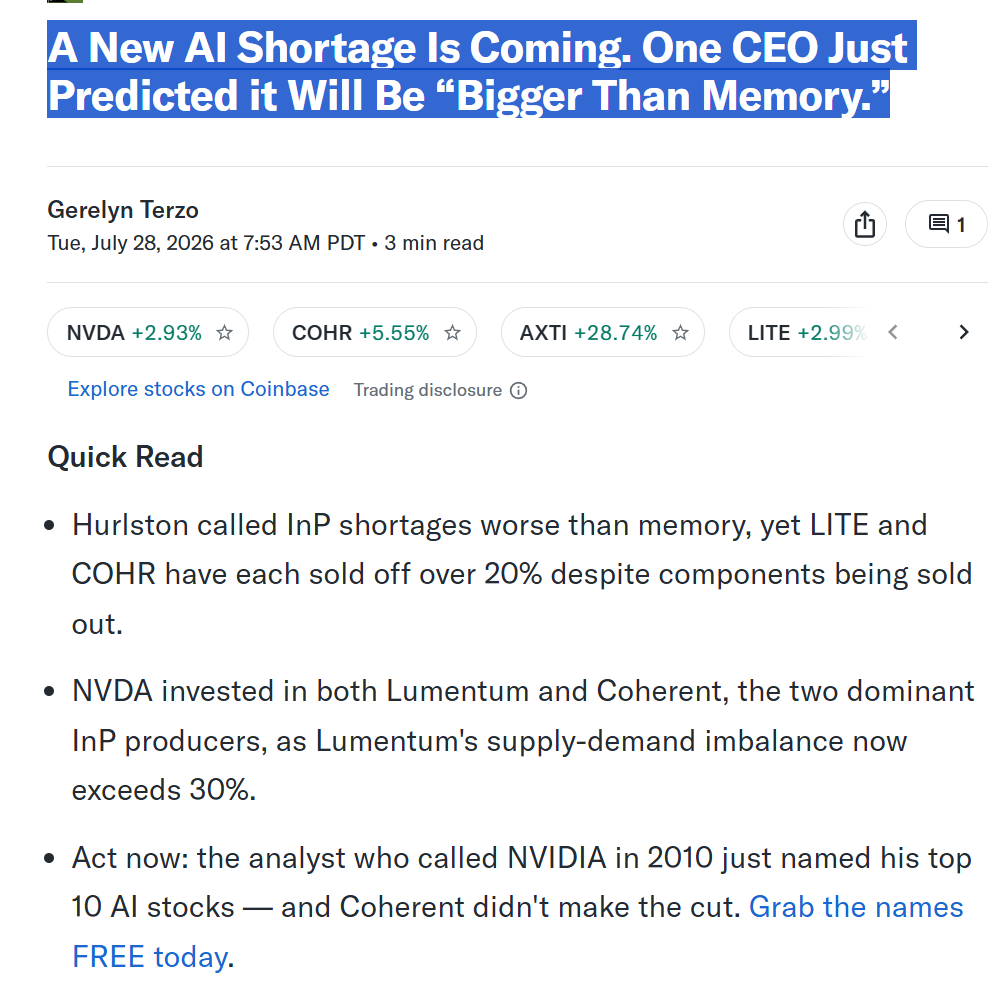
There was one more statement that came out the same week. Lumentum CEO Michael Hurlston reportedly said on a summit stage in Paris that the InP shortage will become even worse than what the memory side is seeing [2][3]. A number came with it: the gap between demand and supply has widened beyond what was said on the last earnings call, to over 30% [2][3].


Thank you for sharing, Molly O’Shea..
And by coincidence, on the very same day, we (Aurelion Research and PhotonCap) published a piece summarizing a conversation with Lumentum’s VP of Investor Relations. That content is available for free in A Conversation with Lumentum, and I’ll be bringing its testimony back throughout this article.
A Conversation with Lumentum

Disclaimer: This article is a joint publication. The management meeting and investment analysis were prepared by Aurelion Research, and the technical comments by PhotonCap. All content is based on publicly available information and the authors’ notes, and is provided for educational and informational purposes only. Nothing herein constitutes investment …
The CEO’s words and the company’s money came out in the same week. That is the starting point of this article and the reason I sat down to analyze it.
2. The Structure of the $87M Deposit
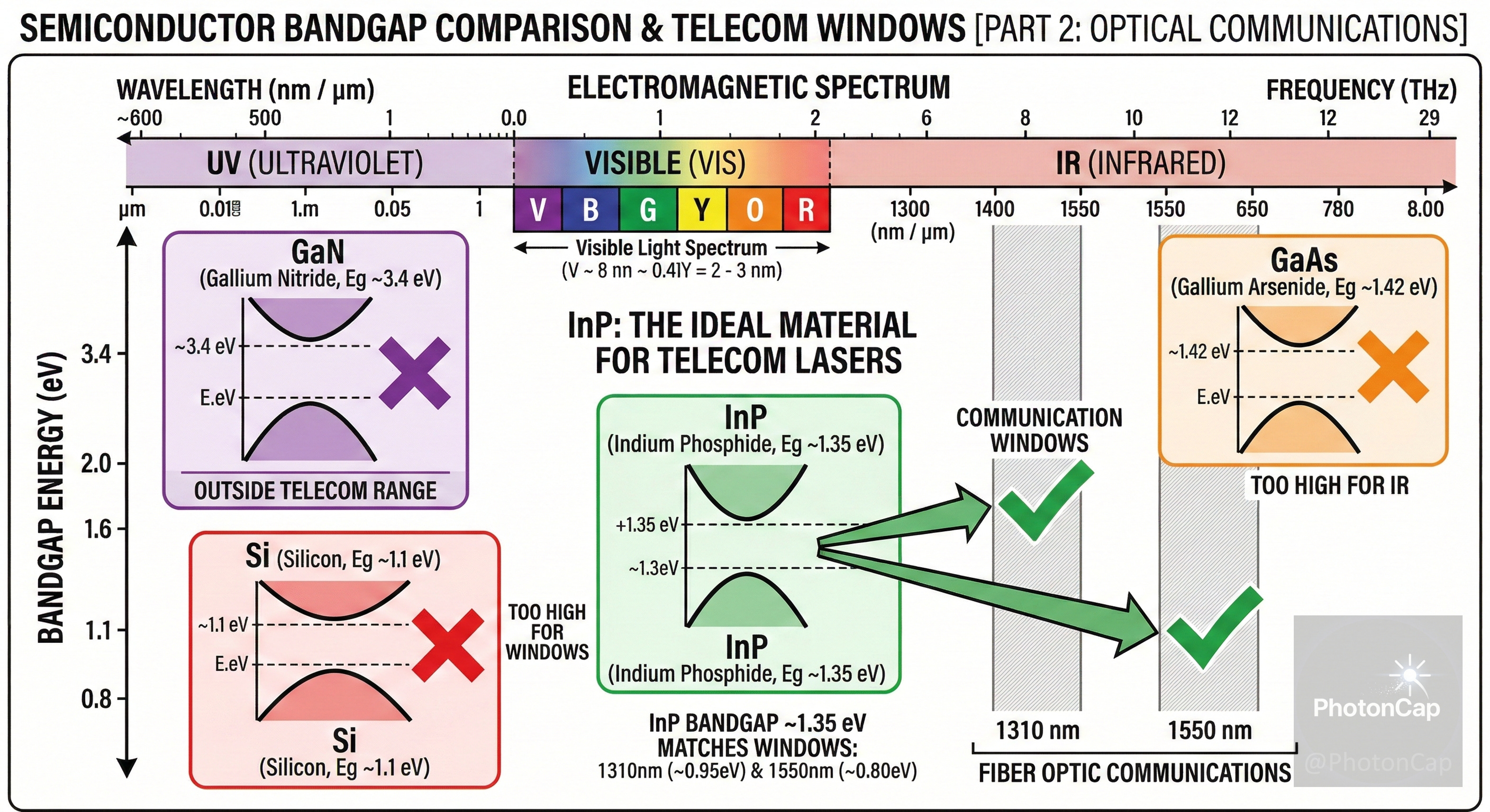
Before we get into the contract, it would be good to quickly go over what InP is. Silicon, the protagonist of the semiconductors we know well, CMOS, CPU, GPU, Memory, is hopeless at turning electricity into light. It carries electricity just fine, but its crystal structure leaks the energy away as heat instead of light when it tries to emit.
InP is the opposite: it is a material that converts electricity directly into light, and above all it is practically the only base wafer on which you can stack, defect-free, the lasers and receiver devices for the wavelengths with the lowest loss in optical fiber (1310nm, 1550nm). That is why every optical link in a data center starts on this wafer. As for why neither silicon nor GaAs can take its place, we covered it at length, starting from the material physics, in March’s AXT Inc. (AXTI) Deep Dive: The Hidden Bottleneck in AI Optical Interconnects, so if you need the background, feel free to start with that piece. (The first half is written to be understandable without an engineering degree.)
Now, the contract itself. It is a definitive agreement disclosed via 8-K, meaning a binding contract, not a letter of intent [1]. The two deposits are applied as credits against future shipment payments, so in effect Lumentum is depositing money in advance for the wafers it will buy [1].
It is a contract where the money moves before the goods.
As you well know, there is no reason to do this in a loose supply market. Putting money down first to hold your place, like paying upfront to lock in a purchase, is an action you take exactly when the goods are scarce, or when you believe they will stay scarce. And indeed, Lumentum’s stock slipped after the announcement, and an article ran with a headline calling it a costly supply deal [4]. To be honest, access to that article was blocked and I could not verify the full text, so I am citing it only at the headline level.
That leaves a natural question. Why did a company running five InP fabs have to buy substrates from outside, and prepaid at that?
3. Who Actually Makes the Substrate
Owning fabs and making substrates are different businesses. There is the stage where indium metal, a byproduct of zinc smelting, is grown into single-crystal ingots and sliced thin into substrate wafers; there is epitaxy (the process of depositing crystal layers on the substrate, epi from here on), which stacks the light-emitting layers on that wafer; and then comes the fab, which processes it into laser chips. What Lumentum owns five of is only the last stage. In other words, it has no wafers of its own.
And the substrate companies in the earlier stage are few in the entire world. Japan’s Sumitomo Electric, US-listed AXT, and Japan’s JX Advanced Metals are known to hold most of the world’s supply (we analyzed this down to the supply chain in AXT Inc. (AXTI) Deep Dive: The Hidden Bottleneck in AI Optical Interconnects) [5].
There is a good reason why there are so few substrate manufacturers: InP (indium phosphide) single crystals are notoriously difficult to grow. Because the phosphorus (P) component tends to vaporize and escape near the melting point, high pressure must be maintained throughout the growth process to prevent its loss. Furthermore, the finished crystals are more brittle than silicon. That’s why, while silicon wafers transitioned to 12-inch sizes long ago, InP wafers are still primarily produced in 2- to 4-inch formats, with mass production of 6-inch products only just beginning. The know-how required to produce usable wafers is embedded in decades of accumulated process data, making this a sector that new entrants cannot easily penetrate simply by injecting capital.
The significance of this in the current market cycle is straightforward: there is a long lead time between the announcement of production capacity expansion and the actual shipment of products. Not only does it take time to set up the crystal growth furnaces, but additional time is required to achieve a yield of wafers that meet commercial quality standards. Consequently, these structural characteristics make this stage of the process a frequent source of bottlenecks when demand surges.
Even Coherent, said to be the most deeply vertically integrated among optical players, buys its substrates outside under multi-year contracts and starts from epi in its own fabs [6]. So buying substrates is, in itself, business as usual, and the signal is in how they are being bought. A deposit instead of a purchase order, a six-year reservation instead of spot.
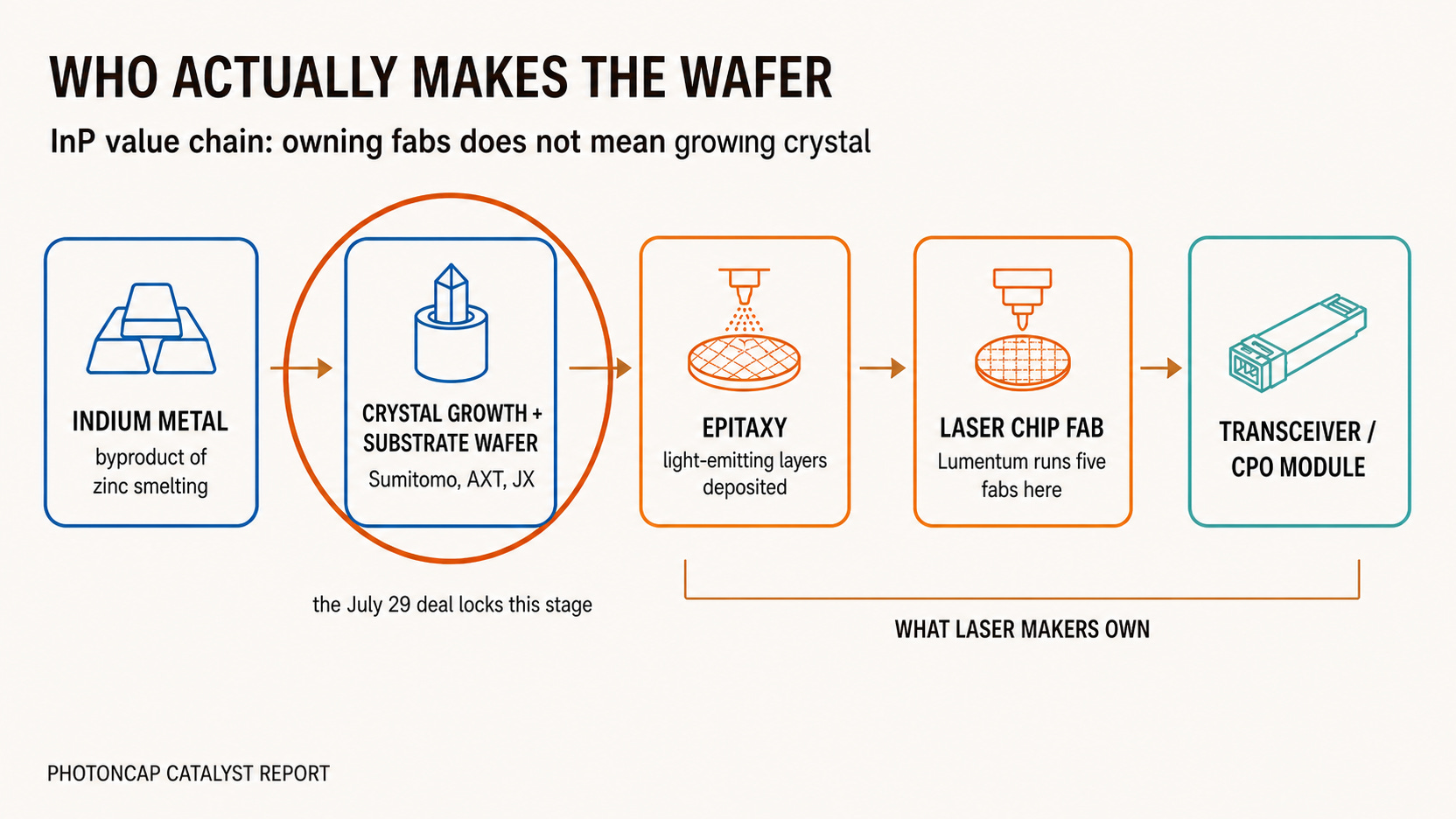
InP value chain layers, from indium metal to laser chip, with the substrate stage highlighted
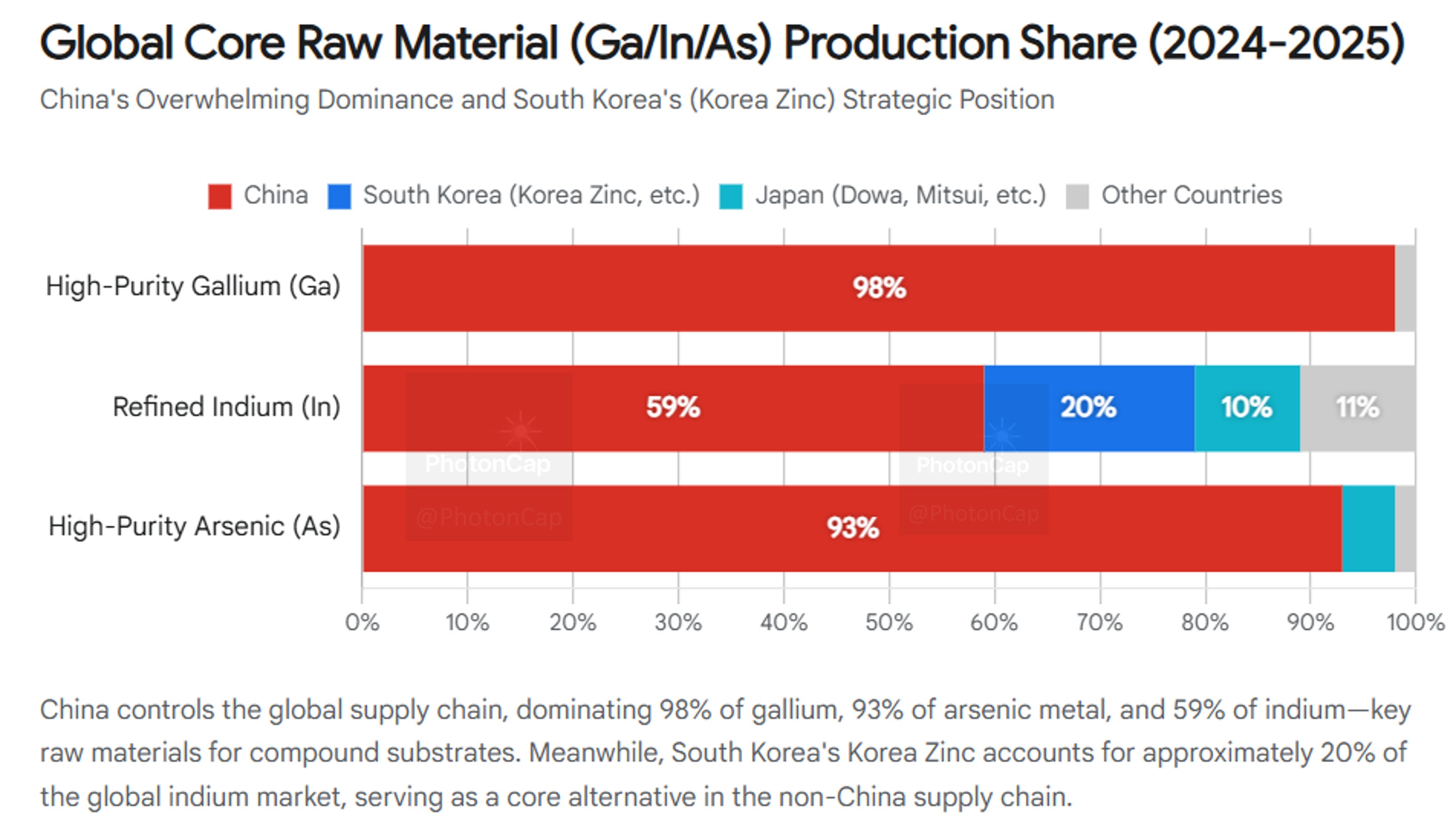
But here an enormous variable called China comes into the picture. AXT’s production sits in its Beijing subsidiary Tongmei, and since indium-related items are on China’s export control list, every shipment needs a permit. In fact, within the past year there is a track record of one quarter getting crushed by permit delays and then recovering sharply once the permits came through [7].
On top of that, the company has said that data-center-driven InP demand is growing fast inside China as well [7]. With Chinese companies occupying the top ranks of the global optical module market, the same substrates end up contested between Chinese domestic demand and export volumes. China’s optical module market, as those who know it will know, is quite large. We covered it in a free article called Chinese Optical Modules Own 7 of the Top 10 Seats. The fact that the supply line Lumentum just locked in sits inside China’s permit regime is both a condition and a risk of this contract.
In the conversation introduced earlier, Lumentum IR said EML capacity at the two fabs in Japan grew eight-fold in two and a half years. And yet it still falls more than 30% short [2], so isn’t the bottleneck not the speed of making chips, but the substrate in front of it??
4. The LTA Chain
The picture gets bigger if you look at this contract not as a single box but as a supply chain. Early this year, NVIDIA invested $2B in Lumentum in the form of convertible preferred stock, attaching a multi-year purchase commitment [8]. One layer down, Lumentum put an $87M deposit on AXT and reserved capacity through 2031 [1], and AXT in turn raised funds for substrate expansion through an equity offering in the $600M range [2]. The money that started on the side buying optical modules has come down a full three links, through contract after contract, all the way to substrate expansion.
Because each layer’s seller is the next layer’s buyer, every company puts a deposit on the layer below and receives a deposit from the layer above. When the shortage is real, this chain is rational for everyone.
But as you may have noticed, the problem is that the moment the shortage ends, the chain works in reverse too. That story comes after the paywall.
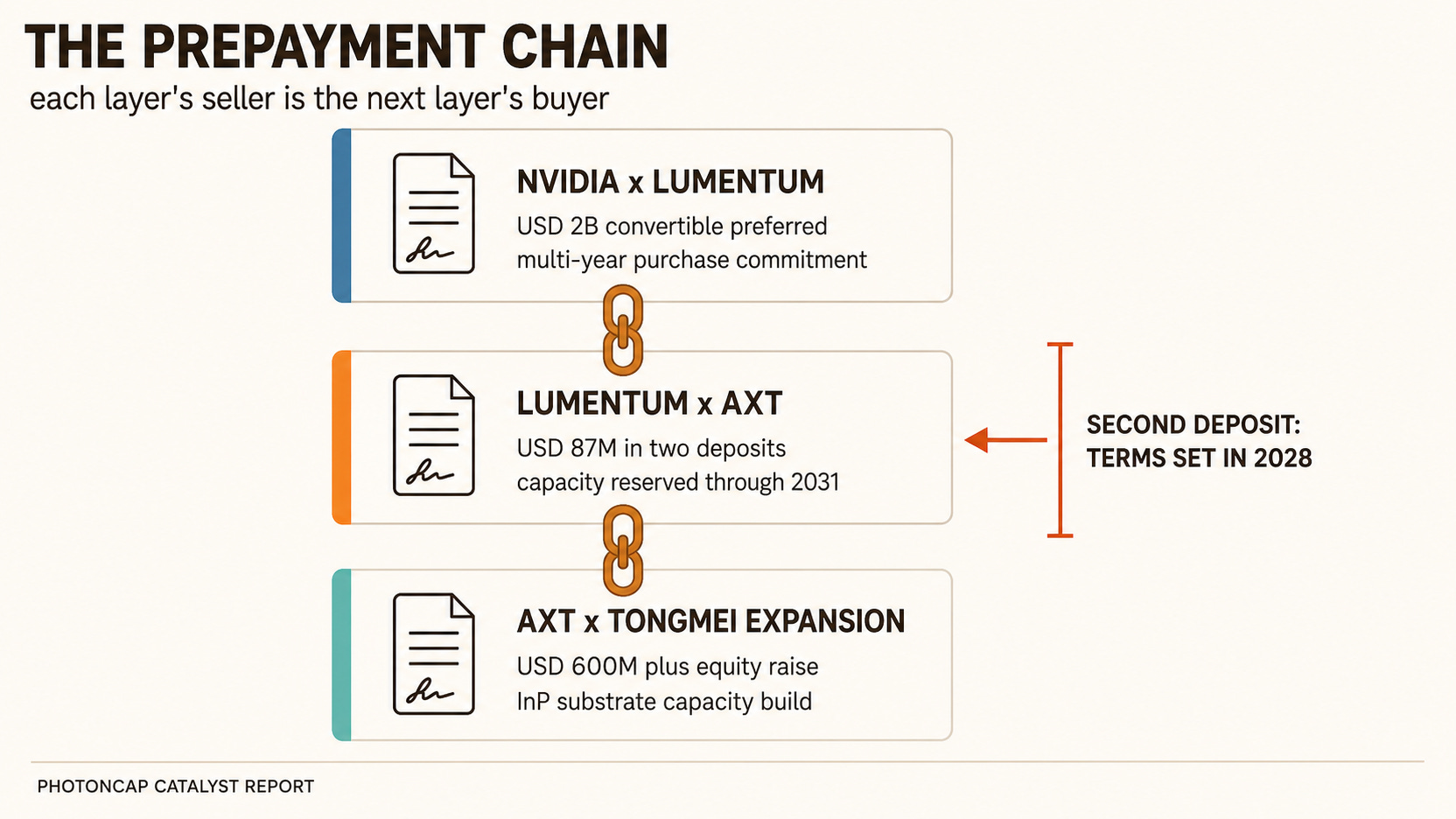
The LTA chain, three contract links from NVIDIA to Lumentum to AXT with deposit and reservation terms
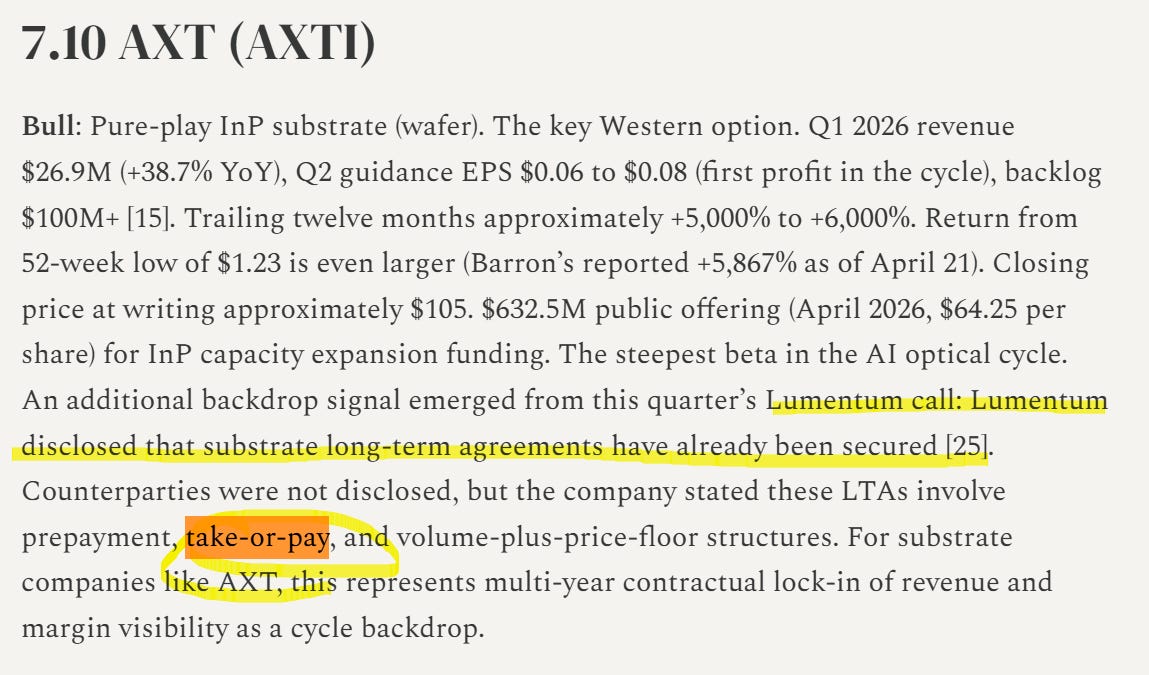
In fact, the existence of this contract was not news. On the May earnings call, Lumentum said it had already secured long-term agreements for substrate, and even explained that the structure included deposits and take-or-pay (you pay even if you don’t take the volume). Only the counterparty was undisclosed. We covered that passage at the time in The 8 Companies Behind Lumentum’s $808M Quarter and put counterparty disclosure on the monitoring list, and this 8-K is the answer sheet. The name was AXT, and the deposit structure was exactly as foreshadowed.
Everything up to here is what anyone can see from public materials. From here on, we stretch the chain up and down: how deposit contracts ended in past materials cycles, when the expansions arrive, and the detour Lumentum itself is building.