
Disclaimer: This article is a joint publication. The management meeting and investment analysis were prepared by Aurelion Research, and the technical comments by PhotonCap. All content is based on publicly available information and the authors’ notes, and is provided for educational and informational purposes only. Nothing herein constitutes investment advice or a recommendation to buy, sell, or hold any security. Interview responses are paraphrased and do not represent verbatim statements by Lumentum or its management. The authors may hold positions in securities discussed. Readers should conduct their own due diligence before making any investment decisions.
Aurelion Research recently met with Kathryn Ta, Vice President of Investor Relations. We (Aurelion Research) found the conversation very useful, and it gave us a clearer view of the central debate around the stock.
Management meeting and investment analysis by Aurelion Research. Technical review comments by PhotonCap.
Aurelion Research’s Methodology: We independently reach out to company management teams. We do not receive compensation from any company covered. The answers from interviews are based on our notes and have been adapted and presented for clarity. They do not reflect the speakers’ exact words and apply Aurelion’s own thinking. We have selected the sections below that we believe are the most relevant parts of our discussion. We believe all information presented is publicly available. This content is for informational purposes only and is not investment advice or a recommendation to buy or sell any security.
AR: Our view, and it is still an emerging one, is that we are compute constrained as a society and may become more so. As models like Kimi K3, GPT 5.6 and the latest Grok get cheaper per token, elastic demand should push total token consumption higher rather than lower. How does Lumentum think about that? Does it shape capacity expansion or the innovation around data center efficiency?
Answer: Lumentum is at the “plumbing“ layer of the data center, two or three steps removed from any token economics. The number they optimise is power efficiency per bit, and the route to it is higher power lasers. The more bits moved per square area of indium phosphide, the more value delivered. Speed and efficiency are the same problem to them; faster transmission is how joules per bit comes down.
On capacity, they are adding as fast as they can. Two fabs in Japan produce most of the world’s supply of EML lasers, and capacity there is up eight-fold in two and a half years. She offered that as representative of adds made elsewhere. Lumentum now runs five fabs, including a new one starting to ramp that is not yet producing wafers. Every site has had tools added, and several have had the building shell expanded to fit more.
Thoughts:
Efficiency as the optimisation target is the right thing to be chasing. Hyperscalers are working on cost per token and that pressure runs all the way down to the “plumbing”.
The useful part is incentive alignment. Higher power and higher speed make the link more efficient and carry higher ASP at the same time. Lumentum gets paid to build what its customers actually need.
One flag. Eight-fold EML capacity in two and a half years cuts against a pure scarcity thesis. Lumentum is racing to relieve the bottleneck that gives it pricing power. We read that as confidence. Management is building for durable demand.
PhotonCap comment: One engineering caveat on the eight-fold figure. Wafer starts and qualified yield at the newest spec are different numbers. A fab-level capacity multiple does not relieve a 200G per lane shortage one to one, because the binding constraint is yield at the highest power bins, not floor space. This is also why PhotonCap reads the margin question differently. Building capacity takes money. Hitting the top bin takes years of practice. That is why the eight fold number overstates the relief, and why the shortage premium itself is not durable while the margin that survives lives in yield and mix, not in the shortage price.
AR: In the same vein, the consensus view is that we are copper constrained, which should pull optics deeper into the compute architecture. Where do you think we are on that migration between racks, into packaging, and eventually on-chip?
Answer: Today’s co-packaged optics is opportunistic rather than forced. Nvidia deploys it because a faster, more power efficient laser frees up power that can be redirected to the GPUs, which buys system performance. Copper has not run out of headroom yet.
She puts copper hitting the wall in late 2027. That is when the first scale-up CPO deployments arrive, or MPO fiber connectors where customers want a different configuration, driven by link lengths beyond roughly three meters connecting rack to rack. Credo and Broadcom argue six meters is achievable. On paper it is, but the power you would have to push through that copper makes it impractical, so the switch to optical happens around that point regardless.
Thoughts:
Voluntary demand is higher quality demand. That framing helps the bull case. You are buying two S-curves. The opportunistic one is largely played out. The scale-up one has yet to begin.
PhotonCap comment: Agreed on the copper framing. Copper’s limit is not a date. It is a cost curve of reach, speed, and power, and Kathy’s answer to the six meter claims concedes it: doable, but the power bill kills it. The same logic cuts through “voluntary.” A data center runs against a fixed power envelope, so every watt saved on networking is a watt handed to the GPUs, and Nvidia’s own material puts CPO at 3.5x lower power than pluggable transceivers. Copper is not forcing this wave; the power budget is. The scarcer power gets, the stronger this demand becomes. The weak spot is not the voluntariness but that it rides on one company’s architecture choice.
AR: Following on the Broadcom point, there are open questions about the long-term winners in optics and whether they end up being the silicon giants who can acquire an optics platform and integrate it on-chip. As value migrates toward integration, how does Lumentum avoid becoming a quality supplier of a commodity input?
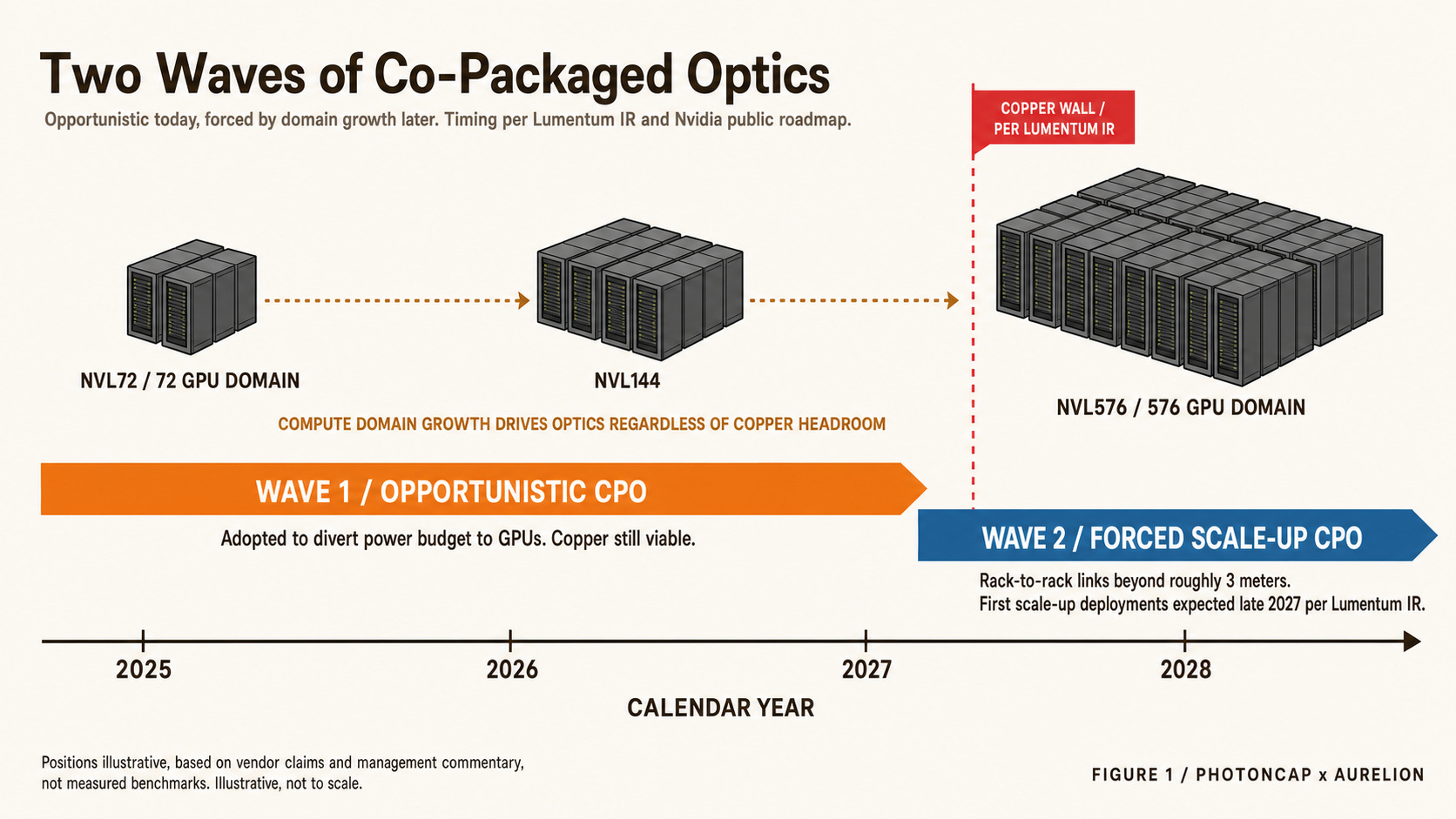
Figure 1: Two Waves of Co-Packaged Optics. Figure: PhotonCap x Aurelion
Answer: Three defences, in her framing.
Competition thins out as power ratings climb. Producing 150 to 400 milliwatt lasers at high volume, high yield and high reliability is difficult, and she does not see many players able to do for Nvidia what Lumentum does today.
Second is survivorship. Lumentum and Coherent are the two companies left standing from telecom, an industry she describes as historically punishing to serve. Lumentum’s laser chip expertise came out of acquisitions and out of meeting reliability requirements the hard way. Coherent is stronger at the systems level and is working to catch up on the component side.
Third, China. New entrants are bringing on large amounts of capacity, mostly in lower power lasers. Lumentum ran the comparison internally and found materially higher yields in its finished transceivers using its own lasers, with better spec uniformity unit to unit and better reliability in testing and in the field
Thoughts:
The power argument is the one we believe. Making high-power lasers is hard and few companies can do it well. But saying you win at the top end also admits you may lose at the bottom. We can live with that, because newer designs need more power, not less.
The telecom history is the weakest argument. Surviving 25 years in a rough industry is real, but it says more about the past than about today. Broadcom and Marvell have plenty of money, and they don’t need the best laser in the world. They only need one that is good enough to put on their own chip.
The China comparison came from Lumentum’s own lab. They tested their lasers against Chinese ones and said theirs came out better. That may well be true. Nobody outside the company has checked it. And Chinese suppliers can close the gap over time. China has shown this so many times.
PhotonCap comment: A product map for readers, because reading Lumentum as an EML company misses half of this article. An EML integrates two things on one InP die: a DFB laser that generates light and an electro-absorption modulator that blinks that light into data. It is a finished modulated source, and today’s 800G and 1.6T pluggable transceivers hang off it. That is the line that is sold out right now. A CW laser is the opposite: it supplies unmodulated continuous light, and a modulator on a silicon photonics chip does the data. That is the external light source for CPO and SiPh transceivers, and the high power line built for Nvidia sits here. In short, EML is today’s cash flow and high power CW is the next mix shift. The figure below shows the structural difference.
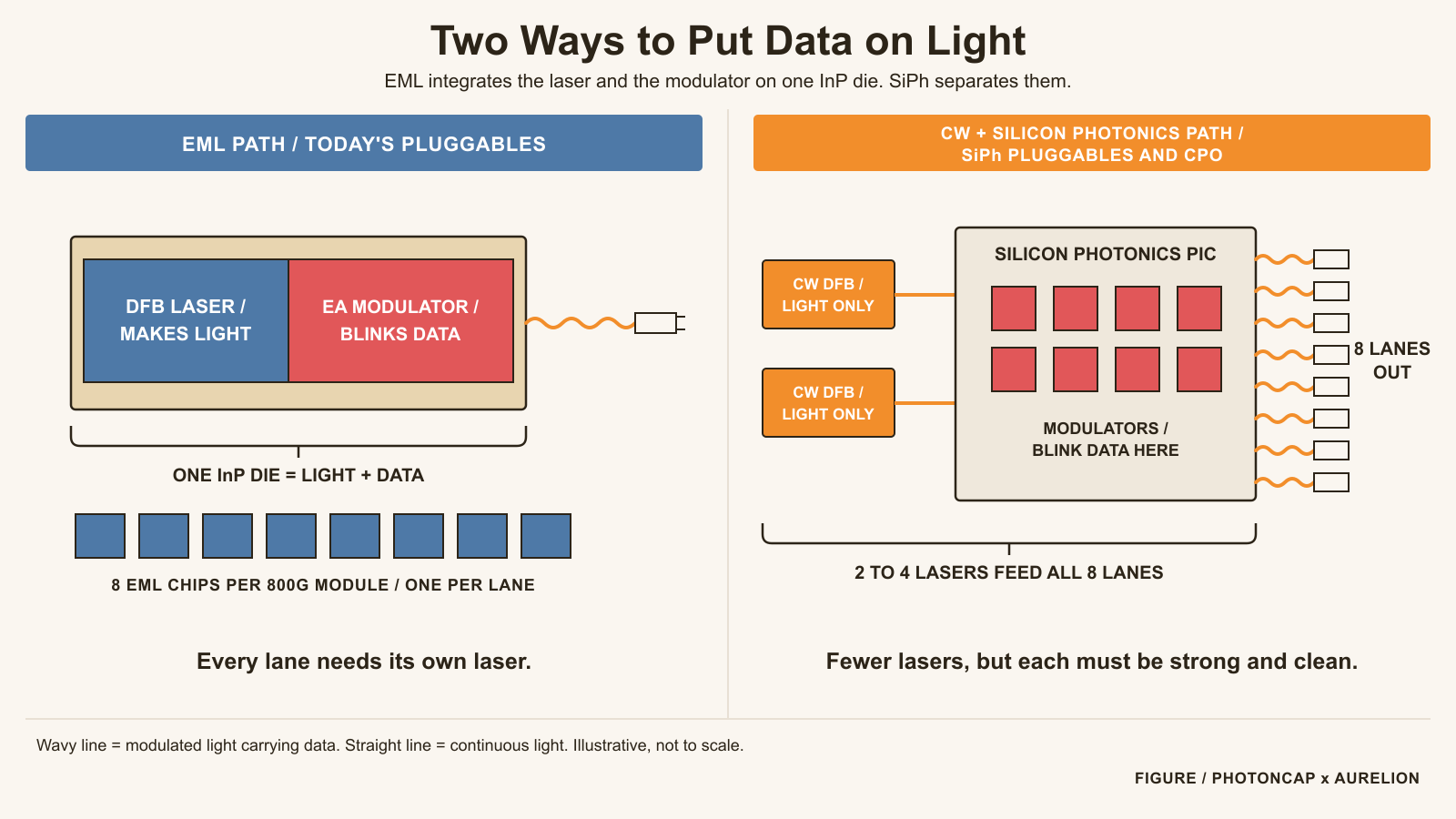
Figure 2: Two Ways to Put Data on Light. Figure: PhotonCap x Aurelion
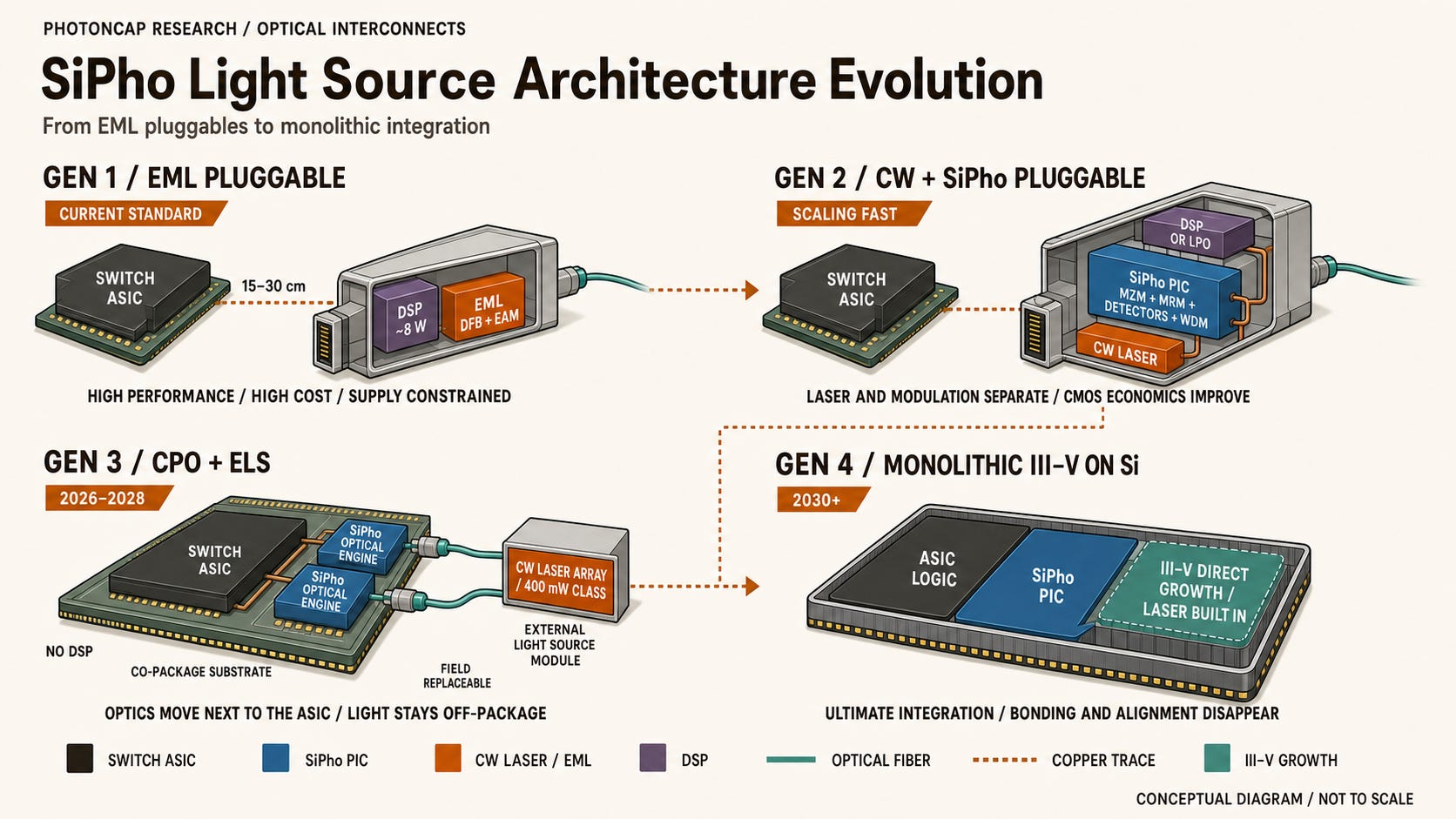
Figure 3: SiPho Light Source Architecture Evolution. Figure: PhotonCap x Aurelion
AR: Looking three, five, even ten years out, and thinking about how compute gets organised as a whole, which of Lumentum’s core competencies prevails? Indium phosphide lasers, MEMS, or coherent optics?
Answer: Indium phosphide laser chip manufacturing first, and she was not close on the ranking. She frames it as architecture agnostic. Customers cannot escape needing photons, and those photons will most likely come from indium phosphide whatever the design. Link counts grow either way, which makes it a high growth market. There is a VCSEL branch on the roadmap if chip-to-chip photonics moves that way, though she still expects indium phosphide to be the answer.
MEMS and optical switching second, and she expects it to become another pillar. It already handles spine replacement and cluster scale-out for Google, and it is a high volume opportunity. Being a systems supplier is new territory, although the telecom wavelength switching business is a more complicated cousin of the same problem. The form factor is much larger than telecom, which raises the reliability and performance bar.
Thoughts:
Her point about not caring which design wins is a good answer to the fear that Lumentum gets cut out. However the industry builds these systems, someone still has to make the light. That job is theirs.
She also brought up VCSELs as a backup plan for chip-to-chip links, without us asking. Worth noting she raised it on her own.
The part she left alone: her two strongest areas carry very different risks. The laser chip business works no matter how the systems are designed. Optical switching does not. It depends on which design wins, and the customer base is thin. Google is the risk there.
PhotonCap comment: “A VCSEL branch on the roadmap” is weaker than the reality. Lumentum has manufactured GaAs VCSELs at consumer volume for smartphone 3D sensing for years, with more than 10 billion emitters shipped per company disclosure. At OFC 2026 it showed that base extended to AI: a 1060nm VCSEL and photodetector 2D monolithic array co-packaged with a host ASIC, targeting slow and wide scale-up protocols such as UCIe and PCIe, with operation above 150°C and channel sparing. So what sits on the roadmap is not VCSEL technology. It is commercial adoption in AI chip-to-chip links. The materials angle matters too. VCSELs live on GaAs, not InP, which means Lumentum holds three light source platforms at once: InP EML, InP high power CW, and GaAs VCSEL. That is a stronger architecture hedge than the paraphrase suggests.
Company Introduction: A Different Method of Connectivity
Lumentum is a photonics company that designs and manufactures hardware which senses, generates, switches, and modulates laser light. Lumentum’s core competency is fabricating semiconductor lasers on indium phosphide, a compound semiconductor that emits light efficiently where silicon, an indirect bandgap material, does not. This capacity is directed at numerous end markets, most prominently AI and data centers. Lumentum describes themselves as an industry leader in providing optical and photonic products. Their demand is driven by the expansion of networking capacity for cloud service, AI compute, and data center interconnect.
Inside a data center, countless GPUs communicate with each other to efficiently compute, sending large quantities of data to one another, which is traditionally done with copper wire. However, copper wiring grows energy inefficient at large lengths and high speeds, forcing a shift into optical solutions. Photonics, conversely, converts electrical signals into light and sends them over fiber. Lumentum makes the chip inside this light-based connection in the form of an EML (electro-absorption modulated laser). An EML pairs a continuous-wave DFB laser with an electro-absorption modulator built alongside it on the same chip. The laser itself runs continuously, and the modulator gates that light on and off billions of times per second to encode the data. Keeping the laser at constant output and modulating externally avoids the wavelength drift, or chirp, that comes from switching a laser directly, which is what allows an EML to hold signal integrity at high speed and over distance. It is also what makes an EML exceptionally difficult to manufacture.
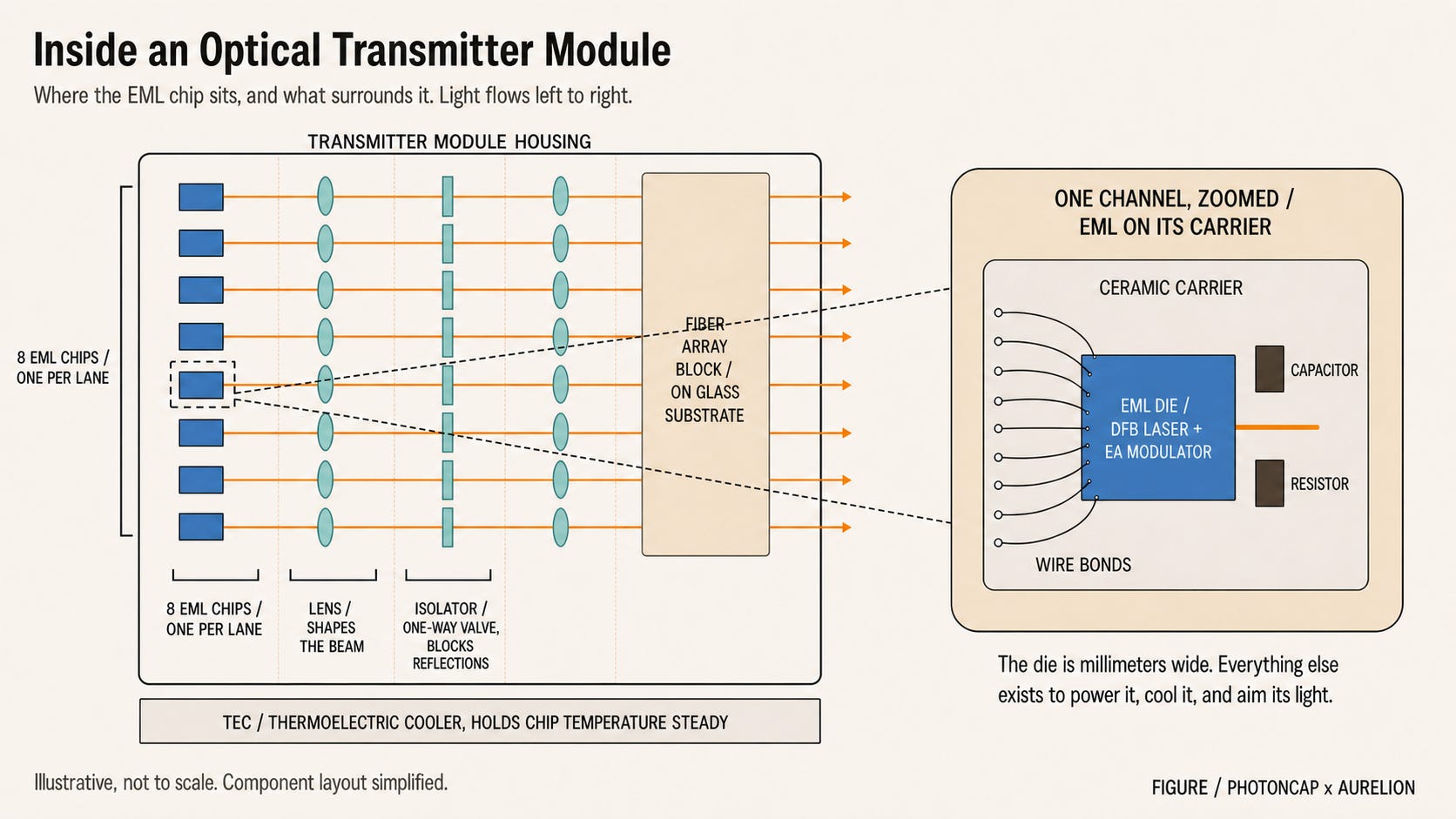
Figure 4: Inside an Optical Transmitter Module. Figure: PhotonCap x Aurelion

Figure 5: Lumentum EML product family. Source: Lumentum
They currently hold roughly 60% of the EML market, and are one of the only, if not the sole, supplier of the highest speed version at volume. Revenues have nearly doubled year over year, with margins swinging positive. Nvidia has invested $2Bn in Lumentum convertible preferred stock and has a standing purchase agreement with them. Lumentum has moved upstream from a component vendor to becoming vertically integrated into a components and systems company, with components (laser chips) accounting for roughly 65% of revenues, and systems (transceivers, optical switches, MEMS) accounting for the remaining 35%.
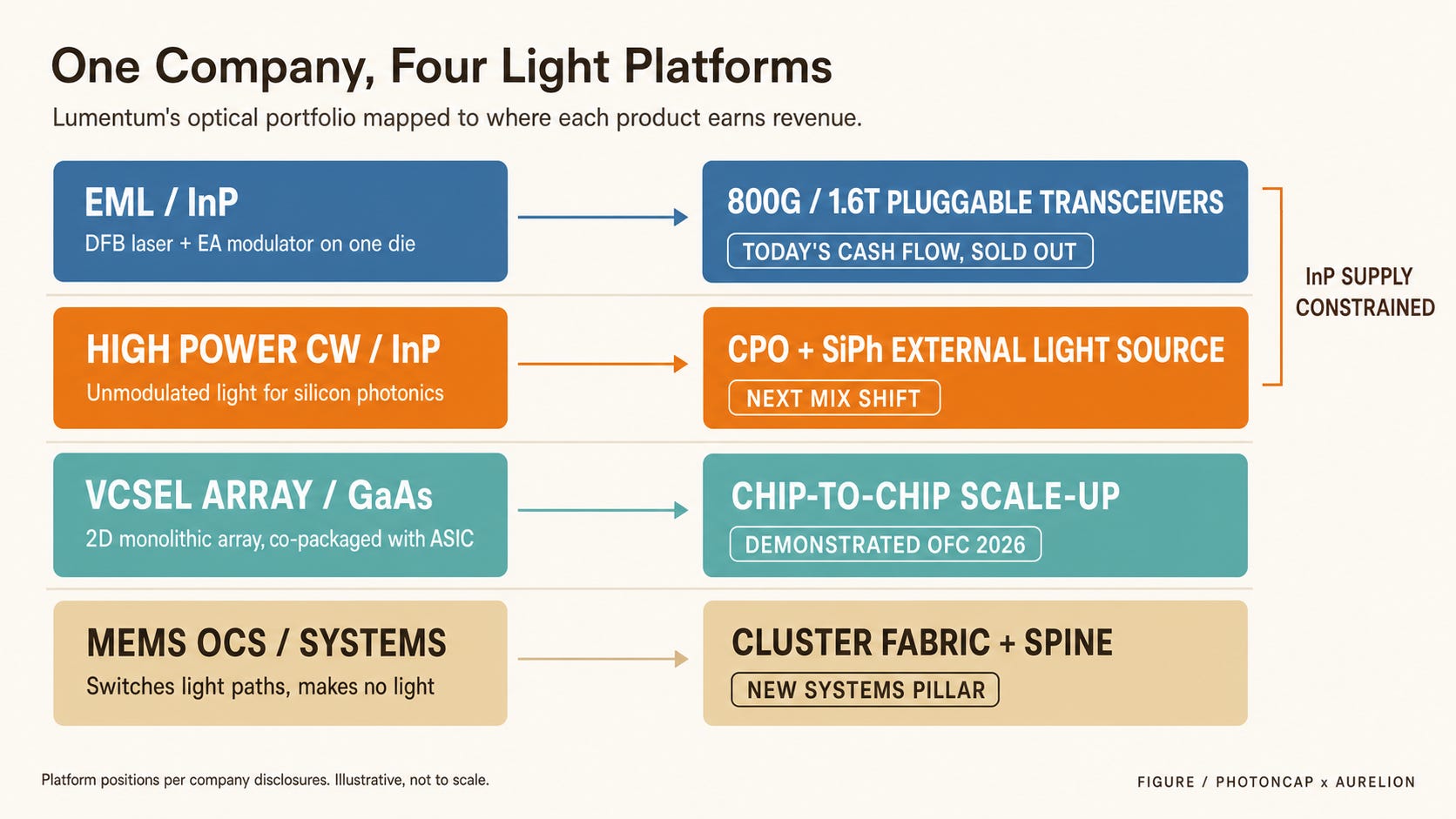
Figure 6: One Company, Four Light Platforms. Figure: PhotonCap x Aurelion
Implications for the AI Trade
Investor sentiment about the AI trade has largely been centered on compute, principally GPUs and memory. However, a cluster of GPUs borders on useless if they cannot communicate with one another quickly and efficiently, because at the scale model training and inference run, a single chip is massively insufficient for a model. Lumentum satisfies this need, connecting GPUs with light. Lumentum’s recent performance serves as a signal for the broader infrastructure buildout, in that their revenues have grown significantly both through higher volume, and elevated ASP with a mix-shift to 200 gig-per-lane speeds. This tells us:
1) The compute bottleneck is not solely concentrated in memory. There are shortages in areas that are multiple orders of magnitude removed from direct token generation.
When thinking about a cluster of GPUs dedicated to AI, the two high-level jobs are compute, and intra-GPU communication. The numerous GPUs that define the cluster need to remain in constant communication to split compute across them. The first two or so years of the AI trade centered around the actual computation needs, with the first constraints being GPUs, then memory, and then power and advanced packaging. While some of these bottlenecks, mainly memory, still persist, sentiment has since moved to a new constraint. Specifically, much of that sentiment has shifted to optics in recent months. Lumentum signals that this bottleneck is real and possibly persistent because its laser chip business has grown both in volume and pricing, which shows that demand is outpacing the physical ability to manufacture the product. Lumentum is the leading provider of indium phosphide chips, which is considerably more difficult to work with than silicon. Lumentum is currently optimizing the number of bits you can transfer per square area of indium phosphide. In an ordinary market, capacity expansion almost always leads to lower ASP. However, Lumentum, by optimizing for more complex and efficient optical technologies, may actually continue to see ASP increase as customers mix shift to newer chips. This is a bullish signal for the AI infrastructure buildout and hyperscaler capex.
2) The optics thesis depends on compute domains growing. It is not fully dependent on a large-scale copper shortage.
Common sentiment around optics use stipulates that copper eventually fails to function or runs out of supply, which then forces migration over to optics, making demand robust. We see this, however, as a slightly misguided mechanism. Jensen Huang, CEO of Nvidia, framed copper as being used for scale-up, and photonics for scale-out, and Broadcom has said that optical scale-up is not quite there yet. This is despite Nvidia’s vast investments in Lumentum and Coherent, while also saying there is a need for copper capacity. With the ongoing rollout of Nvidia’s Vera Rubin GPUs and CPUs, we may begin to see a deepening of constraints outside of just distance or power per meter. Rubin relies on bi-directional signaling to reach its bandwidth targets, and bi-directional signaling over copper degrades substantially at 448G per lane. There is an unknown time-to-market for 448G per lane copper, but optics can scale along modulation, fiber count, and wavelength multiplexing. This means that Kathy’s response to six-meter copper claims is actually directed more at a cost curve based on engineering capabilities rather than a physical wall.
There is a durable source of demand for optics based on the growth of compute domains, meaning the number of GPUs that must operate as one coherent unit. These domains are rapidly outgrowing what copper can serve. Nvidia has begun moving from 72 GPU domains toward as many as 576 by 2027, and copper is already confined on an NV72 rack. Once a domain encompasses multiple racks, linking must be optical regardless of copper’s current efficiency. Thus, the optics thesis necessitates that AI systems continue scaling, not only that copper hits a wall or that 448G copper becomes unattainable. So, as CPO is anticipated to scale up in FY27 or FY28, it can do so in parallel with copper and still see commercial success.
3) If intelligence begins to commoditize and open source models continue to improve, value migrates away from frontier labs into infrastructure, but within infrastructure it does not concentrate evenly.
The cost per unit of model intelligence is persistently decreasing, especially with new open source releases like Kimi K3 and Grok 4.5. If demand for tokens is elastic, which we posit it is, then consumption rises faster than price falls. So, more competitive cheaper-per-intelligence models increase aggregate demand for compute while moving margins away from frontier models. Models would, in this case, become increasingly commoditized, with high competitive pressure and low switching costs. Combined with open-weight models compressing pricing, value migrates toward layers that depend on physical scarcity. This is a widely held conclusion, however, it is normally left at a high level.
Infrastructure is a multi-layer portion of the value creation chain, including power generation and grid capacity, chips, interconnect, and more. Leading edge foundry capacity is arguably the most scarce layer in the entire supply chain, with TSMC being effectively the sole frontier supplier. HBM is also constrained across 3 global suppliers, and behaves as a commodity, with more capacity expected to come online within the next 18 to 24 months. Optical and photonic components are currently in a similar position to memory in terms of viable suppliers and industry barriers to entry, given the underlying material science in indium phosphide fabrication and reliability requirements. However, training is the most communication intensive workload, and the way that optics have traditionally traded is around training economics. Inference is less network intensive, or at least has been historically, so a mix shift toward inference does not translate to a 1:1 demand for optics. But, as inference architecture evolves, this gap may close with things like longer context windows, more intense routing, disaggregated prefill and decode, and higher agentic usage. Inference is also more geographically distributed, which will drive more data center interconnect, regardless of cluster-to-cluster linkage. Optics at large are insulated from model commoditization, because they benefit from bits moved rather than tokens generated across infrastructure.
PhotonCap comment: This gap is already closing. The joint inference solution AMD and Cerebras announced in July is the live example. Helios handles the front half, reading the prompt, and Cerebras handles the back half, generating the answer, so work in progress crosses a network between two machines. What that link is made of has not been disclosed. So this is evidence that inference moves a lot of data, not evidence of any vendor’s revenue. PhotonCap covered the architecture in Same Split, Opposite Directions: Where NVIDIA and AMD Cut the Rack Decides Where Optics Gets Paid, and the data center to data center demand in this paragraph is the axis covered in One Layer Below SemiAnalysis’s Meta Map.
4) Chinese competition is unlikely to be a factor in the near term, though this is the point on which we hold the least conviction.
Chinese competitors do persist, and their technologies currently lag on yield and high-power production. As compute demands skew in favor of energy efficiency, using potentially unreliable Chinese hardware is not particularly viable. Furthermore, with strict import restrictions and bans among US companies demanding compute, Chinese hardware is unlikely to see significant uptake over domestic producers in the near term. We hold this view with less conviction than the three above, and treat it as a live risk rather than a settled question. The evidence supporting Lumentum’s yield advantage is entirely management’s own internal comparison, and Chinese EML production is progressing faster than the near-term view assumes. We set out that counter-argument in the bear case below.
PhotonCap comment: The actual technical point deserves sharpening. The moat is not peak power. It is qualified usable power at operating temperature, multiplied by spectral quality, reliability, and high volume yield. Four terms make the picture concrete. RIN is the small flicker in a laser’s output; with PAM4, which encodes data in four brightness levels, too much flicker makes the receiver confuse levels. COD is catastrophic optical damage, the failure mode where a laser’s own light burns its output facet, and it is the wall you hit first as power climbs. SMSR measures how cleanly the laser emits one wavelength versus stray ones. FIT counts failures per billion device hours; with millions of lasers in a data center, even a slightly high FIT means something dies every day. The point is this. Headline specs are what challengers close first. Distribution tails, noise, and lifetime statistics close last, because they take volume learning and years of field data rather than design. Lumentum’s claimed edge sits exactly there, and for the same structural reason it cannot be externally verified yet.
Bull and Bear Debate
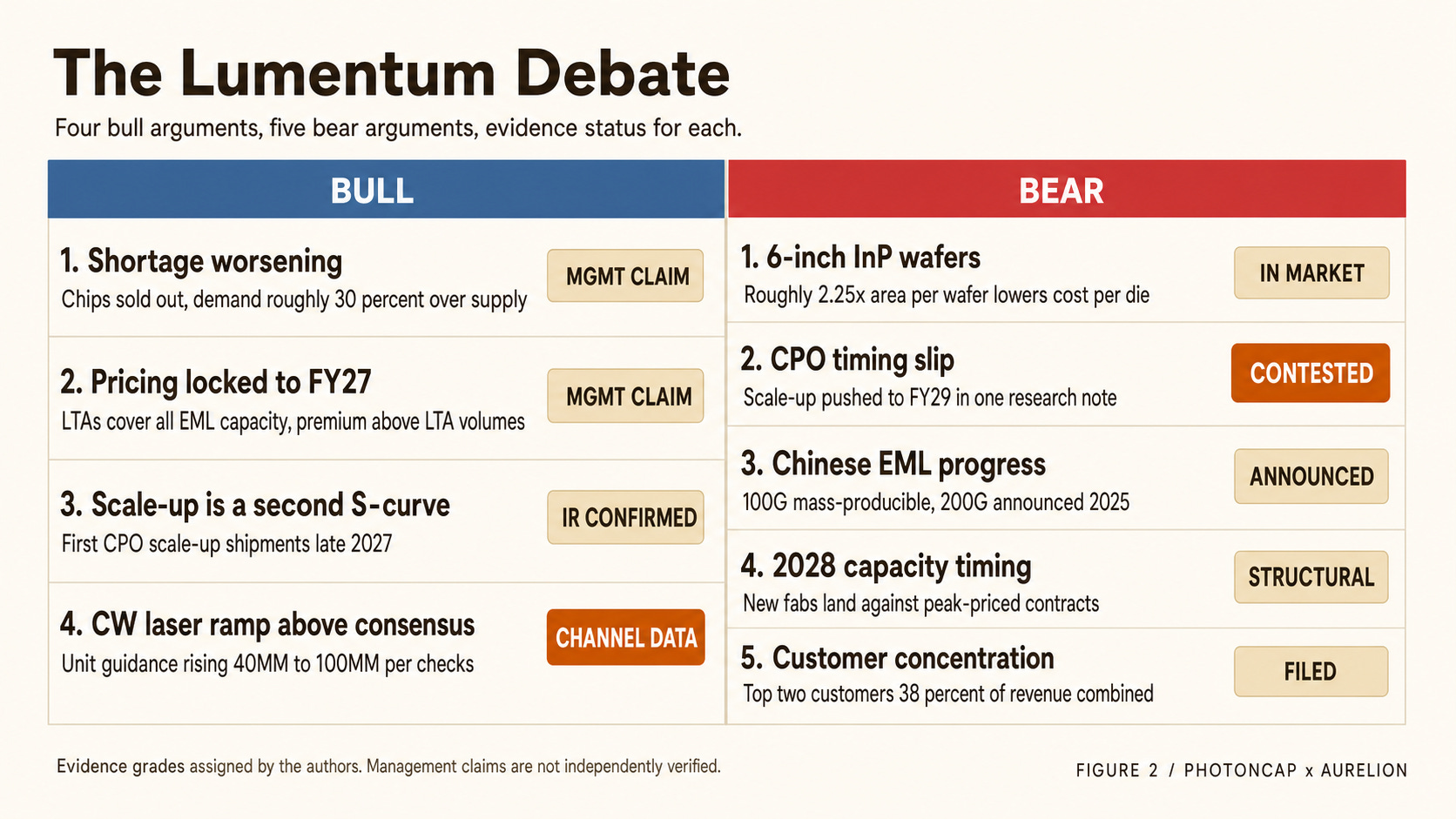
Figure 7: The Lumentum Debate, four bull arguments and five bear arguments with evidence status. Figure: PhotonCap
LITE stock currently sits about 20% below its all-time high. Sellside coverage is roughly split, with shops like TD Cowen cutting its price target to $800 from just over $990, while UBS re-affirmed a hold and Citi reiterated a buy with a $1,100 price target, opening a catalyst watch. Other price targets range from $900 to $1,400 on the sellside. Before looking at the bull and bear cases, it is worth understanding that most of the photonics supercycle has been realized and played out, as photonics stocks at large have seen earnings increases and re-rates over the past 52 weeks. So, the relevant debates revolve largely around the future state of shortage, pricing, and CPO scale-up.
The Bull Case
Folks long Lumentum tend to believe:
1) The shortage is worsening and will continue to do so as compute scales up
Components and laser chips are effectively sold out, as are most chips, while wafer fabs take years to come on line. Management has described this supply and demand imbalance as roughly 30% greater demand than is physically suppliable, which is forcing premium pricing in the near to mid term, and full wafer allocation. Japanese wafer fab capacity is at a premium and fully allocated, while laser chip shipping has more than doubled in volume year over year. A McKinsey study also projects 800G transceiver production falling short of demand by about half in FY27, with shortfalls extending through 2029.
2) Pricing is contractually locked in and skews in favor of Lumentum through FY27
All EML capacity is locked in long-term agreements (LTAs) through FY27, and customers coming back for more than their LTAs cover must pay premium prices, while customers who do not sign LTAs risk losing their entire allocation of supply. General analysts expect double digit price increases in 200G EMLs in FY26 given the lack of second source supply.
3) Optical scale-up is not modeled into short-term consensus and is a second S-curve into which you can buy
LITE’s current business is predicated on scale-out, but management describes scale-up as a game changer that would expand their TAM. They expect first scale-up shipments for CPO in late ‘27. This was also confirmed by what Kathy told us on our call. The bulls see this as incremental TAM on top of a business that is already sold out of supply capacity.
4) CW lasers for CPO are ramping harder than consensus models
This thesis point rebuts the chip selloff in June, and the argument originates with Global Semi Research, who published a direct response to the SemiAnalysis note on June 10. Their supply-chain checks put Nvidia’s guidance to Lumentum and Coherent for high-power continuous-wave lasers at roughly 40MM units in January, rising to roughly 100MM by April and May. That pulls demand forward and back-solves to CPO switch shipments of roughly 200,000 to 300,000 in 2027, scaling toward 600,000 to 800,000 in 2028. It also lines up with TSMC’s COUPE (Compact Universal Photonic Engine) plan. These are channel figures rather than company disclosure, so we weight them accordingly.
The Bear Case
1) Coherent’s 6 inch wafer is a deeply underappreciated competitive threat
Coherent’s competitive product is its 6 inch indium phosphide wafer line. By switching from 4 inch to 6 inch wafers, Coherent produces roughly 2.25 times the usable area per wafer, yielding more laser die at a lower cost per die. Lumentum still runs 4 inch wafers and is trying to catch up. If Coherent’s 6 inch yield closes the gap on Lumentum’s 4 inch performance, this deeply undermines Lumentum’s pricing power. Lumentum even framed its own competitive advantage as bits per square area of indium phosphide, so a competitor with more than twice the usable area per wafer makes direct headway on that metric. Coherent’s indium phosphide lasers are also sold out through 2027.
2) Timing CPO shipments is a risk because they may get delayed
SemiAnalysis published a report to institutional clients on June 9, 2026, arguing that scale-out CPO shipments would be revised down through FY27 and push scale-up to FY29. This implies that the photonics bottleneck trade is over-crowded and disconnected from reality, which caused a relatively violent selloff in June and is one of the most monitored aspects of the bear case. They stated that CPO output is driven by a single ASIC that is very limited, and that ASIC integration is difficult with challenging underlying economics in its current state.
PhotonCap comment: This risk needs splitting by cause. If CPO slips on ASIC or packaging integration while bandwidth demand keeps growing, demand does not disappear. It stays in pluggables longer, and pluggables are EML intensive, which is the line that is sold out today. An integration driven delay pushes CW and ELSFP revenue out while extending the EML cycle. If the delay instead comes from a broader AI capex slowdown, both architectures get hurt. There is also the other side of the same coin. The cannibalization question the call sidestepped, whether CPO eats into the roughly 35% of revenue that is transceivers and systems, flips into a cushion in the delayed CPO scenario. The ladder below shows why: CPO is one rung, and a delayed rung keeps traffic on the rung beneath it. The June selloff punished the whole optical complex without this distinction, which PhotonCap covered in There Is No Such Thing as a ‘CPO Stock’.
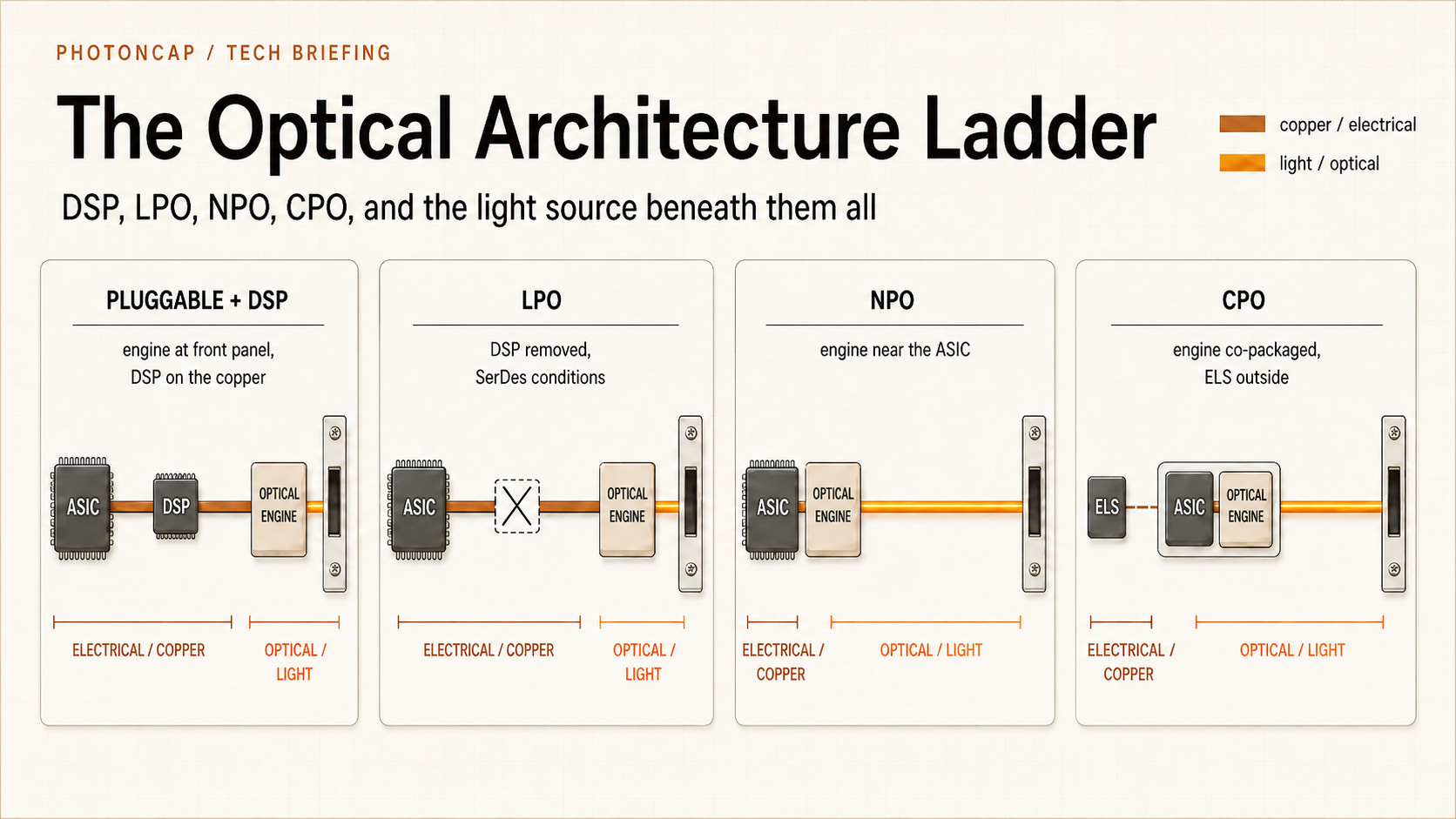
Figure 8: The Optical Architecture Ladder. Source: PhotonCap, DSP, LPO, NPO, CPO: The Four Optical Architectures
3) Chinese EML production is progressing fast, and may soon catch up with domestic production qualit
Chinese companies, like Zetta Semiconductor, announced mass production quality EML systems across a variety of types and wavelengths in late 2025. This shows that there are foreign players that have the production capacity and specialization to play in the photonics market. However, getting past US regulatory structures and import restrictions will be difficult. The main battleground for these technologies will likely be in the EU among non-US companies.
PhotonCap comment: Zetta no longer fits either box, not the low power dismissal and not the imminent catch-up call. On public record it announced a mass producible 100G PAM4 EML at OECC 2025 and followed with a 200G per lane device at ACP in November 2025. Device level performance deserves to be taken seriously now. The open question is exactly the logic in the PhotonCap comment above: can it hold the full spec distribution across operating temperature and lifetime, and do unit-to-unit variation and noise behavior like RIN survive hyperscale qualification. That gets proven by years of volume data, not by announcements. PhotonCap covered how profits split between chips and modules in the Chinese optical ecosystem in Chinese Optical Modules Own 7 of the Top 10 Seats.
4) Lumentum capacity should come online in 2028, which may hit a different market
Two new sources of indium phosphide capacity are coming, and they are separate projects. The first is Greensboro, North Carolina, bought from Qorvo and being converted from gallium arsenide to indium phosphide as Lumentum’s fifth indium phosphide fab. Management guided revenue contribution to roughly six quarters out from the May call, which puts it in late 2027 at the earliest. The second is the new U.S. facility funded alongside the Nvidia investment, which is a ground-up build rather than a conversion. However, capacity commitments are being baked into current contracts at peak pricing against volumes that do not arrive for at least another 18 months. LITE is expanding EML production by 40% annually, but if volume growth decelerates by the time new capacity comes on line, Lumentum’s operating leverage will work against them on a substantially larger operating asset base.
5) Customer concentration is high, and they are deeply entangled with Nvidia
Two LITE customers accounted for 26% and 12% of revenues in fiscal Q3 2026. Nvidia is a large customer, shareholder, and owner of rights to future capacity. These roles are fundamentally unaligned, and its position as a buyer is economically larger than its investment stake, so its incentives skew toward price discipline rather than support. Capacity rights also cause tension among other customers whose supplier is entangled with a competitor that has claims on output.
PhotonCap comment: Concentration is a snapshot. Addressable demand is wider. Every camp pursuing CPO needs high power light. AMD’s rack scale expansion creates EML, CW, and pluggable demand. Broadcom is a potential customer and at the same time a platform competitor with its own laser sources. Marvell can be a buyer, an ecosystem partner, and an integration layer competitor all at once. Absent a disclosed design win, though, these are demand paths, not confirmed customers. The reverse direction is also on the public record: second sourcing is in progress, not a hypothesis. NVIDIA’s technical blog names three ELS vendors, Lumentum, Sumitomo, and Coherent. The same day Lumentum got its $2B, Coherent got an identical $2B. Coherent’s OFC 2026 release formalizes its 6 inch InP ramp and a 400mW CW laser, and AAOI announced sampling of a 400mW narrow linewidth laser in December 2025. The time axis is what matters. Competing capacity lands outside the FY27 LTA window, which is exactly where the 2028 capacity argument above picks up.
Enjoyed this one? This article is free. The full PhotonCap archive, from the InP supply chain to CPO economics, is where the deeper work lives.
Share this with anyone who needs to see the world through a different wavelength.
And if management access and fundamental equity work is your thing, go follow Aurelion Research. This piece exists because they picked up the phone.
Disclaimer: This article is a joint publication. The management meeting and investment analysis were prepared by Aurelion Research, and the technical comments by PhotonCap. All content is based on publicly available information and the authors' notes, and is provided for educational and informational purposes only. Nothing herein constitutes investment advice or a recommendation to buy, sell, or hold any security. Interview responses are paraphrased and do not represent verbatim statements by Lumentum or its management. The authors may hold positions in securities discussed. Readers should conduct their own due diligence before making any investment decisions.
It was a pleasure working with PhotonCap! Smart but very technical, which is highly needed in these times where photonics and semiconductors have become mainstream and everyone is talking about them.
Hi Aurelion/Photon,
Could you provide your opinion on the AXTI and LITE wafer substrate deals? Is this net negative for smaller guys like AAOI and SIVE if bigger players like Lumentum and Coherent keep locking up InP substrate capacity? Where are AAOI and SIVE going to get their InP substrates to ramp up volume production?
Thank you