
On June 9, an institutional-only SemiAnalysis note lit the fuse, and optics names dropped together. AAOI fell 14%, COHR 11%, LITE 8% [1][2]. The market’s logic was simple: “CPO volume slips to 2028 to 2029, so photonics is over.” Yet the very next day the same names bounced (AAOI +7%, LITE +5%, COHR +2%) [3], and in the same week NTT, SK, and Chunghwa Telecom launched a new $500M fund pointed at optical communications and light sources [4][5]. This piece lays out the four optical architectures, DSP, LPO, NPO, and CPO, in a way a non-specialist can absorb in one read, then maps where Lumentum, Coherent, AAOI, and Sivers actually sit on that ladder. The thesis is one sentence. Photonics is not CPO. CPO is one form factor among several, and the light source, substrate, and fiber sit inside every one of them.
Table of Contents
In the Same Week, Two Opposite Things Happened
Why “Photonics Equals CPO” Is the Wrong Equation
The Optical Architecture Ladder: DSP · LPO · NPO · CPO (Pluggable+DSP / LPO / NPO / CPO)
So Why Does This Matter for Investing
Form Factor by Form Factor: What Gets Removed, What Stays
The Copper-Light Boundary: Lane Speed Pushes the Line Inward
The Light Source Map: Lumentum · Coherent · AAOI · Sivers
Capital Votes on the Destination, Not the Quarter
Copper Runs Longer. That Is Not a Bear Case.
Scenarios and Monitoring
Closing: Look Far, Not at Tomorrow
The PhotonCap Series Behind This Piece


Coherent, Lumentum, Marvell, and Now Corning: NVIDIA’s 4 Photonics Bets · COHR, LITE, MRVL, GLW

NVIDIA’s $2B Marvell Bet and Celestial AI’s “25x” Claim · MRVL, interconnect

The Silicon Photonics Light Source War: Same Problem, Three Solutions · Sivers, QD Laser, Aeluma

Intro: In the Same Week, Two Opposite Things Happened
On June 9, optics stocks fell apart in a single session. AAOI led the way down 14%, with Coherent off 11%, Lumentum 8%, and Ciena 7% [1][2]. The trigger was an institutional-only note from SemiAnalysis. It reportedly said CPO (Co-Packaged Optics) volume timing is later than hoped, and outlets relayed summaries without confirming the original [1].
The story the market read was this: “CPO is late. CPO is photonics. So sell photonics.” The middle sentence is wrong, and the selling started from there.
That there is no such thing as a “CPO stock” is the argument I made in yesterday’s part 1. Today’s part 2 builds on it: draw the optical architecture once, and you can see why that middle sentence is wrong.
The same week ran the other way too. On June 10, the names that fell the day before simply bounced back. AAOI +7%, Lumentum +5%, Coherent +2% [3]. And that same day, at NTT headquarters in Tokyo, NTT, SK Telecom, Taiwan’s Chunghwa Telecom, and the Development Bank of Japan (DBJ) announced the IOWN AI Fund. Size $500M (about 760 billion won), with a management company, Catalight Capital, based in Silicon Valley and Tokyo. The stated investment scope names “Photonics Technologies,” “Light Source and Modulators,” and “optical communications” outright [4][5][6].
On one side, a “CPO is late, so sell the light” wave. On the other, telecom carriers and financial capital putting fresh money into “light.” Both in the same week. One of them is misreading the clock.
The June 9 selloff translated “CPO delay” into “sell photonics.” Whether that translation holds becomes a one-minute judgment once you know what the optical architecture actually looks like.
Why “Photonics Equals CPO” Is the Wrong Equation
Start with an analogy. There is a power plant, and there are lamps that run on its electricity. Lamps come in types: ceiling fluorescents, desk lamps, recessed wall fixtures. CPO is the “recessed wall fixture.” It is fiddly to install, and the work can run late.
But you do not sell the power plant because the recessed fixtures are behind schedule. Fluorescents, desk lamps, and recessed fixtures all draw from the same plant. In CPO terms, the “power plant” is the light source, the substrate, and the fiber. Whatever form factor you choose, light has to be generated somewhere, modulated or routed through something, and carried somewhere.
Many of the names sold off on June 9 are closer to “power plant companies” than “fixture companies.” Lumentum and Coherent make lasers, transceivers, and materials, a layer that pluggable, LPO, and CPO all need. The plant stock fell on news that the recessed fixtures are running late.
This either-or, “CPO or copper,” is not new. Back in March, when Broadcom’s Hock Tan said on the earnings call that copper could carry the within-rack job and that CPO would arrive in time, not in 2026 or 2027, the market read it the same way, as a fight between a copper camp and an optics camp. As I laid out in NVIDIA’s $4 billion optics bet, Broadcom and NVIDIA were not in conflict but looking at different axes of time and distance. Inside the rack at 0 to 2 meters, copper is right for 2026 to 2027. Across clusters at 10 to 100 meters, optics is right for 2028 to 2030. This CPO delay panic is just the June version of that same frame.
So how do you tell “plant” from “fixture”? You learn the optical architecture ladder.
The Optical Architecture Ladder: DSP, LPO, NPO, CPO in One Pass
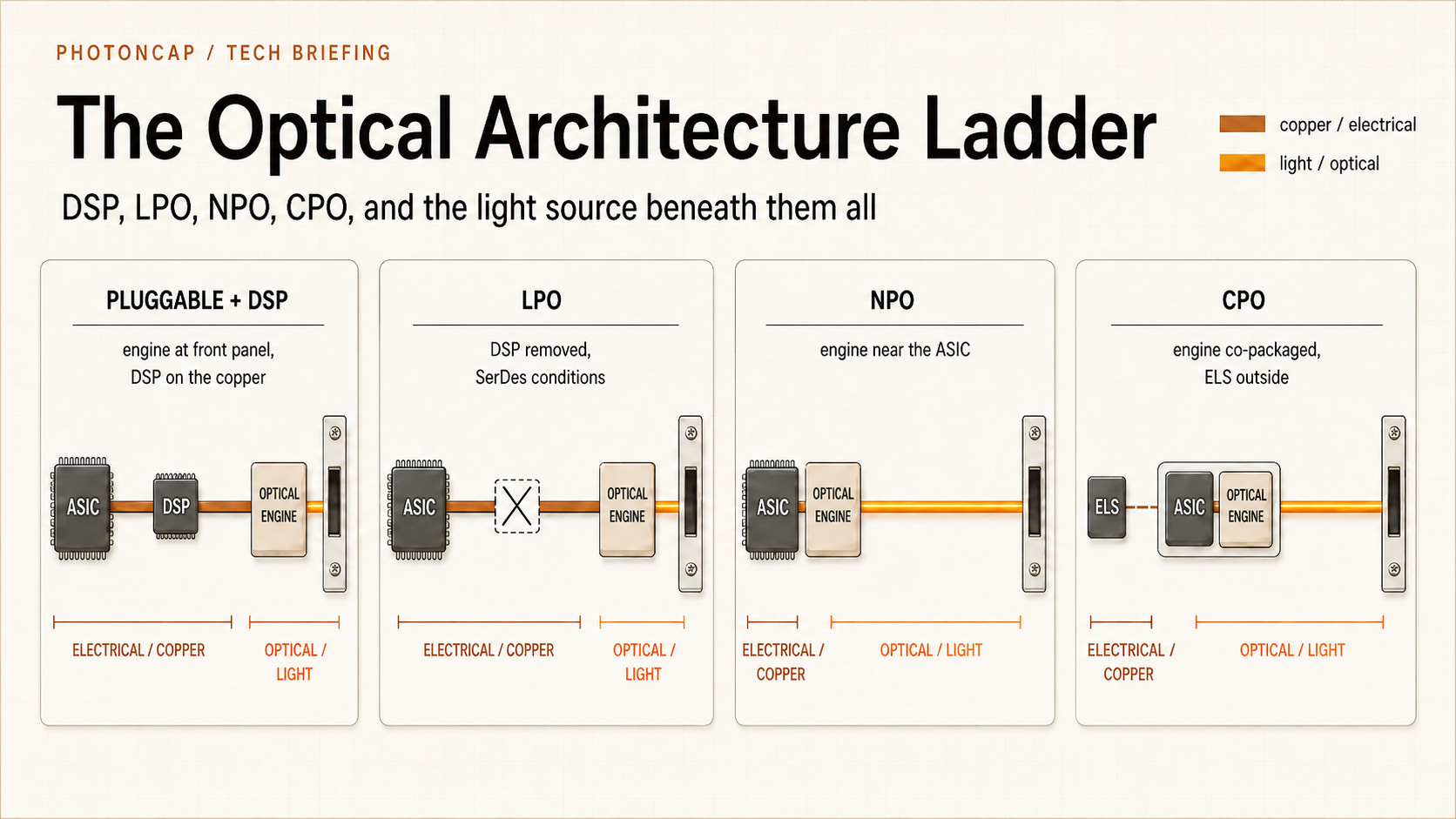
This ladder is best read along two axes. One is how close to the ASIC you put the optical engine. The other is where you restore the degraded electrical signal. LPO is a move along the second axis: it removes the module DSP and leans more on the host ASIC’s SerDes. NPO and CPO are moves along the first axis: they pull the optical engine toward the ASIC. The optical engine (the cluster of optics that makes and receives light) and who restores the signal, those two together are what name every form factor.
Why does that matter? Because the electrical signal coming out of the AI chip (ASIC) travels over copper wiring. The faster the signal goes (these days over 200G per lane in PAM4), the faster it degrades on copper. There are only two ways to deal with that. One is to attach a chip (DSP) that restores the degraded signal. The other is to pull the optical engine closer to the ASIC and cut the copper distance outright. The ladder is the process of shrinking the copper electrical run by reducing the DSP, pulling the optical engine toward the ASIC, or combining the two. Let us climb it.
Rung 1. Pluggable + DSP (today’s standard)
The optical engine sits inside a swappable module that plugs into the switch front panel. The 800G and 1.6T transceivers you usually hear about are this. Electrical signals from the switch ASIC travel across copper PCB to the front panel, and the longer that run, the more the signal degrades, so a DSP (Digital Signal Processor) inside the module restores it. It is the most mature and most proven approach.
Definition: optical engine inside a pluggable front-panel module. Today’s 800G/1.6T standard.
How it works: ASIC to copper PCB to front-panel module. The long run degrades the signal, so the module’s DSP restores it.
Upside: standardized, hot-swappable (swap just the module on failure), long reach, the most mature ecosystem.
Tradeoff: the DSP is power hungry, and each module has a power and thermal ceiling, so rising bandwidth hits a wall.
Rung 2. LPO (Linear Pluggable Optics)
Same pluggable form factor, but with the module’s DSP removed. The switch ASIC’s SerDes handles signal conditioning instead, and the module’s amplifier (TIA) and driver simply pass the signal through in linear mode. The DSP was the most power-hungry part, so removing it brings power and cost down together [7].
Definition: same pluggable form factor, with only the module DSP removed, the “linear” version.
How it works: signal restoration moves from the module to the switch ASIC’s SerDes. The module only passes through.
Upside: power, cost, and latency drop with the DSP gone. Reuses existing pluggable infrastructure.
Tradeoff: performance can vary by host platform, so interoperability is tricky. A practical bridge before CPO.
Rung 3. NPO (Near-Packaged Optics)
The optical engine moves off the front panel to sit next to the switch ASIC on the main board. The electrical run shortens, so loss and power drop. It is a midpoint before full CPO, a compromise that captures some of the benefit at lower packaging difficulty than CPO.
Definition: optical engine pulled off the front panel to sit beside the ASIC on the board.
How it works: shortens the electrical path to board level, cutting loss and power.
Upside: some of CPO’s benefit at lower packaging difficulty. Easier to use the existing supply chain.
Tradeoff: less efficient than full CPO, and a board-level electrical path still remains.
Rung 4. CPO (Co-Packaged Optics)
The optical engine is co-packaged on the same package as the switch or GPU ASIC, right beside it. The electrical signal barely moves, so power efficiency is best. The catch: lasers are heat sensitive and hard to place beside a hot ASIC, so the laser is pulled out into a separate module outside the package. That is the External Light Source (ELS). It is the most efficient, but packaging and yield are the hardest, so volume comes latest.
Definition: optical engine co-packaged with the ASIC, the final rung.
How it works: minimizes the electrical path. The heat-sensitive laser is split out into an external ELS.
Upside: best power efficiency and bandwidth density. The copper electrical wiring nearly vanishes.
Tradeoff: highest packaging, yield, and test difficulty, so volume comes last. This is exactly the rung SemiAnalysis called late.
The Whole Ladder in One Line
We climbed all four rungs, but the point is not the ladder itself. It is the shared foundation under all four rungs. Whether rung 1 pluggable or rung 4 CPO, light is made in a laser (the source), modulated on a substrate, and carried on fiber. Silicon is not an efficient light-emitting material in the first place (I covered this in detail in the earlier light source piece), so most commercial silicon photonics links bring in a III-V light source separately, as an ELS or through hybrid integration. So whether DSP is removed (LPO) or the engine relocates (NPO, CPO), those three layers, light source, substrate, and fiber, do not drop out of any form factor.
One more thing. This ladder is also a story about where light begins. Short distances (inside one rack) still favor copper, and from longer distances (rack to rack) light takes over. Which way that boundary moves over time is what actually sets the pace of the whole ladder. I unpack this in detail later, as copper demand versus light demand.
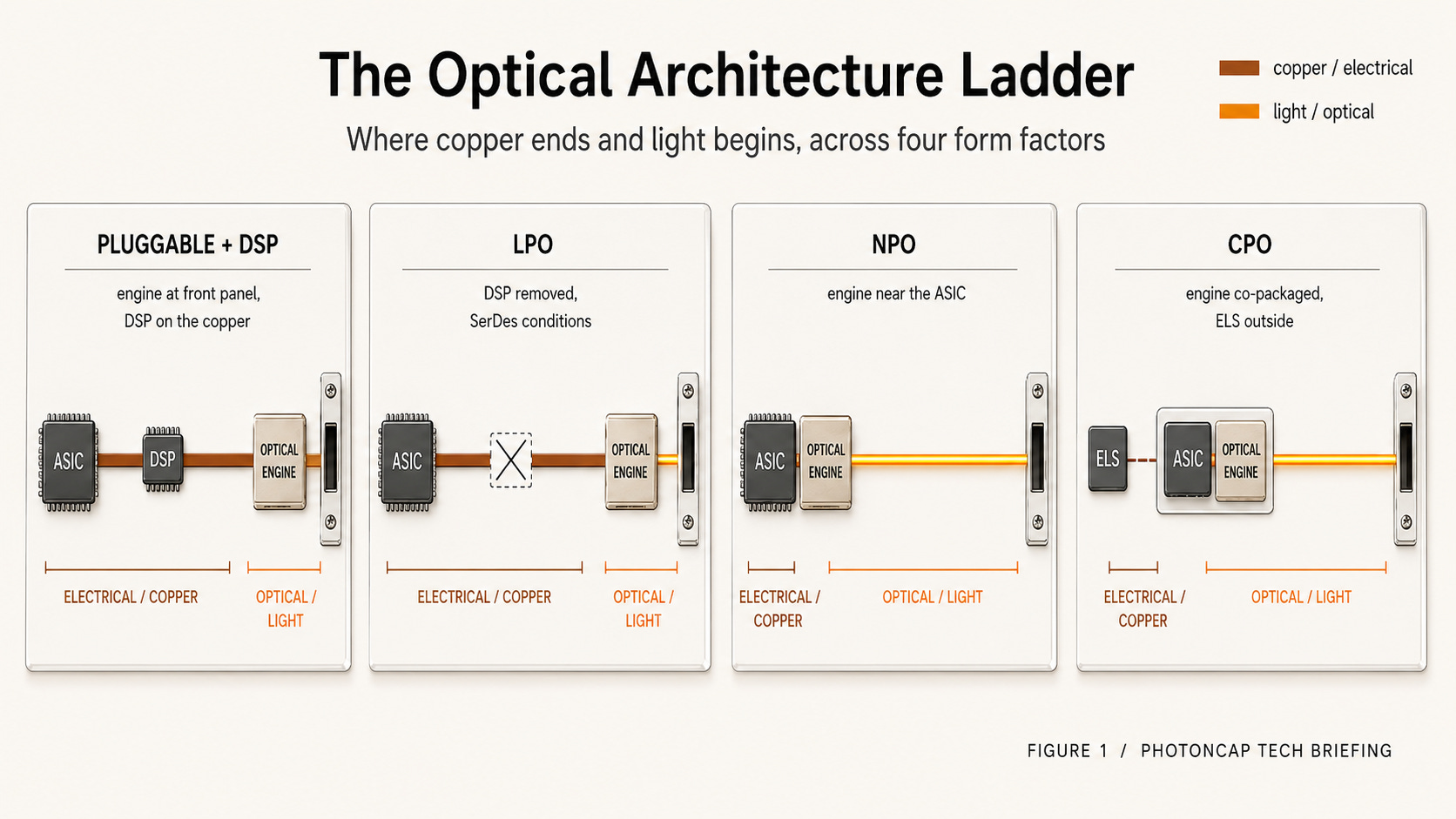
[Figure 1: The optical architecture ladder. Four form factors from pluggable+DSP to CPO, with the copper (electrical) line and the optical (light) line color-distinguished, the copper segment shrinking and the optical engine moving toward the ASIC up the rungs]
To restate it, what SemiAnalysis called late is rung 4, CPO. And not “CPO will not happen” but “large-scale volume timing slips,” a speed claim. Rungs 1, 2, and 3 keep selling in the meantime, and all four draw on the light source and fiber beneath them. So selling the entire optical layer on the single sentence “CPO delay” is a trade that fails to separate the form factor from the shared component layer.
So Why Does This Matter for Investing
That is the picture I can lay out for free. The architecture is a ladder, CPO is the top rung, and the foundation beneath is shared.
The real question starts here. Among the names that fell together on June 9, who is CPO-dependent and who is not? Who is the plant and who is the fixture? Was Lumentum’s drop justified, or was it a power plant swept up in fixture news? Where does the EML that AAOI makes hang on the ladder? Does a pure light-source company like Sivers fall with CPO if it slips, or is it actually safer?
And the direction of capital. Was it a coincidence that NTT and SK put $500M into optical communications in the same week, or are they looking at the destination of the whole ladder?
One preview before the paywall. That AAOI fell hardest on June 9 (down 14%) and bounced hardest the next day (up 7%) is no accident. It is because of the rung AAOI stands on in the ladder. Where that rung is, and by the same logic why Lumentum is a “power plant” and why Sivers is actually safer, I work through one by one just below.
Below, I lay out the form-factor comparison quantitatively, map the four light-source companies onto the ladder, and itemize the capital that actually flowed into photonics in the second week of June. AAOI is a pluggable overshoot, Lumentum is laser capacity, Coherent is a composite materials-and-transceiver exposure, Sivers is the purest light-source option. Same selloff, but not the same bet.
Form Factor by Form Factor: What Gets Removed, What Stays
Let us lay the ladder back down, quantitatively. Put the four form factors side by side across DSP presence, optical engine location, reach, light source needed, and CPO-dependency, and the picture sharpens.
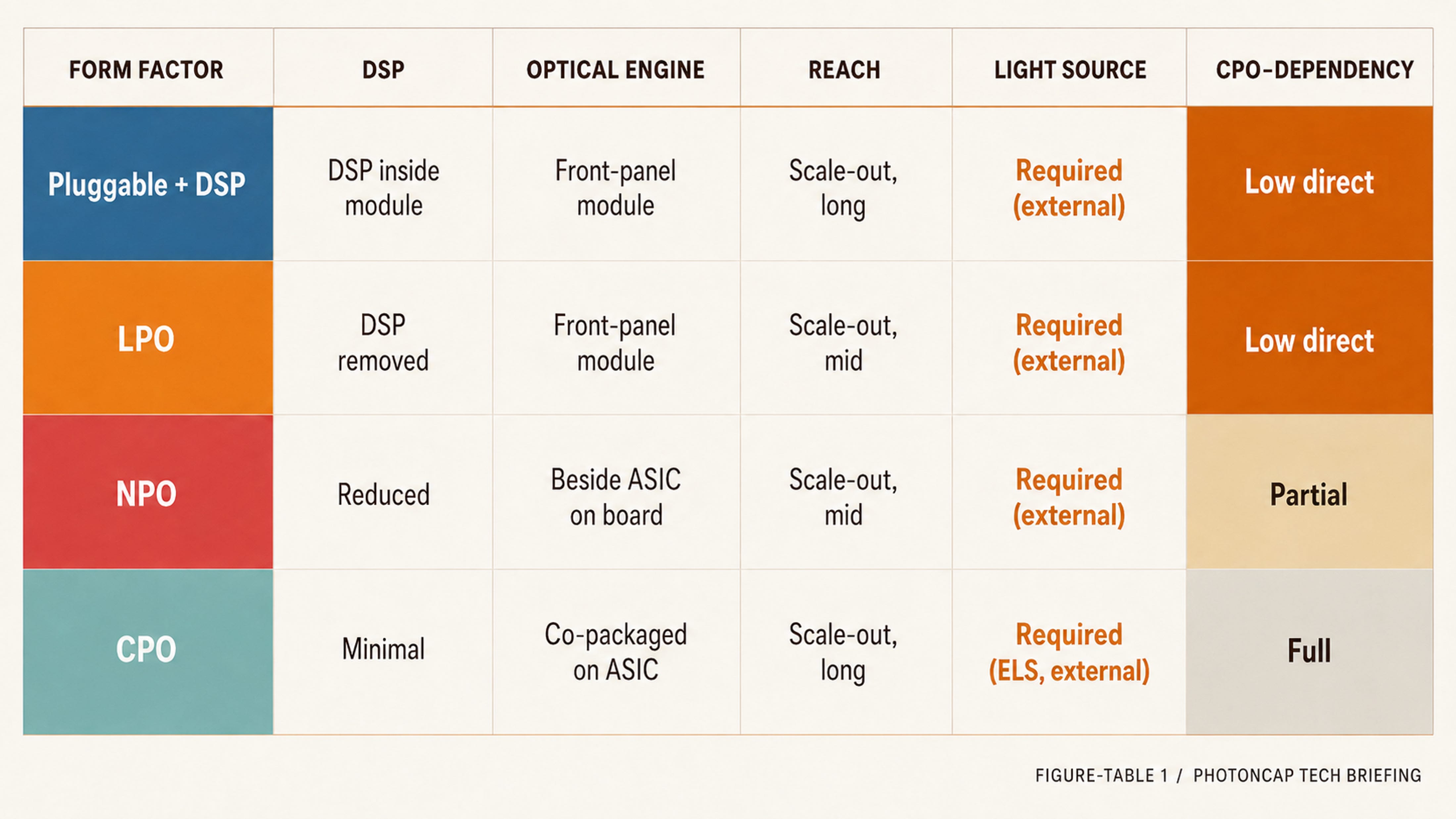
[Figure-Table 1: Form factor comparison matrix. Pluggable+DSP / LPO / NPO / CPO compared across DSP, engine location, reach, light source, CPO-dependency]
Read it like this. Follow the leftmost column (form factor) down, and look only at the rightmost column (CPO-dependency). Pluggable and LPO have the lowest direct CPO-dependency. They have their own market whether CPO is late or early, and if anything, when CPO is late, LPO and pluggable fill the gap longer. NPO straddles the middle, and CPO has the highest direct dependency. (Long term CPO could encroach on the pluggable socket, so read this as “low direct dependency,” not “zero.”)
The key is the reach column. On the Ethernet and switch side, like NVIDIA’s Spectrum-X, CPO and ELS make sense first in scale-out (rack to rack, longer distance) links. By contrast, scale-up (binding GPUs densely within a single rack) has short distances, so copper runs longer there for now. There is a separate push to bring optics into scale-up too: what Ayar Labs targets with NVLink Fusion is exactly this scale-up optical I/O, and it is the furthest-out and hardest rung. So “CPO delay” is precisely “delay in the large-scale timing of scale-out going optical,” plus the persistence of scale-up copper, plus the extension of LPO and pluggable in between. None of those three is a picture of photonics revenue disappearing.
If you do not know there are four rungs, the single sentence “CPO delay” sounds like it knocks down all four. In reality, when one rung is late, the three below it buy that time.
The Copper-Light Boundary: Lane Speed Pushes the Line Inward
For anyone seeing this selloff for the first time, let me bring up something from two years ago. In March 2024, when NVIDIA unveiled the GB200 NVL72, the optics market had exactly the same panic. NVL72 binds 72 GPUs inside one rack over NVLink, and it did that link in copper, not optics. On the fear that “binding the rack in copper cuts optical transceiver demand,” optics names fell in a heap [8]. That it was a misread is clear from the fact that the same names rose several times over in the two years since.
The key is that an AI data center has more than one kind of network. It splits into two.
Scale-up. Binding GPUs densely within a single rack (or a single NVLink domain). Distances are short (tens of centimeters to 1 to 2 meters). NVL72 handles this with an NVLink passive copper cable backplane [9]. Push a tray in and it mates straight into the copper backplane at the rear. Per NVIDIA, one NVL72 rack carries about 5,184 direct-drive copper cables, totaling 2 miles (3.2 km). Doing this in optics would have cost about 20kW more in transceivers and retimers alone, and putting that into copper freed the 20kW for compute, as Jensen Huang explained [8]. Over short distances copper needs no laser, no optical-electrical conversion, and no DSP, so it wins on power, cost, and latency.
Scale-out. Linking rack to rack and cluster to cluster. Distances are long. This is optical. But one decisive fact. Even though NVL72 switched scale-up to copper, scale-out optical intensity did not drop. The NVL72 rack still carries 400G/800G OSFP ports at one per GPU, the same ratio as the prior H100 generation [8]. Binding the inside of the rack in copper and shooting light out of the rack are different networks. One becoming copper does not make the other disappear.
That is the truth of the 2024 panic. The June 2026 CPO panic has the same structure. “One form factor (CPO) is late, so light shrinks” is the same misread.
So will copper hold scale-up forever? No. Here is where per-lane speed enters. How fast you send a signal per lane climbs from 100G to 200G to 224G, and the faster it goes, the shorter the distance copper can carry it cleanly. Passive copper (DAC) at 112G PAM4 topped out around 1.5m, and at 224G PAM4 the signal attenuates so badly it can barely travel an inch on a standard PCB before vanishing [10]. Attenuation, skin effect, and inter-symbol interference all hit at once [10]. That is the copper wall.
But copper does not retreat easily. The AEC (Active Electrical Cable) arrived, putting a DSP and retimer inside the cable connector head to regenerate the signal. AECs push past the passive-copper limit to extend reach up to 7m even at 224G [11][12]. Credo, MaxLinear, Astera Labs, and Amphenol are the players here. In March 2026 MaxLinear shipped a 224G scale-up retimer (Annapurna), formalizing the hybrid framing that “optics is essential for scale-out and longer distances, electrical is the advantage for scale-up” [10]. In other words, the very way copper holds scale-up is itself a new growth market, evolving from passive cable to active cable with retimer and DSP inside. Copper holding on means not “stasis” but “a different kind of silicon demand.”
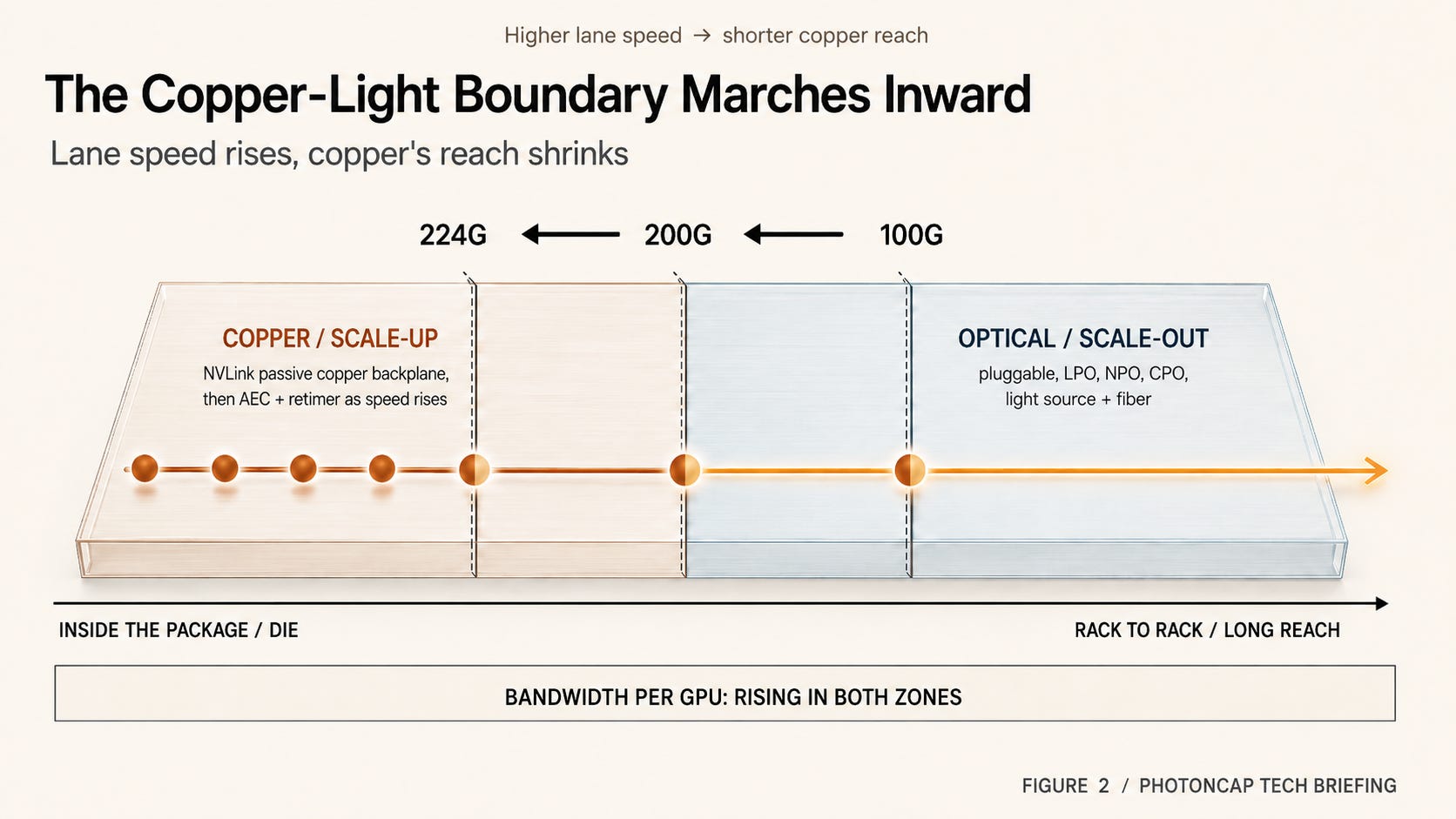
[Figure 2: The copper-light boundary. The line between scale-up (copper) and scale-out (optical) marches inward as lane speed climbs from 100G to 224G, with bandwidth rising in both zones]
So the whole picture resolves like this. There is a boundary line between electrical and light, and on the distance axis it marks “past here, light is the advantage.” Each time lane speed climbs a generation, the distance copper can hold shrinks, so the boundary marches toward the die, inward. Light that once lived only outside the rack moving into the rack, onto the board, and finally into the package (CPO) is exactly this march of the boundary.
The architecture ladder drawn earlier is precisely this march. Pluggable+DSP has the boundary at the front panel, NPO pulls it onto the board, and CPO pulls it into the package. Climbing the ladder means removing the in-box copper electrical wiring and the DSP that restores it, and filling that space with light. What gets shaken in that process is not the light source but the DSP. LPO removing the module DSP threatens Marvell and Broadcom’s DSP revenue, not laser demand, and CPO removing the electrical wiring is the same.
Translated to investing, two things. First, copper holding scale-up longer is itself a growth driver for the AEC and retimer layer (Credo $CRDO, MaxLinear $MXL, Amphenol $APH, and others), and it does not cut scale-out optical demand. Second, what the June 9 selling confused is exactly this point. It bundled “copper/CPO timing” with “light demand.” In reality only where the boundary sits changes, while both copper-interconnect demand and optical demand rise together. It is not a picture of light shrinking but a picture of where light enters being pulled one rung inward every year.
Copper wins scale-up, light wins scale-out. And each time lane speed climbs, that boundary moves inward, eating into copper’s side, not light’s. In 2024 and again in 2026, the market read the direction of this line backwards.
The Light Source Map: Where Do Lumentum, Coherent, AAOI, and Sivers Sit
Now place the companies on the ladder. All four fell on June 9, but their positions on the ladder are completely different.
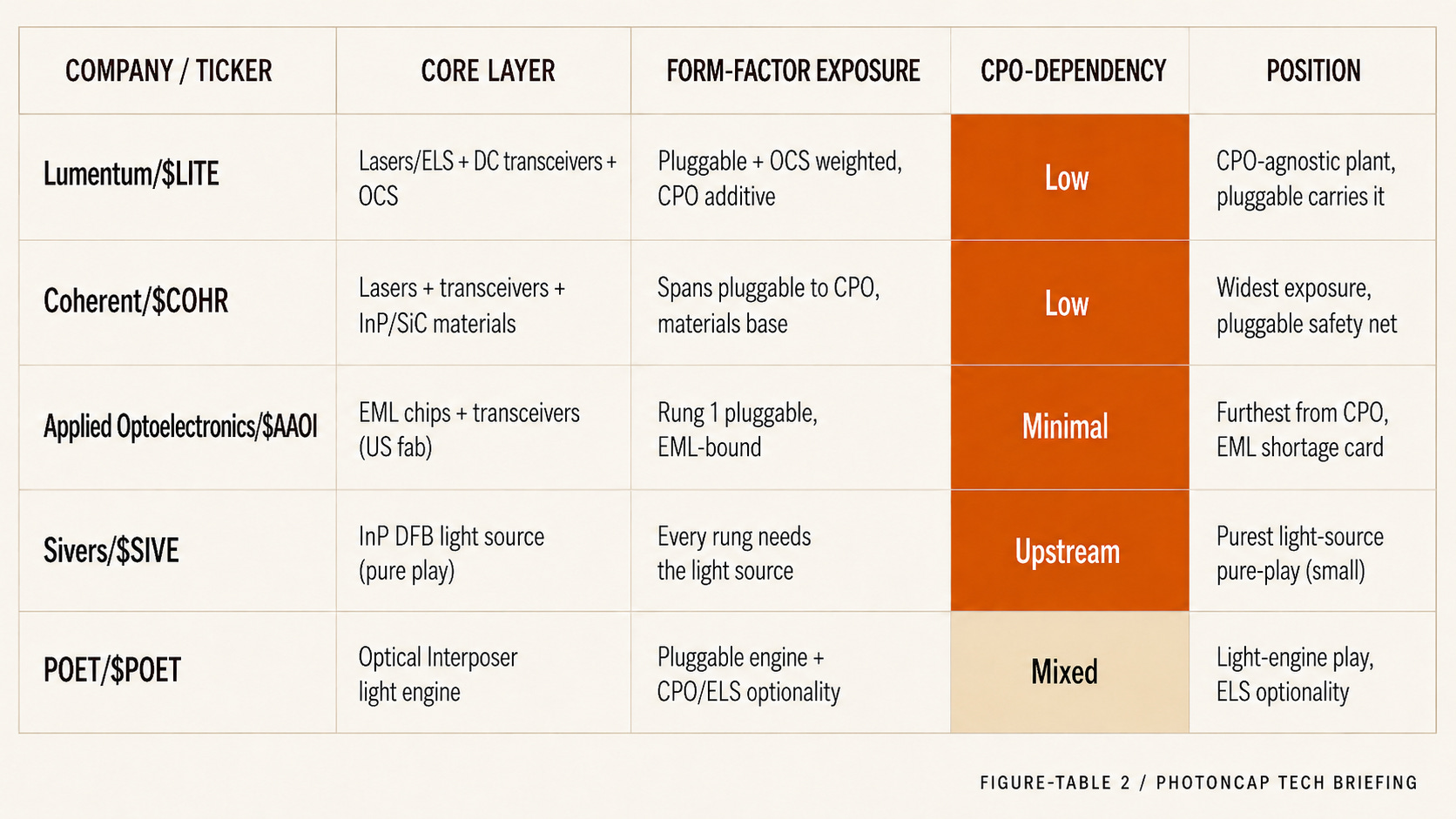
[Figure-Table 2: Light source company map. Lumentum / Coherent / AAOI / Sivers / POET across core layer, form-factor exposure, CPO-dependency, position]
Lumentum ($LITE). Makes lasers, datacenter transceivers, and components. Q3 FY2026 revenue was $808.4M, up about 90% year over year [13]. OCS (optical circuit switch) and CPO are still early: in its prior earnings update, management disclosed an OCS backlog well beyond $400M and an incremental CPO order deliverable in the first half of calendar 2027 [14]. The thing to see: most of Lumentum’s revenue comes not from CPO but from pluggable lasers and OCS. CPO is additive, not the body. If CPO slips, ELS revenue defers by that much while pluggable laser demand carries the company. NVIDIA’s $2B investment in Lumentum in March was made for exactly this laser capacity [15].
Coherent ($COHR). On top of lasers and transceivers, it owns materials like InP and SiC vertically. Q3 FY2026 revenue was $1.80B, with the datacenter and communications segment growing 41% year over year and making up 75% of the revenue mix [16]. It is partnered with NVIDIA on CPO-related products, anchored by a high-power CW laser made on its 6-inch InP line in Sherman, with next-generation product revenue expected to ramp from 2027 [16]. Coherent spans light source, transceiver, materials, and fiber/connector at once, so its exposure is the widest. Even if CPO is late, pluggable and materials are the safety net.
Applied Optoelectronics ($AAOI). Makes EML (externally modulated laser) chips and transceivers, and is one of the few EML makers with US domestic production. Q1 2026 revenue $151.1M (up from $99.9M a year earlier, +51%), with datacenter up 154% to $81.4M on a first volume 800G shipment to a hyperscaler. It guided Q2 to $180M to $198M and signaled a larger ramp through the second half [17]. EML is a component bolted firmly to rung 1 (pluggable). It is effectively unrelated to the CPO schedule, and the longer the EML shortage runs, the more the US domestic-production card stands out. The fact that it fell hardest at 14% on June 9 and bounced hardest at +7% the next day is no accident. It is the rung furthest from CPO taking the biggest hit on CPO news, a textbook overshoot.
Sivers Semiconductors ($SIVE). Makes InP DFB lasers, that is, the light source itself, as a pure play. It co-develops a CPO/ELS light engine with POET Technologies [18]. The light source is the foundation that rungs 1, 2, 3, and 4 all need, but by scale that light-source layer is occupied far more by Lumentum (ELS and InP capacity) and Coherent (6-inch InP high-power CW). What sets Sivers apart is that its entire business is the light source, so it is the purest, and therefore smallest, pure-play exposure to that layer. Even if CPO is late, the light source demand itself does not vanish, and how much of that delay Sivers absorbs into pluggable or LPO needs customer and product confirmation. If CPO arrives early, ELS demand pulls forward. If it slips, the broader need for external light sources remains, though the exact revenue path depends on customer design wins.
So the four companies that fell as one bundle on June 9 stand in completely different places on the ladder. AAOI on rung 1, furthest from CPO. Sivers under every rung. Lumentum and Coherent as the plant spanning rungs 1 through 4. The companies truly high in CPO-dependency are not these four but the ones selling the CPO switch itself, Broadcom and NVIDIA. And those two barely moved on June 9.
Capital Votes on the Destination, Not the Quarter
Better than saying “photonics is a buy” is showing where the money went. Here is the capital that flowed into photonics in the second week of June, itemized. I will keep the figures separate rather than summing them.
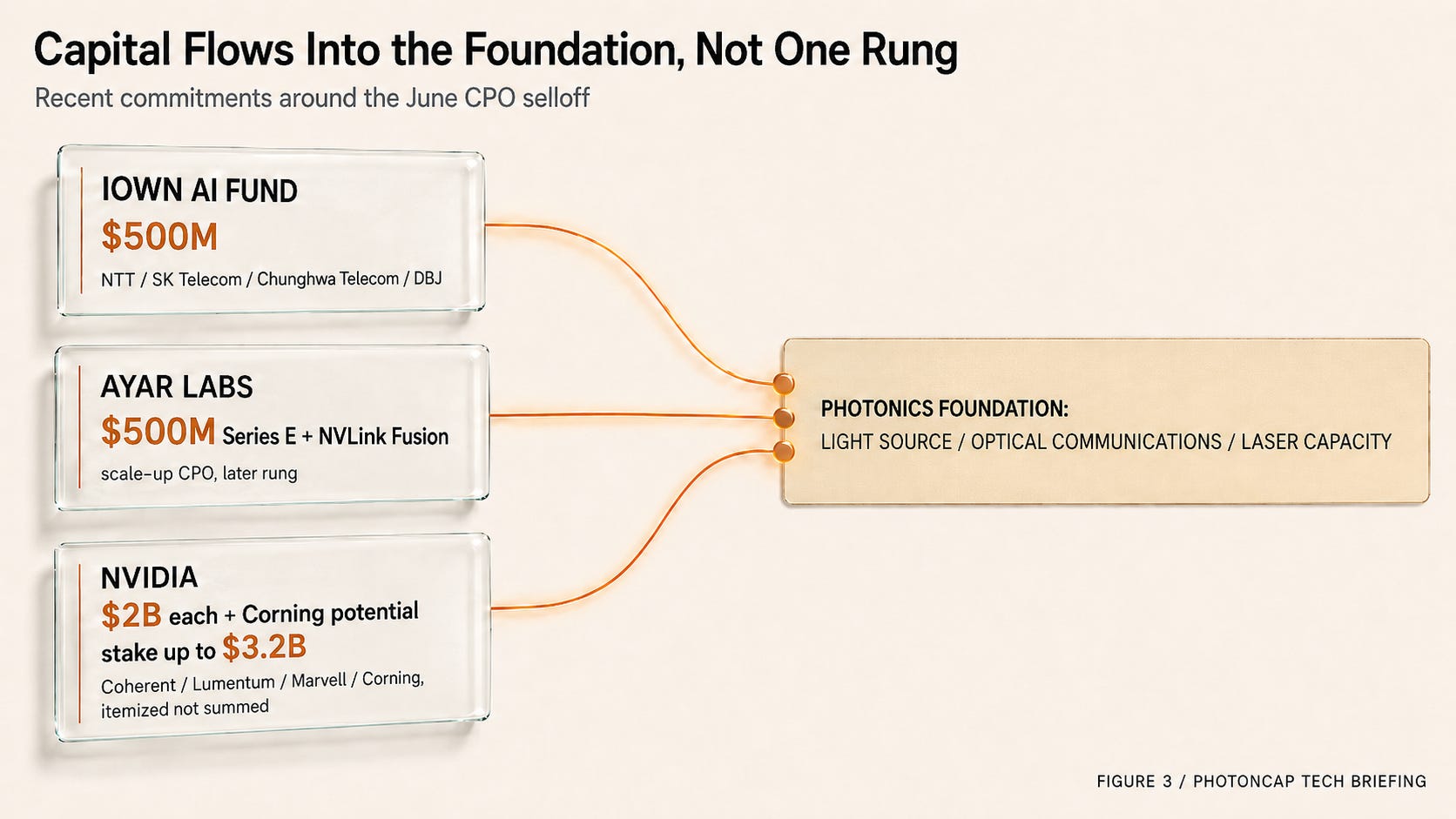
[Figure 3: Capital into photonics in the second week of June. IOWN Fund, Ayar Series E and NVLink, and NVIDIA’s four optical bets (COHR, LITE, MRVL, GLW) all converge on the shared foundation, not one rung]
IOWN AI Fund: $500M. Announced June 10 in Tokyo by NTT, SK Telecom, Chunghwa Telecom, and DBJ [4][6]. Per Yomiuri reporting, the initial plan was about 70 billion yen (about $440M) [5], firming to $500M (about 760 billion won) in the formal announcement [4]. The management company Catalight Capital is set up in Silicon Valley and East Asia, about 20 firms including Sony and Toshiba expressed interest as investors, and SK Hynix is on the list of interested investors [4]. The investment targets explicitly list “photonics-electronics convergence,” “Light Source and Modulators,” and “optical communications” [5][6]. IOWN is NTT’s 2019 concept of carrying data with light instead of electricity inside chips and across networks [5]. Telecom carriers and financial capital built a new fund treating “light” as the core of next-generation infrastructure. The timing happened to be the same week as the CPO selloff.
Ayar Labs: NVLink Fusion + $500M Series E. On June 3, the CPO pure play Ayar Labs joined NVIDIA’s NVLink Fusion ecosystem, making its products compatible with NVIDIA optics and SerDes to bring CPO into scale-up [19]. The announcement sits on top of a $500M Series E that NVIDIA participated in [19]. What stands out is that Ayar is going after scale-up. As we saw, scale-up is where copper runs longer for now. So Ayar’s bet is the furthest-out and hardest hand, which is itself evidence that photonics’ time axis sits not tomorrow but further out.
NVIDIA’s optical bets, now four. In early March, NVIDIA invested about $2B each into Coherent, Lumentum, and Marvell (Lumentum confirmed via NVIDIA newsroom) [15], and in May it added Corning on the fiber side. With Corning, through a multiyear commercial and technology partnership, Corning will grow its US optical connectivity capacity 10x and its fiber production by more than 50% [20], while NVIDIA’s stake is structured as an initial $500M plus warrants (15M common shares at a $180 strike) that, if fully exercised, would reach up to about $3.2B [21][22]. I covered all four together in this piece, and the Marvell bet on its own, from the interconnect angle, in this one. The meaning of the four reduces to one line: light source (COHR, LITE), interconnect (MRVL), fiber (GLW). All of it flows not into one CPO form factor but into the shared foundation under the ladder itself.
The three capital sources (the IOWN fund, Ayar, NVIDIA) share an obvious trait. All flowed not into one rung but into the foundation beneath: light source, optical communications, fiber, laser capacity. While the market fights quarter by quarter over whether CPO lands in 2026 or 2028, strategic capital is betting on a longer horizon: that light eventually replaces copper.
Selloffs trade the quarter. Strategic capital trades the destination. In the second week of June, the two moved in exactly opposite directions.
Copper Runs Longer. That Is Not a Bear Case.
To avoid confusion, let me be clear. The CPO skeptics are not without a point. Looking at packaging complexity, yield, test, and chiplet ecosystem maturity, it is entirely realistic that large-scale CPO volume runs later than the market expected in 2025. And in scale-up, copper will hold on longer than people think.
But those two things do not make a photonics bear case. The reason is in the ladder.
When CPO is late, LPO and pluggable buy that time. Both are photonics that use light source and fiber. When copper holds longer in scale-up, scale-out going optical proceeds longer and more gradually, not as one abrupt switch but across a long bridge, with NPO and LPO each generating revenue as midpoints. An attempt like Ayar’s to push CPO even into scale-up is a bet on the latest rung, which means not the end of photonics but a longer runway for it.
One sizing estimate to add: some see the CPO market going from $70M in 2024 to $8B in 2030 (estimate). That is over 120% annual growth, and the point is this curve still starts near zero. A curve starting from zero does not collapse on a single quarter. It just slips in time.
Scenarios and Monitoring
Qualitative scenarios at the sector level. No price targets on individual names.
Base. Scale-out going optical proceeds gradually, large-scale CPO volume defers to 2027 to 2028, and LPO, pluggable, and OCS carry revenue in between. Demand for the light source, fiber, and materials layer continues regardless of the form-factor transition.
Alternative. CPO volume lands sooner than the market expects (for instance, early adoption by a specific hyperscaler), and ELS demand pulls forward. In this case Lumentum and Coherent’s high-power CW/ELS revenue accelerates, and the pure light-source plays (Sivers, POET) see direct benefit.
Downside. AI capex itself slows, or copper (or LPO) dominates far longer than expected, delaying the optical transition. Even here, it is “transition delay,” not “demand disappearance.” Transceiver and OCS demand holds as long as AI traffic grows.
I narrow the monitoring points to five. First, the timing of hyperscaler CPO adoption disclosures (NVIDIA, Broadcom, Marvell switches). Second, LPO standardization and interoperability progress (this governs how much further CPO slips). Third, whether the EML shortage clears and the resulting utilization of AAOI’s US capacity. Fourth, the pace of OCS backlog converting to revenue (Lumentum’s per-quarter target). Fifth, which startups strategic capital like the IOWN AI Fund actually flows into.
Closing: Look Far, Not at Tomorrow
June 9 and 10 were days when the same names fell double digits and bounced back within a day. On days like that, price carries almost no information. What it carries is fear and relief trading places.
The real information is in the ladder. Photonics is a four-rung ladder, CPO is the top rung, and the light source, substrate, and fiber beneath are stepped on by all four. Selling the foundation on news that one rung’s volume is late is like dumping a stake in the power plant because the recessed fixtures are behind schedule.
And in the same week, telecom carriers and financial capital put fresh money into exactly that power plant. They traded not the next quarter but the next decade.
Copper clearly runs longer. But “runs longer” and “wins” are different statements. As traffic grows, copper hits the wall of distance and power, and beyond that wall is light. Trading whether the pace of light replacing copper is a quarter late or early is fine. Selling the direction itself is the mistake to avoid.
If you watched this selloff without knowing the optical architecture, what to sell and what to hold would have looked inverted. Once you have drawn the ladder once, you will not repeat the same mistake at the next selloff. That is the purpose of this piece.
References & Sources
[1] Seeking Alpha, “Applied Optoelectronics Leads Networking Stocks Down Following Report on CPO Rollout Delay”, Jun 2026.
[2] GuruFocus, “Applied Optoelectronics (AAOI) Shares Drop 14% Amid Bearish Report”, Jun 2026.
[3] 24/7 Wall St., “Applied Optoelectronics Jumps 7%, Lumentum Climbs 5%, Coherent Rises 2% as Optics Stocks Ride the AI Boom”, Jun 2026.
[4] BusinessKorea, “SKT, NTT Launch $500 Million AI Fund”, Jun 2026.
[5] UPI / Asia Today, “NTT, SK Group plan $440M AI optical network fund”, Jun 2026.
[6] TechNode Global, “NTT, SK, Chunghwa Telecom, DBJ team up for $500M AI fund”, Jun 2026.
[7] Flexoptix, “Introducing Linear Pluggable Optics (LPO)”, 2026.
[9] NVIDIA, “DGX GB200 Rack Scale Systems User Guide: Hardware (NVLink passive copper cable backplane)”, 2026.
[8] SemiAnalysis, “Nvidia’s Optical Boogeyman: NVL72, InfiniBand Scale Out, 800G and 1.6T Ramp”, 2025.
[10] MaxLinear, “MaxLinear Unveils Annapurna 224G Scale-Up Retimer to Extend Copper Connectivity in AI Data Centers”, Mar 2026.
[11] Credo, “Credo Expands AEC Active Electrical Cable Family with Second Generation HiWire LP SPAN AEC”, 2021.
[12] Molex, “Active Electrical Cable Solutions (AEC, 112G and 224G, up to 7 meters)”, 2026.
[13] Lumentum Holdings, “Lumentum Announces Third Quarter of Fiscal Year 2026 Financial Results”, May 2026.
[14] Lumentum Holdings, “Form 8-K, Second Quarter Fiscal 2026 Results (Exhibit 99.1: OCS backlog well beyond $400M; incremental CPO order deliverable in first half calendar 2027)”, Feb 2026.
[15] NVIDIA Newsroom, “NVIDIA Announces Strategic Partnership With Lumentum to Develop State-of-the-Art Optics Technology”, Mar 2026.
[16] Coherent Corp., “Form 8-K, Third Quarter Fiscal 2026 Results (Exhibit 99.2: revenue $1.80B, Datacenter & Communications 75% of mix, +41% YoY)”, May 2026.
[17] Applied Optoelectronics, “Applied Optoelectronics Reports First Quarter 2026 Results”, May 2026.
[18] Sivers Semiconductors, “Sivers Semiconductors Partners With POET Technologies”, Nov 2025.
[19] HPCwire, “Ayar Labs Joins NVIDIA NVLink Fusion Ecosystem to Bring Co-Packaged Optics to AI Factories”, Jun 2026.
[20] Corning Incorporated, “NVIDIA and Corning Announce Long-Term Partnership To Strengthen U.S. Manufacturing for AI Infrastructure”, May 2026.
[21] Corning Incorporated, “Form 8-K: NVIDIA Warrant Agreement (15M shares at $180, $500M aggregate)”, May 2026.
[22] Reuters, “Nvidia funds construction of Corning plants, in addition to equity investment (stake of up to $3.2B)”, May 2026.
Disclaimer: This article is an independent, engineering-driven technical analysis published by PhotonCap. All content is based on publicly available information and is intended for educational and informational purposes only. Nothing herein constitutes a recommendation to buy, sell, or hold any security. The author may hold positions in securities discussed and may transact at any time without notice. Readers should conduct their own due diligence before making any investment decisions.
Great article. Loved the structure of this piece. Analogy, details, how it relates to investing, then connecting to specific companies. 👌🏽
Thank you for another great article. I would love to hear your thoughts on microled technology and if it has the potential to disrupt lasers. Avicena is farthest along with backing from big players and since CPO is possibly delayed, does this open a door for replacing lasers with microleds?