
At the afternoon roundtable of SK hynix’s Global Forum, held in the US on September 18, two questions from the audience were really about the same thing. One asked whether a bigger role for Indiana might shake the company’s relationships with its foundry partners and customers. The other was blunter. At last year’s forum the company had said it wouldn’t do logic because the TSMC ecosystem works well, so had things gone bad with TSMC, and was that why it was turning to in-house work?
Both answers went the same way. The point was that Samsung and Intel overlap with TSMC in their core business while SK hynix doesn’t, and that this is what makes it a good partner. The speaker said the company won’t go where it would overlap with TSMC, and has no plan to become a foundry just because its base dies are doing well. On the Indiana question, the speaker answered that the company doesn’t have the capability to do it right now, that it’s preparing step by step, and that you need the technology before you can even negotiate.
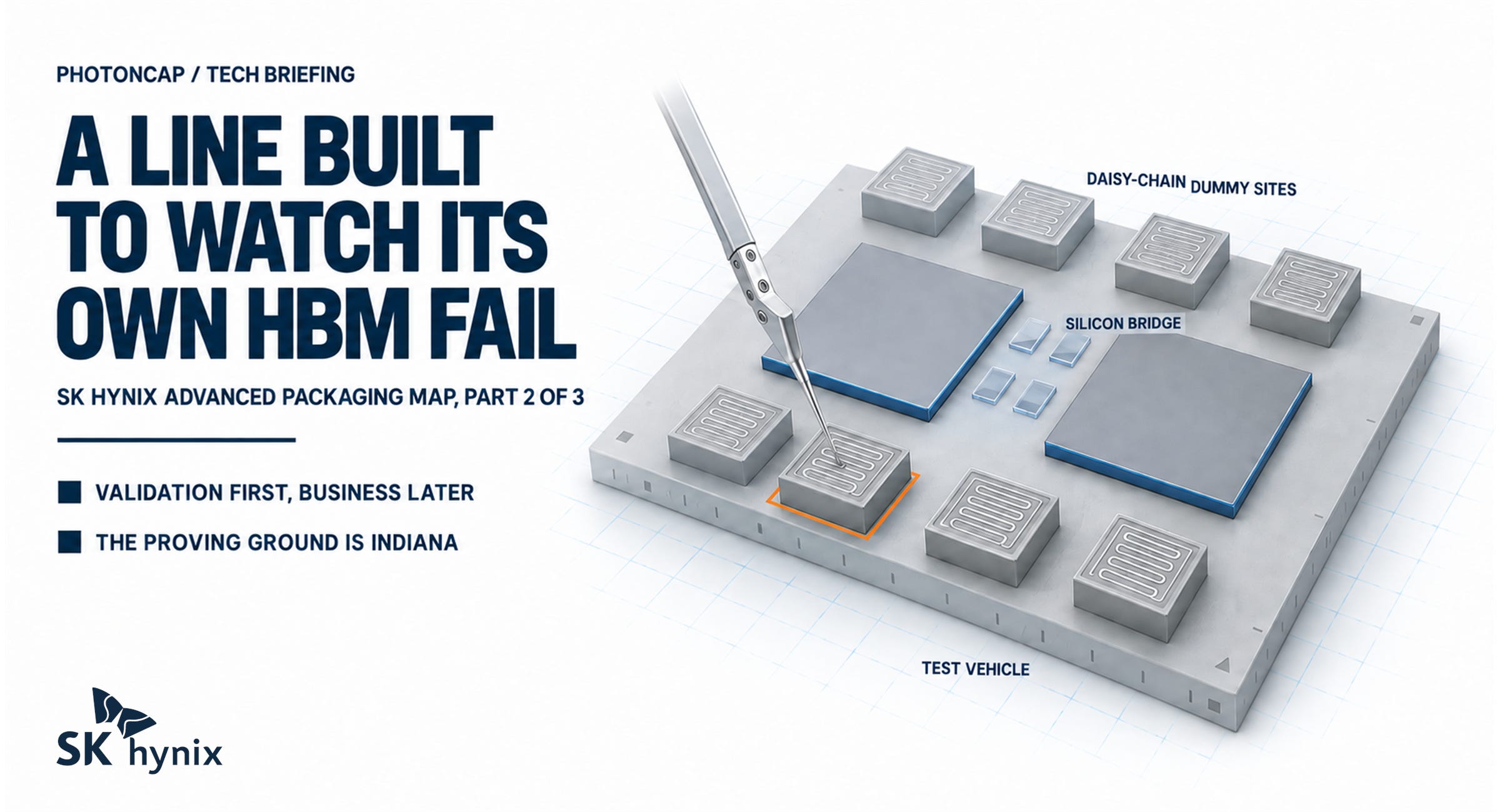
Those questions came up because, early in the roundtable, the speaker had said the company has been preparing a CoWoS-L class 2.5D package for two years. Last week, in [Investment Map] 22 Listed Companies in the Hybrid Bonding Value Chain, I went through twenty-two companies in the hybrid bonding value chain. If hybrid bonding is about stacking chips upward, 2.5D is about spreading them out sideways. Let me give you the conclusion first. For now, the line’s purpose is to find out firsthand under what conditions the company’s HBM fails inside customers’ packages, and the place to do that work is the R&D testbed in Indiana. That’s the answer I heard. Commercialization comes after that.
Contents
What I Heard and What I Checked
Where Part 1 Left Off
What Has Been Built So Far
Why Build It: Two Purposes
The Weight of Yield, and Shift-Left
The Work That Overlaps with Indiana
Closing
References
1. What I Heard and What I Checked
The event was an invitation-only session that doubled as recruiting, so I didn’t get the slides. That’s why every number and fact in this piece that carries a source number was checked against public material, and anything I only heard in the room is flagged as such. A good part of the talk overlaps with the slides an executive from the same company presented publicly at Hot Chips 2026 on August 23, so the broad outline can be checked against that public presentation [1].
The audience questions ended up focused on the TSMC relationship, but there’s something to look at before that: how far the in-house 2.5D has actually come, and why it’s being built. The idea that the relationship had gone bad was the questioner’s guess. The company never said so.
2. Where Part 1 Left Off
In Part 1, SK hynix’s Four Packaging Paths: Where Is the Fight After HBM?, I laid out four paths in advanced packaging, filed silicon bridges and 2.5D under Path 4, drew the map and left the rest for later. In August 2024 the company’s vice president in charge of packaging development was reported to have said in a lecture that the silicon interposer underneath 2.5D was close to a “chicken rib,” something of little use yet hard to throw away [2]. In December 2025 came a report that the company was pushing to build its first 2.5D production line in the US, and the company’s response was that nothing specific had been decided [3]. In May this year a Korean outlet reported that it was pursuing 2.5D packaging cooperation using Intel’s EMIB (Intel’s approach of burying a small silicon bridge in the package substrate to connect chips) [4], and the word 2.5D doesn’t appear even once in the official groundbreaking release of August 28 [5]. That release introduced the Indiana fab as an HBM production line plus an advanced packaging R&D testbed.
But at this roundtable, what came out was that the company has been preparing its in-house 2.5D for two years and that the Indiana fab will take the technology first. Going by public material alone, this is a company that called the interposer a chicken rib, said nothing had been decided about a US 2.5D line, and left 2.5D out of its groundbreaking release. Meanwhile, behind the scenes, it had been building a test vehicle, and this time the specs came out in some detail.
