
TL;DR
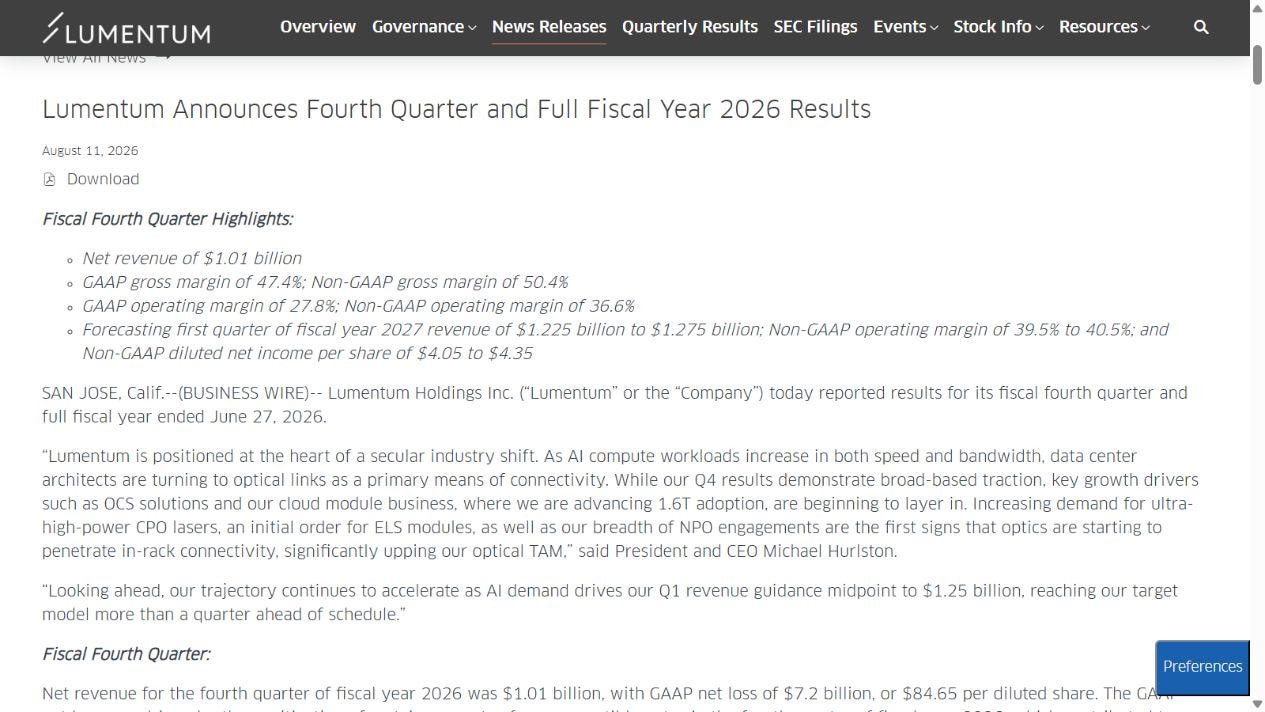
Lumentum’s FQ4 2026 revenue, announced after the market close on August 11, came in at $1,006.3M. Quarterly revenue crossed $1B for the first time, up 24.5% from the prior quarter and a striking 109.3% from a year ago [1].
The same quarter shows a GAAP net loss of $7.2B, but the source of this loss sits outside operations. The cause is a one-time, non-cash accounting loss of $7.8B from converting convertible notes into stock, and I walk through it in the body [1][2].
Non-GAAP operating margin of 36.6%. While revenue doubled, operating margin rose 2,160bps year over year. Next quarter’s guidance calls for $1.25B revenue at the midpoint and a 39.5-40.5% operating margin, arriving at the target model the company laid out at OFC more than a quarter early [1][2].
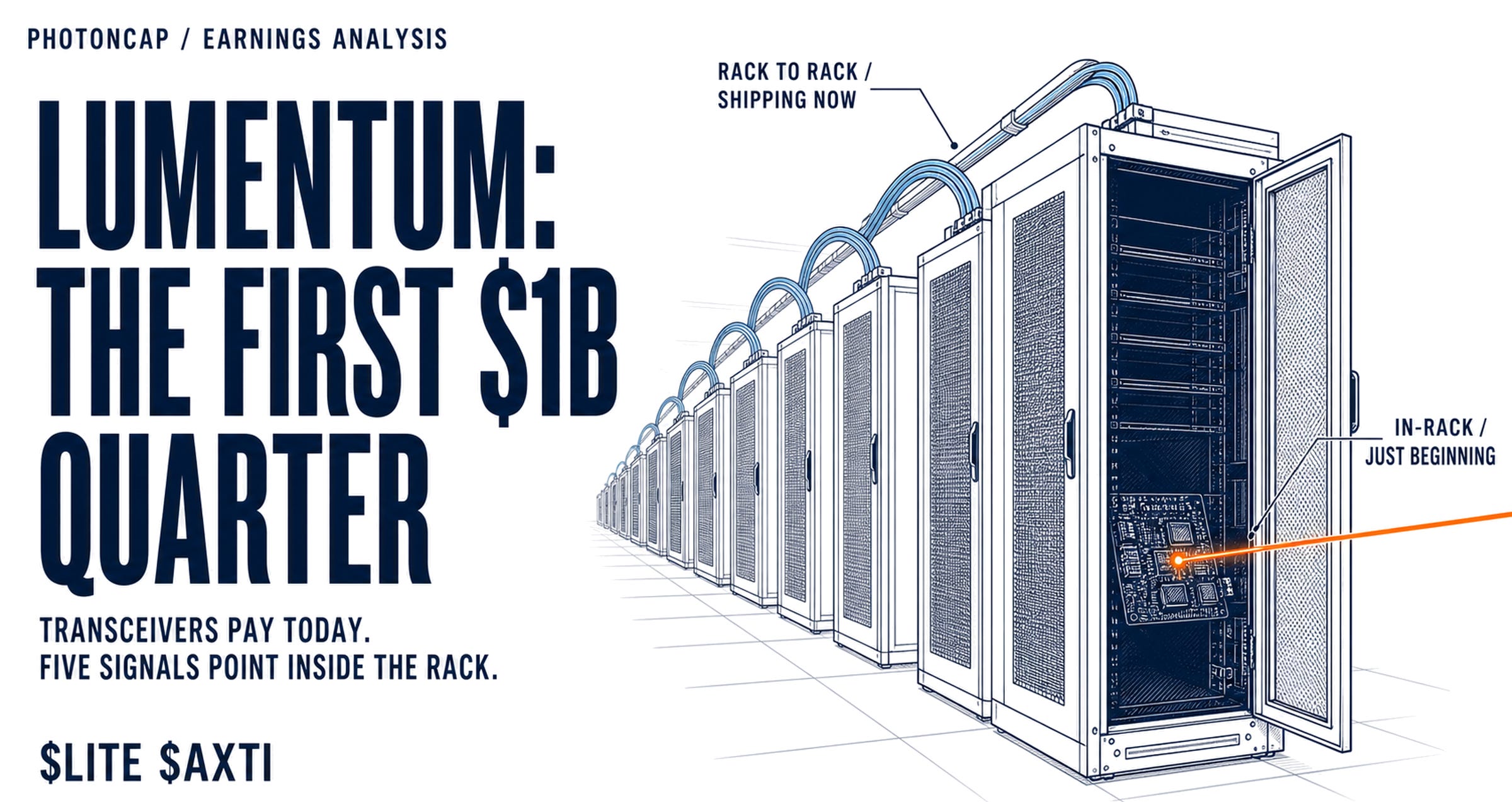
Here is my lead. I think the real news this quarter is less the revenue figure and more the five signals mentioned alongside transceivers. What those signals are, and why they change the very size of the market Lumentum can address, is laid out in the body.
Contents
August 11, the First $1B Quarter
What the $7.2B Loss Really Is
Where These Orders Come From
Segment Breakdown: Both Sides Ran Together
Five Signals: Optics Moving Into the Rack
Guidance Check: What a 40% Operating Margin Implies
Prior-Call Review: The AXT LTA and the Supply Gap
Conclusion: These Dates Will Decide
1. August 11, the First $1B Quarter
Lumentum reported FQ4 2026 results (quarter ended June 27) after the market close on August 11. Revenue was $1,006.3M, up 24.5% QoQ and up 109.3% YoY [1]. A year ago this company’s quarterly revenue was $480.7M, so revenue has more than doubled in four seasons.
You may wonder whether this growth is a one-off jump. Borrowing the language from the call, this is the eighth consecutive quarter of revenue growth, and counting only quarters with more than 20% sequential growth, it is the third in a row [2]. The comparison base keeps getting bigger, and the growth rate is holding anyway. Back in May I covered the $808M quarter in The 8 Companies Behind Lumentum’s $808M Quarter: Why Beta Splits by Orders of Magnitude Across the InP Cycle, and just one quarter later another $200M has been stacked on top. As a growth rate, that is an enormous number.
The profitability numbers actually catch my eye more. Non-GAAP gross margin came in at 50.4%, crossing 50% for the first time. The company reportedly planned to cross this threshold at around $2B in quarterly revenue, and it got there first at half that revenue [2]. Operating margin was 36.6%, an expansion of 440bps QoQ and 2,160bps YoY [1]. While revenue doubled, operating expenses stayed pinned at 13.7% of revenue [2], so this is a zone where added revenue drops almost straight through to profit. When operating leverage works the way the textbook says, this is the picture you get.
The stock reaction was, unexpectedly, on the calm side. The August 11 regular session closed at $820.59 (+0.87%), and after the release the stock was up around 2% after hours (as of 2026-08-11, including after hours) [3]. Market cap is $63.8B, and the 52-week range runs from $111.20 to $1,085.68, so even after printing these results the stock still sits more than 20% below its 52-week high [3]. As it happens, the optics-only ETF LYTE listed five days before these results [4], and LAZR had already arrived in late June [5]. I suppose that means the market’s eyes have reached this layer, enough for optics to become a standalone theme product.
But one of the headline numbers probably snagged your eye. A GAAP net loss of $7.2B. What does it mean that a $1B-revenue company lost more than $7B in a quarter?
2. What the $7.2B Loss Really Is
To put the conclusion first, this loss involved no cash leaving the company, and it does not mean the business rolled over. It is an accounting loss created by the stock rising sharply over the past year.
Here is what happened, in order. Lumentum had issued convertible notes some time ago. A convertible note is borrowed money, but in the form of a bond the holder can swap into stock at a preset price if they choose. Over the past year, with the stock up severalfold, the value of that conversion option grew. This quarter the company proactively converted a portion of these notes into stock (equitization), and as a result $1.1B of debt was erased from the books. That is about 35% of the convertible notes that were outstanding [2].
Here is why an accounting loss shows up.
On the books this debt is recorded at the amount borrowed, but the market value of the shares handed over in repayment is far larger, by as much as the stock has risen. Accounting books that difference as a loss on debt extinguishment. This quarter that amount was $7.8B, which is how the $7.2B GAAP net loss came about [1][2].

As a rough analogy, it is like borrowing the price of rice while promising “you can take our field as repayment,” and in the meantime the field’s value has gone up severalfold. The moment you repay with the field, a big loss prints on the books, but the cause of that loss is the field’s value, that is, the company’s value, having risen in the first place. So I read this $7.2B as closer to a footnote than a worry. Actual quarterly profitability is told by the non-GAAP side: net income of $326.3M, or $3.23 per share [1].
There is one thing to add. Since debt was swapped into stock, dilution for existing shareholders is real, and unlike the one-time accounting number, it stays. That said, interest-bearing debt did shrink, so I lean toward seeing this as a sensible trade: cleaning up debt while the stock is high.
3. Where These Orders Come From
So where does the demand that doubled revenue come from?
The starting point is hyperscaler spending. I covered the capex upgrade trend confirmed in the big four’s late-July results in The GPU Repricing Cycle and Q2 Hyperscaler Earnings: Which Hardware Layer the Capex Flows To, and when that money goes into a data center, a network linking the GPUs to each other always goes in right beside them, and the physical layer of that network is optics. The transceivers that turn the signals running between GPUs and switches into light and carry them, the InP laser chips inside them that make that light, and the pump lasers in the long-haul links connecting data centers to each other: as it happens, all of it is on this company’s product list.
One anecdote from this call captures the scale of this demand well.
For one major hyperscaler, the network capacity connecting two AI data center sites is reportedly double the entire global backbone that company laid over the past decade [2]. A line connecting ‘just two sites.’ The picture is training and inference splitting across multiple sites and inter-site traffic growing, and thanks to that, pump lasers for long-haul links are effectively sold out even after shipments grew more than 80% year over year, and the company plans to quadruple shipments over the next several quarters [2].
I actually found this part interesting and mentioned it in the subscriber-only chat as one of the seven things I was watching.
This flow itself is not a new story. In fact, together with Aurelion Research, I had already handed you a big hint. In July’s A Conversation with Lumentum, which recorded a conversation with Lumentum IR, we had already heard that EML capacity was up eightfold in two and a half years and still could not keep up with demand, and these results are close to the first quarterly closing where those words print as numbers.
Reading the CEO comment, though, I get the impression that what the company really wants to emphasize is not the products selling today. The CEO paragraph of the press release strings together words that are probably a bit unfamiliar: OCS, 1.6T, ultra-high-power CPO lasers, a first ELS module order, and NPO. Five of them packed into one paragraph, and the concluding sentence is that “optics are starting to penetrate in-rack connectivity” [1].

Why is a company that sells transceivers talking about the inside of the rack? And why is the simultaneous appearance of these five words the real news of the quarter?
