
On August 14, the June 30 positions of two funds were disclosed on the same day. Leopold Aschenbrenner’s Situational Awareness had pulled off almost all of the roughly $8.4B in puts it carried through the end of March in a single quarter, and Gavin Baker’s Atreides went the other way and doubled its QQQ put contracts [1][2][3][4]. A month later, on July 29, semiconductor and optics names all bottomed together, and while the index fell a bit over 10% that day, SanDisk was down 55% and Astera Labs 48%. This piece is part two of the August 1 article, and it goes back to the SEC originals to see where each of them cut the AI infrastructure value chain and how each reads it. On Baker’s side I looked at one more thing. The speaker list for the TomorrowX Summit he co-hosts in Austin in November overlaps substantially with the top names in this 13F [5]. To put my lead up front, I think the part of Baker’s 13F actually worth reading is less the list of top holdings and more the stretch he did not touch.
Contents
Two 13F Filings Opened on August 14
Aschenbrenner’s June 30
Baker’s June 30
What the +1.73% Is
Splitting Interconnect Into Layers
Why Only Lumentum Was Dropped
What the Two Filings Share, and Cerebras at 10.7%
Baker’s TomorrowX Event
1. Two 13F Filings Opened on August 14
August 14 was the 13F deadline. The rule is that you file your holdings as of June 30 within 45 days, so every quarter the 13Fs of US institutions all open at once on this day. Berkshire came out that day, so did Druckenmiller, but the ones I looked at with interest were two.
The reasons being
AI and AI infrastructure and related tech stocks make up most of my brokerage
Memory, optics, semis, related names, a wide range of stocks that both 13Fs hold
I see these two as the two masters of the tech long. Leopold Aschenbrenner in particular is someone I think looks carefully at bottlenecks and invests by seeing straight through to those points, and he did it successfully. (Leaving the leverage aside, of course.) Everyone knows this, but he left OpenAI and set up Situational Awareness in 2024, and reportedly grew assets under management from around $200M at launch to tens of billions in two years.
Gavin Baker ran the Fidelity OTC fund for a long time before starting Atreides, and he keeps up an active presence in online communities, so these days he has exchanges with real depth with all sorts of tech industry experts, tech stock supporters and analysts. There’s an event that’s been getting a lot of promotion lately, where he co-hosts something called the TomorrowX Summit under his own name. It’s held in Austin in November, and looking at the speaker list, I get the sense there aren’t many tech longs who can pull semiconductor company CEOs together like that [5].
Part one on these two was written on August 1. In Compute Short, Memory Long: Aschenbrenner’s Unwind, Gavin Baker’s Hold I opened the March 31 filings and covered why compute sells expensive and memory sells cheap. When I wrote that piece, I was looking at why Leopold built his positions the way he did, and by coincidence Baker’s portfolio was also sitting on tech stocks in a fairly similar way, so I found it interesting to analyze.
This piece is the picture from the next quarter.
But the situation of these two has now split completely. Leopold is reported to have had his public equity book forcibly liquidated in July, and Baker is still riding high (there is no public data on the fund returns themselves, so this is just my impression). That said, people say Leopold blew up, but his year to date return is still above the average person’s. I thought his attempt was a bold and admirable challenge, but looking at it now with hindsight it was a reckless challenge, and it feels like he got brutally trampled.
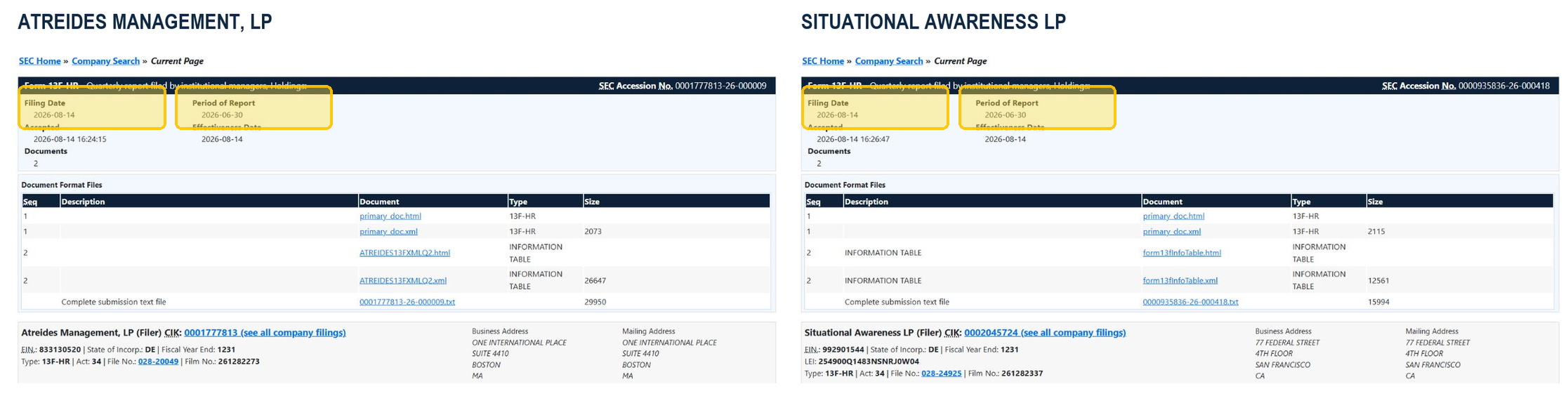
SEC EDGAR filing index for both funds, 2026-08-14
All the numbers were pulled directly from the info table originals posted at the SEC. The aggregator sites were still showing end of March data as the latest as of yesterday, so to check I downloaded and parsed the original XML, and that work took half a day. Thankfully the verification came out clean. The implied unit price you get by dividing reported value by share count matched the June 30 close for every name [6]. Micron $1,154.29, Ciena $490.56, QQQ $736.40. Which means the parsing was not wrong.
Let me draw one distinction up front. What a 13F shows is a slice cut out of the book. Only US listed equity longs and options appear, and shorts, non US assets, cash and private stakes all drop out. So when I talk about weights below they are all on a reported value basis, and the weight in the actual book could be smaller than this. That gap becomes the raw material of this piece in sections 4 and 7.
2. Aschenbrenner’s June 30
The thing that stood out most in the March 31 filing was the puts. Around $2.0B on the SMH semiconductor ETF, around $1.5B on NVIDIA, roughly $1B each on Oracle, Broadcom and AMD. Add Micron, TSMC, ASML, Intel and Corning on top of that and it comes to around $8.4B on an underlying market value basis [4]. It was a double structure, long memory and power with puts draped across semiconductors broadly.
Open the June 30 filing and this is gone.
The only put left is Infosys, and that one is around $5M [3]. Everything else disappeared, and Micron and TSMC flipped completely from puts to common. Nothing is public about what judgment happened in between. Someone who held 1.72M Micron puts in March holds 4.83M Micron common shares in June.
So what came in to fill that space. The answer is two memory names. SanDisk at around $5.7B and Micron at around $5.6B, together 55.6% of reported value. After that comes Bloom Energy at around $1.9B, TSMC at around $1.3B, Nebius at around $1.2B, then CoreWeave, Core Scientific, STMicro, Applied Digital, RIOT, IREN [3]. It’s a lineup that runs through power and neoclouds and bitcoin miners, and the big picture is the inputs to compute. It’s a layout that says buy electricity and memory and compute comes out.
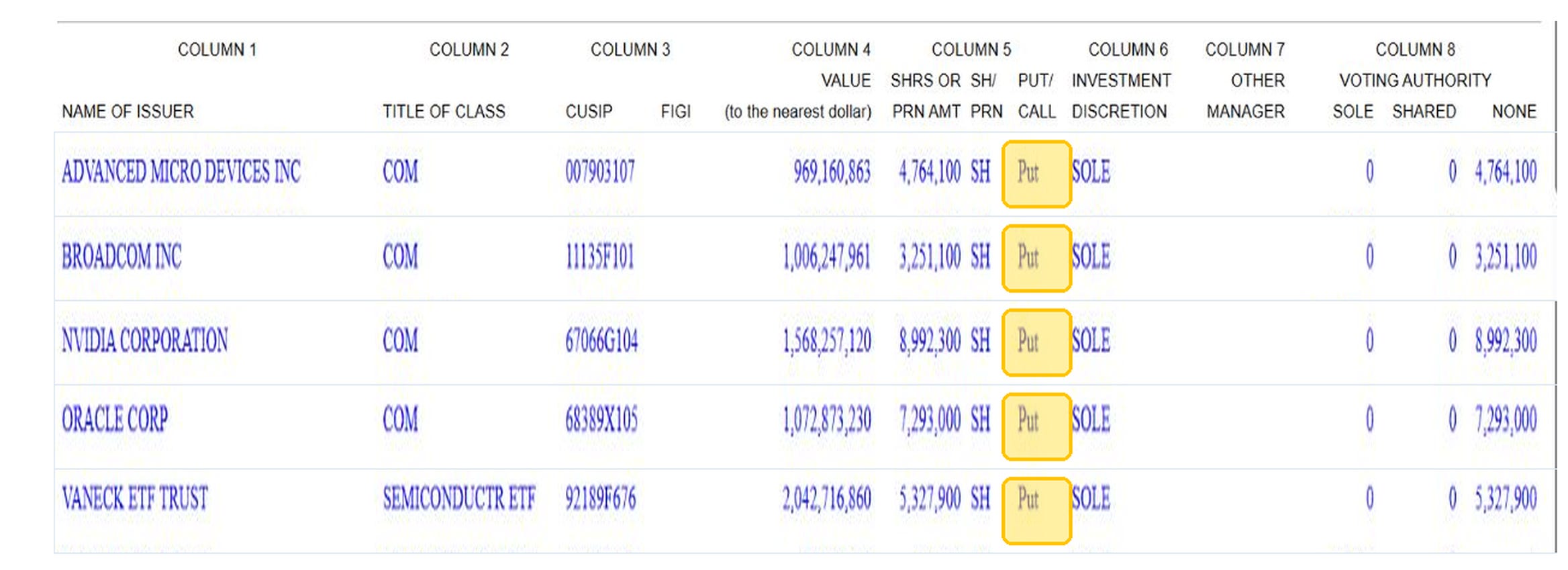
Situational Awareness Q1 2026 13F info table, put rows highlighted
The biggest empty seat in this filing is optics. There isn’t a single name. No coherent equipment, no transceivers, no optical DSP, not even connectors. It carries the same AI infrastructure fund label but the connection layer is completely empty. This comes back later as the biggest difference when we compare with Baker.
This picture is right before the liquidation. On June 30 he had all the hedges pulled off and 55% loaded into two names, and you all know what happened in July. It’s said to have been a forced liquidation.
3. Baker’s June 30
Atreides’ total reported value jumped from $5.0B at the end of March to $14.3B at the end of June [1][2]. The number of holdings actually went down, from 54 to 49. So what came in to make it grow like that. Yes, as you’ve probably guessed, SpaceX.
27.33M shares, around $4.6B, 32.6% of reported value. It’s the single largest position, and it is more than five times the gap to Micron, the second largest on a common stock basis [1].
I’ve held SpaceX myself since the IPO, and I’ve kept writing in support of the earnings analysis and the compute rental business. What I laid out in SpaceX’s First Earnings Report: Revisiting the S-1, and the Hardware Value Chain Behind 10GW is that story, and my view is that this company is closer to an AI company than a space company. I see it as an AI company wearing a space costume. I don’t think the reason Baker loaded 32% into it is the orbital launch business either.
The second largest is the QQQ put. Around $2.3B on 3.2M shares, 16.4% of reported value. He more than doubled it on a contract basis from 1.4M shares at the end of March [1][2].
This part is interesting, because in the second quarter QQQ went from $577 to $736, up a full 27.6% [6]. While the index was melting up like that, he doubled his index puts. One of them pulled every hedge off and the other doubled his hedge, and both of them are AI infrastructure bulls.
The rest of the top names are Micron at around $800M, Cerebras common at around $600M plus around $100M in calls, Meta calls at around $600M plus around $200M in common, Astera Labs at around $500M, Ciena at around $300M, Credo at around $300M, Coherent at around $200M [1].
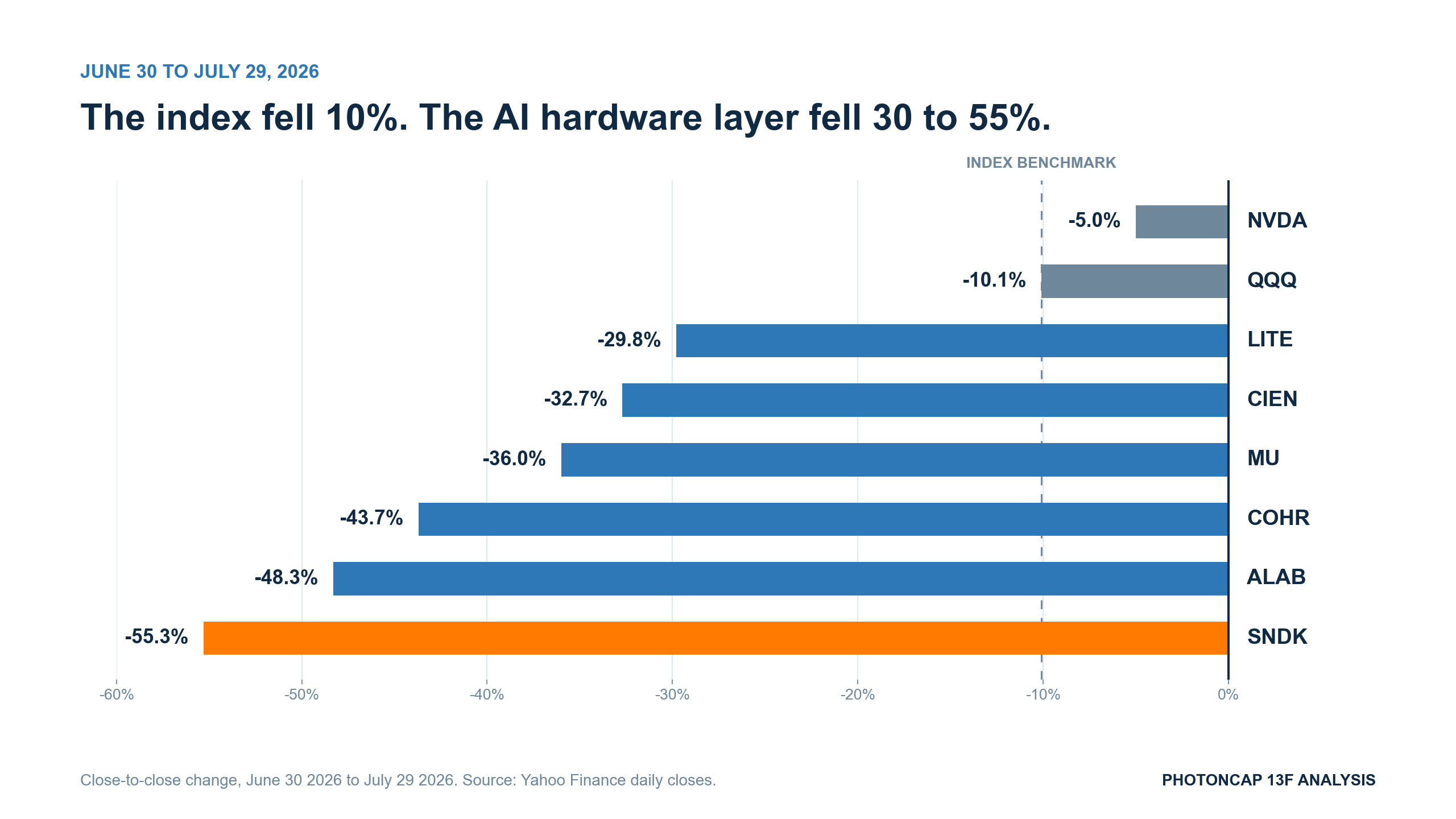
Layer by layer comparison of the July 29 trough drawdown. QQQ and NVDA against the AI hardware names
The lows clustered on July 29. Almost every name bottomed together that day, but the size of the drawdown was completely different by layer. Measured against the June 30 close, while QQQ fell 10.1% and NVIDIA 5.0%, SanDisk fell 55.3%, Astera Labs 48.3%, Bloom Energy 45.9%, and Coherent 43.7% [6].
At the time I was studying the representative coherent optics players in order to look into Scale-Across names, and the piece I wrote is exactly Down 40%, 40%, and 14% in Six Weeks from last July, and the moment of publication was the middle of this correction, with the actual bottom coming ten days after that piece.
Up to here is the range anyone can see by skimming public material. The top holdings list and the drawdown table go up on the aggregator sites within a day or two.
There is a separate reason I downloaded the original XML and calculated every share count delta. The share count increases for Ciena and Coherent and Nokia and Semtech were the same down to the second decimal place. What that means, and once you know it, is what separates judgment from plain drift in this 13F.
