
SpaceX, the name that ran so hot, has put out its first earnings since going public. Back in June I read the S-1 and wrote a piece breaking the company down layer by layer, and watching this release, I wanted to pull that piece back out and check it against what I had published. The first quarterly filing carries the judgments I had built on the IPO documents, and it is the first material that lets me check how well my thinking actually held up, so I thought it mattered. And if the 10GW compute outlook from this earnings call becomes real, I thought it also matters which side of data center investment we should be looking from. So this piece runs in two parts. The front half is the work of reviewing the judgments made at S-1 time against the first earnings, and in the back half I try to follow the feasibility of the 10GW outlook and the hardware layers that money will flow into. To note just the direction up front, I read this report less as a space company’s earnings and more as the first quarterly report of an AI infrastructure company, and I expect the benefit to arrive first not at SpaceX shareholders but at the ones receiving the parts orders, or the investors around them.
Contents
Quarterly Capex of $18.4B, With $15.8B Going to AI
Revisiting the S-1, Part 1: Connectivity, the ARPU Decline Has Stopped
Revisiting the S-1, Part 2: Space, Seven in Ten Launches Were Internal
Revisiting the S-1, Part 3: The AI Segment and the 90-Day Termination Call
Rereading the 90-Day Termination Clause: Weakness or Sales Condition
Is 10GW Real: Power, Money, Skepticism
The Hardware Bill: Power, Optics, and Scale-Across
Conclusion, and What Would Prove Me Wrong
1. Quarterly Capex of $18.4B, With $15.8B Going to AI
SpaceX’s capex this quarter was $18.4B, and the AI segment’s share of it was a whopping $15.8B [1]. That works out to 86%, and is that a high number or a low one, what would the answer be? Yes, as you probably guessed, it is quite high. A company that builds rockets and satellites put nearly nine tenths of its quarterly investment into AI data centers.
The August 4 release was the first earnings since the red-hot June 12 listing. Revenue came in at $7.8B, up 92% year over year, net loss narrowed to $541M, about half the level of a year ago, and Adjusted EBITDA was $3.5B [1]. Even with revenue beating estimates by nearly $1B, the stock reportedly slid around 8% after hours [2]. The capex caught the eye before the surprise did. It is the same reaction pattern as the four hyperscaler earnings in late July.
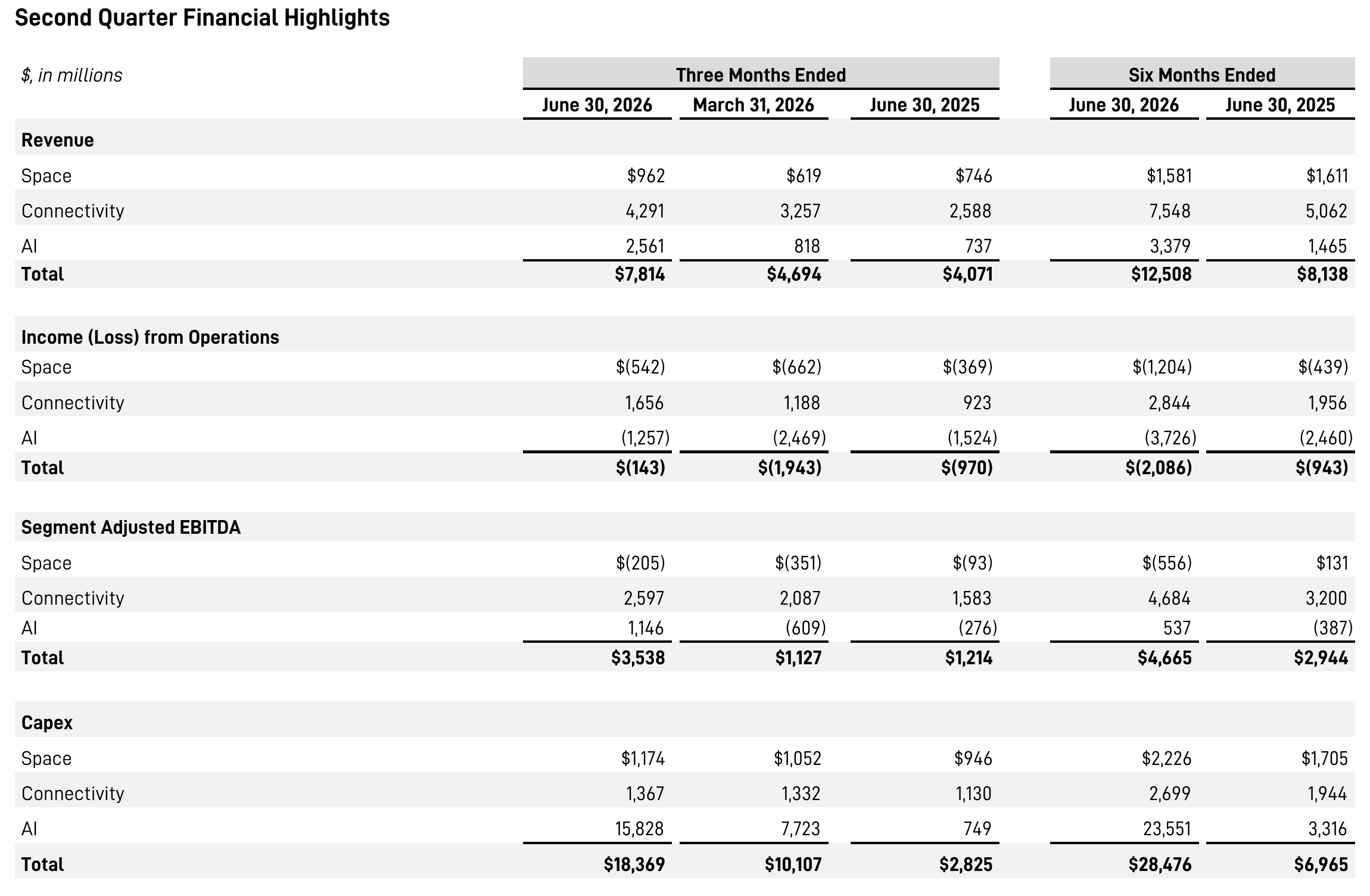
Segment results table from the SpaceX Q2 2026 press release
And on the call, Musk named the destination of that capex. Past 2GW of compute by the end of 2026, and by the end of 2027, to a level closer to 10GW than to 5GW [3]. This from a company at 1.4GW nameplate today [1].
There are two things I want to do in this piece today. One is to review the layer-by-layer judgments built on the S-1 in June’s The Largest IPO in History, One Profitable Layer: Where SpaceX Exposure Really Sits, and the Traps against the first earnings. The other is which hardware layer gets the attention if that 10GW number becomes real, or which one we should be paying attention to.
The Largest IPO in History, One Profitable Layer: Where SpaceX Exposure Really Sits, and the Traps

SpaceX, the largest IPO in history (ticker SPCX, targeting a June 12 Nasdaq debut at a $1.75T valuation), posted a loss in its most recent fiscal year. The analysis uses the S-1 as the primary source and starts from one observation: SpaceX’s extreme vertical integration makes the pool of “supplier beneficiaries” thinner than people assume. From there it splits the upside into four layers ranked by certainty. Two conclusions. The profit and the proof sit in Layer 1 (LEO connectivity, Connectivity revenue $11.4B, 61% of the company), and the AI revenue that anchors part of the $1.75T valuation comes from idle compute that rivals Anthropic ($1.25B/month) and Google ($920M/month) rent, with the Anthropic contract cancellable on 90 days’ notice and the Google contract carrying GPU delivery conditions plus a 90-day termination right after year-end 2026. So the liquid exposure is not direct supply to SpaceX. It sits in dual-use light source and DSP names ($COHR, $LITE, $MRVL), the OISL bottleneck ($RKLB, $CACI), and the AI infrastructure bottleneck (power, CPO, cooling, $NVDA).
2. Revisiting the S-1, Part 1: Connectivity, the ARPU Decline Has Stopped
In the June piece I classified Starlink as SpaceX’s only profitable engine, while also writing down as a risk the pricing pressure that had pushed ARPU from $99 to $81 on an annual basis, and down to $66 on a quarterly basis.
Layering the first earnings on top of that, it looks like this. Connectivity revenue was $4.3B, up 66% year over year, operating income $1.7B, up 79%, and subscribers doubled in a year to 12 million [1]. And ARPU held at $66, flat with the prior quarter [1]. There was reporting in May of an attempted price increase, and at least this quarter, the picture that came out was doubling subscribers while thankfully holding the unit price. There is also a side growing faster than consumer. Enterprise & Government revenue grew 108% year over year, and the filing also includes over $6B in multi-year US government contracts won through Starshield [1].
The result of a quick review is that I keep the judgment that the company still has its profitable engine. That said, the decline stopping and the price rising again are different stories. That it stopped at $66 is as far as this quarter’s facts go, and whether this price increase actually shows up in ARPU has to be checked precisely against next quarter’s numbers.
3. Revisiting the S-1, Part 2: Space, Seven in Ten Launches Were Internal
The S-1 contained the language that “to meet our orbital compute goals, we may prioritize our own payloads ahead of US government contracts or third-party customers” [4]. At the time I wrote, based on that language, that the upside for outside listed names in the launch layer was narrow. The first quarter’s numbers show that language in action. Of 38 launches in the quarter, 28 were internal, and of 485 metric tons put into orbit, nearly 400 tons were internal payloads [1]. More than seven in ten launches went to lifting its own satellites, that is, Starlink satellites.
Space revenue grew 29% year over year to $962M, yet the operating loss was $542M [1]. Starship R&D is booked at around $1.1B for the quarter. Flight 12 in May and Flight 13 in July hit their objectives back to back, and Flight 13 reportedly went as far as deploying 20 production V3 satellites [1], so the nature of this loss is closer to deployment speed than failure cost. There is nothing to change in the June judgment on the launch layer.
4. Revisiting the S-1, Part 3: The AI Segment and the 90-Day Termination Call
Now for the main part of this piece. In the June piece I attached a warning to the AI revenue line. The Anthropic contract at $1.25B a month and the Google contract at $920M a month sit at the center of the AI revenue story, but both can be ended on 90 days’ notice, so the headline contract sizes should not be taken at face value. That was the warning [4][5].
In the first earnings, AI revenue was $2.56B, 3.5x year over year. Of that, AI solutions & infrastructure was $2.19B, up more than 4x in a single quarter from $475M [1]. The Anthropic ramp was scheduled across May and June, so the timing lines up. Compute capacity stood at 1.4GW nameplate, up from 1.0GW the prior quarter [1].
But what caught my eye first in this filing was not the revenue number but a definition tucked into the back of the release. SpaceX announced the Cloud Services Agreements newly signed this quarter as $14.1B in contracted sales, and in Note 2 it spelled out how it counts that number. It does not count the full amount written into the contract, only the revenue from the period that cannot be cancelled [1]. Meaning that for a contract that can be ended on 90 days’ notice, even if three years of value is written on paper, only the non-cancellable first few months land in contracted sales. The $45B and $30B deal values the press quotes add up the entire contract term, while the number the company officially tallies counts only the locked-in piece. This is exactly the point I made in June. That as long as the 90-day clause is there, the headline totals should not be taken at face value. With this filing, the company effectively discounted the number that way itself.

Contracted sales definition language in Note 2 of the press release
Up to this point, you could say PhotonCap’s June call was more or less right. But there is a flipped half to this observation. That the 90-day clause may be, rather than a weakness, the very condition that makes this business sell so well. That is where we pick up below.
