
TL;DR
The government says it will catalyze 550 trillion KRW of private investment to build 8.4 GW by 2029, SK signed a 2 GW AI factory LOI with NVIDIA, and NAVER put out a 200 MW expansion plan for Sejong [1][2][3][4]. Every announcement names an accelerator and a memory company, but not one line says who supplies the optical interconnect that links rack to rack.
OE Solutions, a Korean listed transceiver maker, booked 57.38 billion KRW of revenue for fiscal 2025 with 283 employees. Coherent sold 7.12 billion dollars in the fiscal year ended June 2026 with 51,480 people [8]. That’s a 166x gap in revenue.
The Ministry of Science and ICT budgeted 3.85 trillion KRW for 140 Vera Rubin NVL72 racks next year. That’s 27.5 billion KRW per rack, against Bernstein’s rack cost estimate of 12.2 billion KRW. The government said it allowed for GPU price rises and facility costs, and NVIDIA said the configuration includes networking, cooling and storage, so a simple comparison doesn’t work [6][7].
Korean companies do hold 400G and 800G optical module supply contracts. But a supply contract, in-house production, and domestic sourcing of core parts are three different things, and whether Korea’s supply chain can carry the certification, capacity and component sourcing an AI factory of this scale requires isn’t something the public record confirms. There is one layer where a Korean company has done its own production and delivery, and it’s a layer that wasn’t on the SemiAnalysis map at all.
My base case is that the bill for this layer ends up with vendors outside Korea. But who takes each layer splits differently than you’d expect, and whether Korea ends up at the back of that line is still an open question.
Contents
The Layers SemiAnalysis Counted, and the One It Didn’t
The Plan in Practice: What the Announcements Say and What They Don’t
A Korean Supply Chain Audit: Who Is in the Optics Layer
27.5 Billion KRW per Rack, and What’s Inside It
Five Layers, Five Bills
Dispersed Sites and Scale-Across
The Cross Constraint from the FCC Draft
How Far Localization Has Actually Come
The Price of the Queue, and What to Watch to Judge It
1. The Layers SemiAnalysis Counted, and the One It Didn’t
The conclusion of the September 1 piece is in its title. Nvidia wins, Hynix loses [9]. Follow the body, though, and what’s actually argued is a bit different. It estimates 2027 HBM4 pricing at 3.0 to 3.3 dollars per Gb for Nvidia versus 3.7 to 4.1 dollars for other tier-one customers like AMD and Broadcom, and reads the discount as the price of priority GPU allocation for SK Group [9]. That’s less an Nvidia win than value moving from SK hynix’s income statement to SK Group’s data center business. It’s a transfer between affiliates, and more a governance story than a semiconductor story.
Up to there it’s a well built analysis. But the piece counts two layers. Accelerators and memory. Inside the rack it’s dense, outside the rack it’s empty.
I’ve run into the same shape before. On the SemiAnalysis piece about Meta’s data center map, I dug one layer down in One Layer Below SemiAnalysis’s Meta Map: Scale-Across Is Coherent, Not CPO, and what was missing then was the connectivity layer too. The same spot is empty this time.
If SemiAnalysis covered accelerators and memory, the question left is outside the rack. Unpack the 8.4 GW plan into procurement line items and the layers Korea can build split from the layers where it has to stand in a foreign queue.
2. The Plan in Practice: What the Announcements Say and What They Don’t
The government announcement came at a national briefing in late June. The structure isn’t direct fiscal spending but pulling in private investment: 550 trillion KRW to build 8.4 GW by 2029, then another 10 GW by 2035 for 18.4 GW and over 1,000 trillion KRW of investment drawn in [1]. The sites line up as SK Telecom targeting 2 GW plus across the Gyeongsang region starting from Ulsan, GS at 2.4 GW in Donghae, Gangwon, and NAVER aiming at 1 GW in Sejong [16][17][18].
One thing to flag. SemiAnalysis wrote the plan up as 919 billion dollars [9], but 1,000 trillion KRW at the September 7 rate of 1,341.88 works out to 745 billion dollars [8]. Back-solving gives 1,088 KRW, and it’s unclear which point in time that rate is from. The KRW figures are the primary ones, so this piece works mainly in KRW and quotes dollars alongside with the rate stated.
On July 24, SK Group and NVIDIA announced a partnership of more than 500 billion dollars. SK Telecom builds a 2 GW NVIDIA Vera Rubin DSX AI factory, the first unit runs in 2027, and it carries SK hynix HBM4 [3]. But the form on the document is an LOI. That means it isn’t a binding contract, so the amount shouldn’t be read as committed capex [3].
The NAVER side is a bit more specific. The plan starts at 55 MW in the first half of 2027 at the GAK Sejong data center, grows to 200 MW in 2028, and ultimately aims at 1 GW. The 200 MW stage was reported at roughly 100,000 GPUs, NVIDIA plans to invest 1 billion dollars in NAVER, with conditions attached including NAVER separately finalizing at least 9 billion dollars of committed financing, and Brookfield has signed a nonbinding term sheet to fund up to 9 billion dollars [4][5].
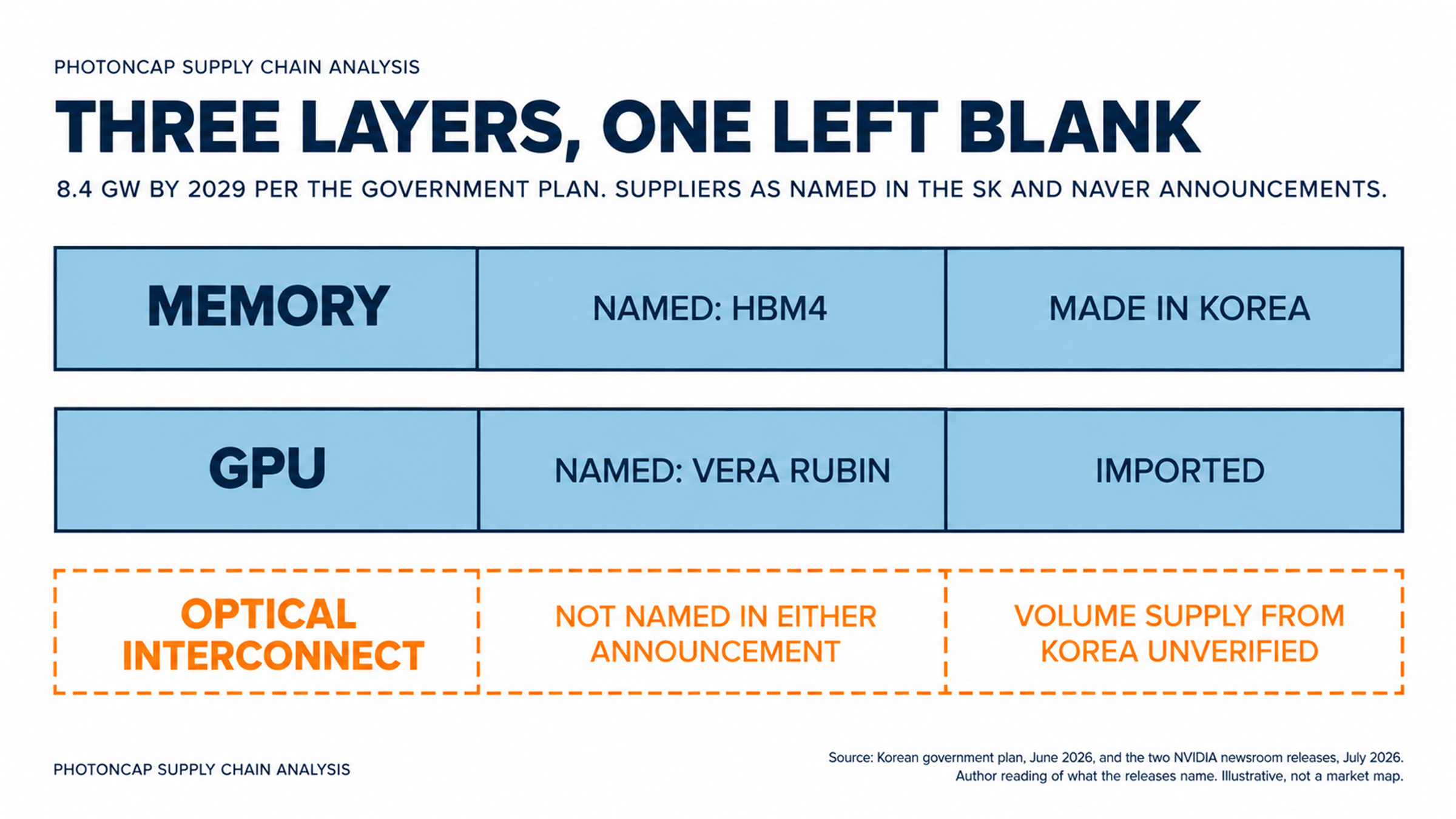
Korea’s AI data center plan by procurement layer, and which layers are made at home
Now let’s reread these announcements from a procurement angle. The accelerator is named: Vera Rubin. The memory is named: SK hynix HBM4. Power and land have named owners: SK, GS, NAVER. It’s a structure that names a supplier for each layer, and only the optical interconnect goes unnamed. The full text of the SK-NVIDIA release contains none of the words networking, transceiver, optics or CPO [3]. The NAVER release is the same [4].
Concluding from absence in a press release alone is a weak argument. Releases never list everything. What gives this absence meaning is the next section. A Korean supplier that could take that volume on a 2027 schedule doesn’t show up in the public record.
3. A Korean Supply Chain Audit: Who Is in the Optics Layer
The representative listed company in Korea whose core business is optical transceivers is OE Solutions (138080). Founded in Gwangju in 2003, it has developed its own transceivers and laser diodes.
For the fiscal year ended December 2025: revenue 57.38 billion KRW, net loss 27.04 billion KRW, 283 employees. At 21,400 KRW on September 7, the market cap is 251.9 billion KRW [8]. It’s up 125.5% over one year and 63.5% year to date, so the market is clearly treating it as an AI data center name [8].
Here’s the control group. Coherent sold 7.12 billion dollars in the fiscal year ended June 2026, with net income of 805 million dollars and 51,480 employees [8]. At the exchange rate that’s 9.554 trillion KRW, about 166 times OE Solutions’ revenue, and 182 times on headcount [8]. Lumentum is at 3.01 billion dollars and 13,760 people [8]. Turn to China and Innolight is number one with 21.2% of the global optical interconnect market on 2025 revenue as stated in its Hong Kong listing prospectus (market definition per the prospectus) [23]. On scale it overlaps head-on with Coherent.
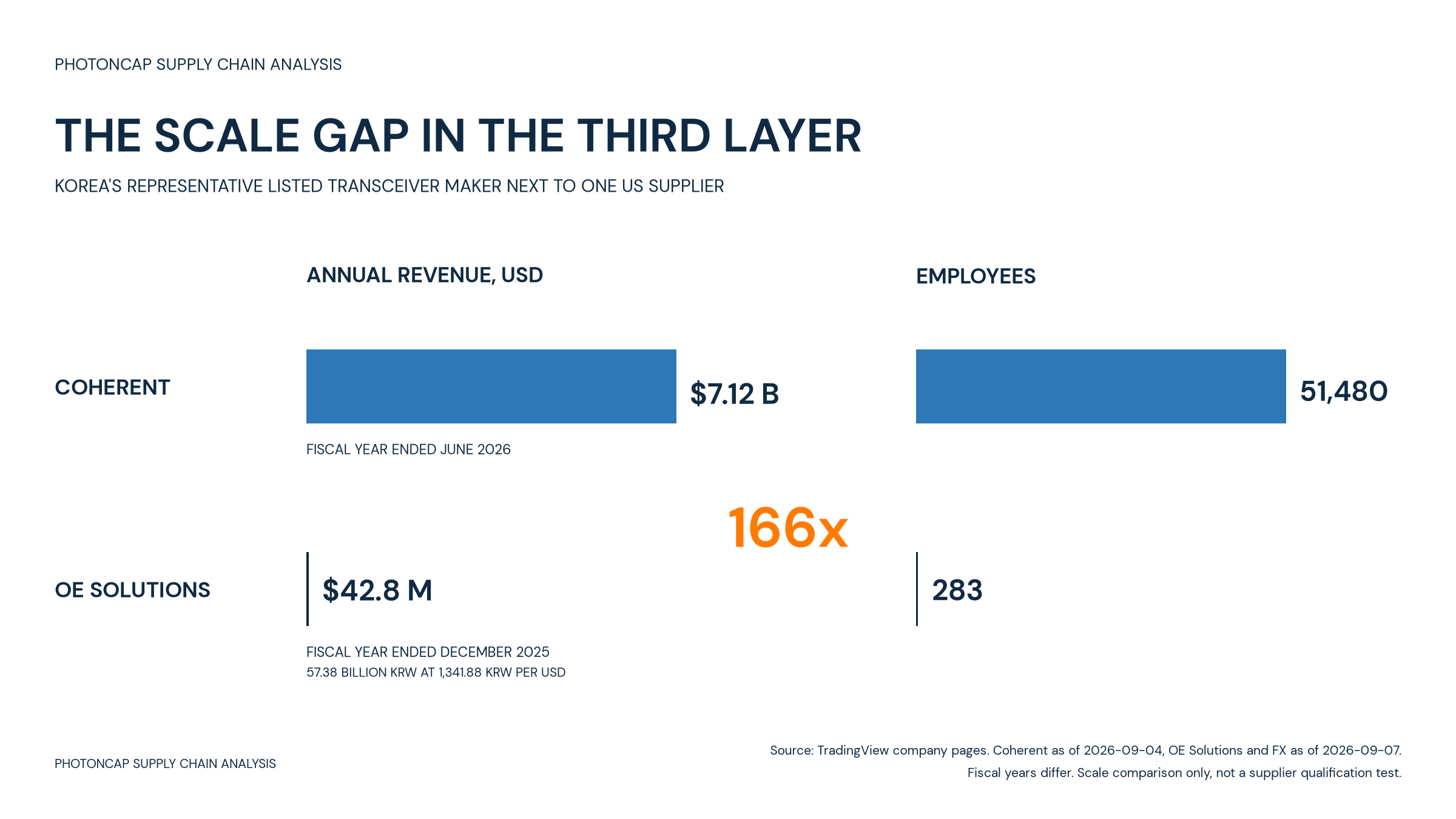
Revenue and headcount, OE Solutions versus Coherent
Put the numbers side by side and the feeling is a little strange. The optics supply chain standard-bearer of a country that says it will build 8.4 GW is a 283-person company with annual revenue in the 57 billion KRW range and a loss. It’s far below one quarter of one US company’s data center segment.
Of course, the comparison isn’t meant to run the company down. OE Solutions built its position on 10G and 25G telecom transceivers and has been widening the lineup toward datacom recently. It already has an AI product out. In March it announced a 23 dBm cooled ELSFP, an external laser source module for CPO, stated it was aimed at 1.6T scaling, and set sampling for the third quarter of 2026 [12]. So writing that Korea has no technology would be wrong. The issue is weight class, not whether the technology exists. And in an AI data center scale-out fabric, weight class can turn into a constraint on certification, capacity ramps and delivery response. Light sources alone are a market where TrendForce sees combined monthly capacity for EML and CW-DFB lasers at 50.7 million units in 2026 [22], so the units of certification and capacity are of a different order.
There’s one more Korean name. Opticore (380540) lists an 800G OSFP and a 1.6T OSFP for AI and high performance computing on its official product page, and between September 2025 and May 2026 it filed four supply contracts on DART for 400G and 800G AI data center optical transceivers. The amounts are 6.68, 6.01, 4.01 and 2.42 billion KRW, and the supply region is Korea in every case [28]. So current-generation optical module supply contracts held by a Korean company do exist. But read the filing tables and a different picture appears alongside. All four list the production method as in-house production not applicable, outsourced production applicable, and the counterparty was withheld as a trade secret and then disclosed only as a domestic server and peripheral supplier [28]. On top of that, the company has been suspended from trading since March 23, 2026 after its auditor refused an opinion on fiscal 2025, and it sits in delisting review with an improvement period granted [28]. So whether a Korean company is party to the supply contract, whether it makes the product in a Korean factory, and whether core parts like light sources and DSPs come from a Korean supply chain are three different questions, and this case answers yes only to the first.
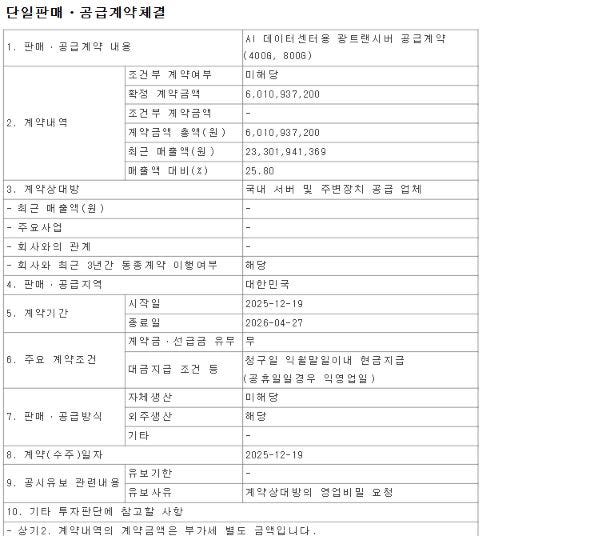
The production-method row in Opticore’s DART supply-contract filing
Light sources show the same picture. There is no Korean name on the top supplier list for AI data center EML and CW-DFB lasers [22]. OE Solutions’ ELSFP is Korea’s first attempt in this layer, and for DSPs and packet switch silicon I couldn’t find a Korean candidate in the public record.
So this is what Korea’s sovereign AI procurement stack looks like. Memory is domestic, accelerators are imported, and the layer that connects them has products but no scale. That third layer is the subject of this piece.
So who fills this gap? As you’ve probably guessed, American names come to mind first, but split the supply chain by layer and the answer doesn’t come out in one line. There’s a layer American companies take, a layer where China is hard to exclude, and one layer where a Korean company has already done production. And the two commitments NVIDIA locked in with Coherent and Lumentum this March show who grabbed capacity access first [14][15]. Whether that actually reaches Korea’s place in the procurement queue is still a hypothesis.
