
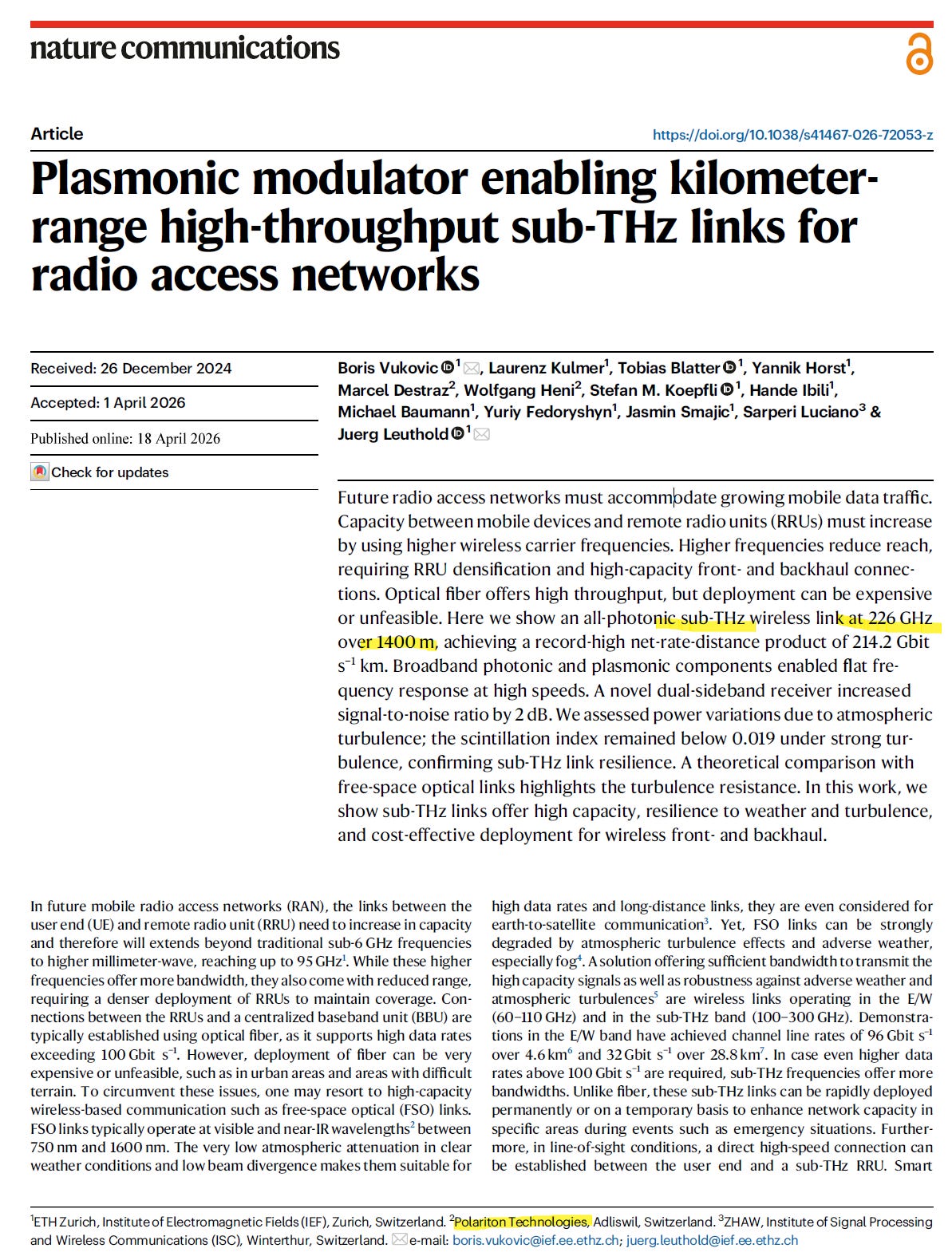
Somewhere on a Swiss airfield, two points 1.4 km apart were linked over a 226 GHz radio carrier. Net rate 153 Gb/s. The thing that caught that carrier at the receive end and put it back onto light was a plasmonic modulator. The paper is from ETH Zurich and Polariton, and the publication date is the interesting part: it ran four days before Marvell announced the acquisition. But a more important document came out two months later. The Polariton founders, now carrying Marvell business cards, wrote up the application range of this technology themselves. In that post, plasmonics sits on co-packaged optics inside the package and on coherent links between campuses, at the same time. The layers do not divide. They overlap. Which raises a question about the other optical platform this company bought four months earlier for more than three billion dollars. To say where I land before the paywall: I read this overlap as an internal contest that has not been settled yet rather than a failure of division, and I think it gets settled on materials and reliability rather than on bandwidth. The name of that material never appears in anything Marvell has published. It does appear in the August deck of the company that sells it, where Marvell is listed as a customer.
Contents
The paper that ran four days early
Two months later, the company drew its own map
What 1,400 meters proved and what it did not
So where does Celestial AI’s SiGe stand
Two blanks left in the material layer
One sentence from August 11
The ECOC 2026 checklist
Closing
1. The paper that ran four days early
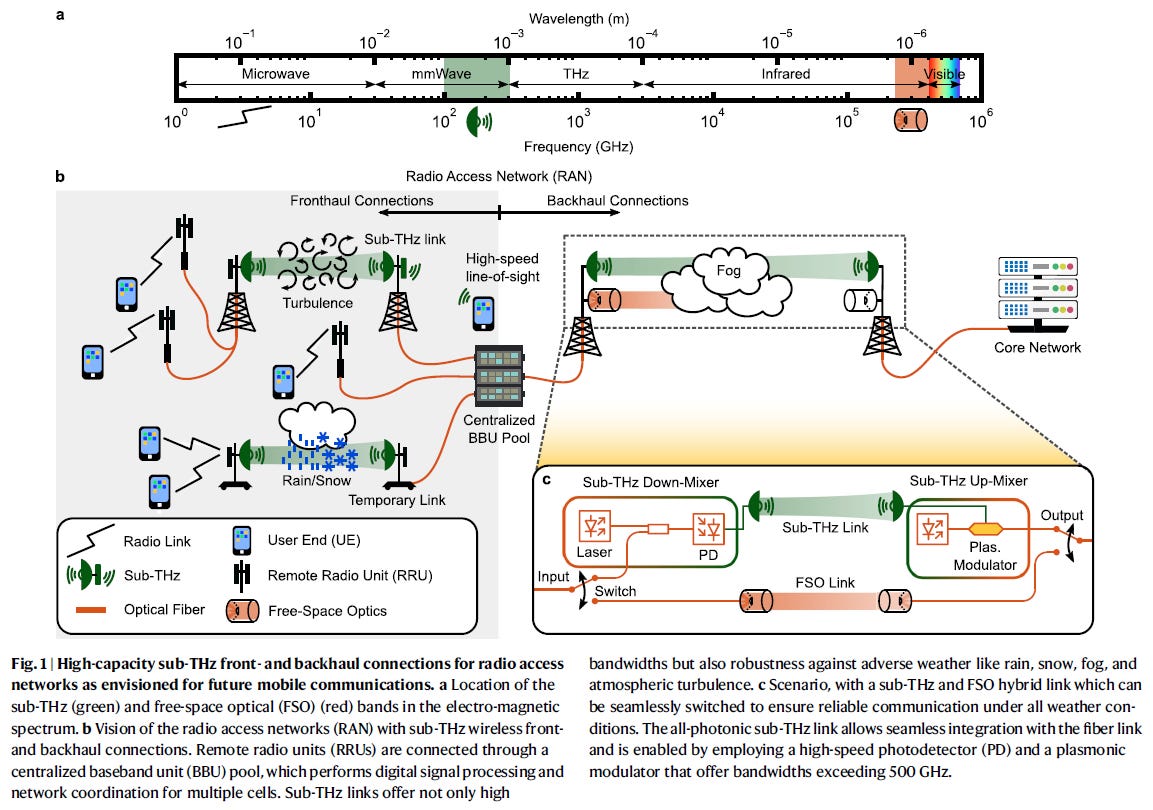
A joint team from ETH Zurich and Polariton Technologies linked two points 1,400 m apart over a 226 GHz carrier [1]. Net 153.2 Gb/s, 184 Gb/s at the line rate. The paper claims this as a record on net-rate times distance. The signal did cross 1.4 km of outdoor path rather than a short bench span. Worth keeping in proportion though: the equipment sat in a container and the modulator was contacted with GSG probes, so this is an outdoor link demonstration and not a finished product.
The architecture is unusual. At the transmit end, two optical tones are mixed to generate the 226 GHz carrier and radiated. At the receive end, an antenna picks that carrier up and feeds it straight onto the modulator electrodes. The resulting electrical signal rides back onto light and goes into fiber. What gets skipped is the electronic downmixer in the wireless receive front end, with the sub-THz signal lifted directly into the optical domain instead. Baseband conversion and signal processing still happen downstream in the coherent receiver, and the RF amplifiers, the antennas and the optical amplifiers are all still there. The part doing the receive-side job is a plasmonic Mach-Zehnder modulator filled with an organic material.
Now the dates. The paper was received on December 26, 2024 and published on April 18, 2026 [1]. Four days after that, on April 22, Marvell announced the Polariton acquisition [2]. Two of the thirteen authors, Marcel Destraz and Wolfgang Heni in the fifth and sixth slots, carry Polariton Technologies affiliations.
What the sequence supports stops there. This result was public before the acquisition was announced. What Marvell actually reviewed during diligence is internal, and dates alone are not a basis for guessing. I covered the acquisition itself and the material question inside the slot in The Truth Behind Marvell-Polariton: Is LWLG the First Candidate, or Just a Backup Bet?, so this piece picks up what the company has said in the four months since.
2. Two months later, the company drew its own map
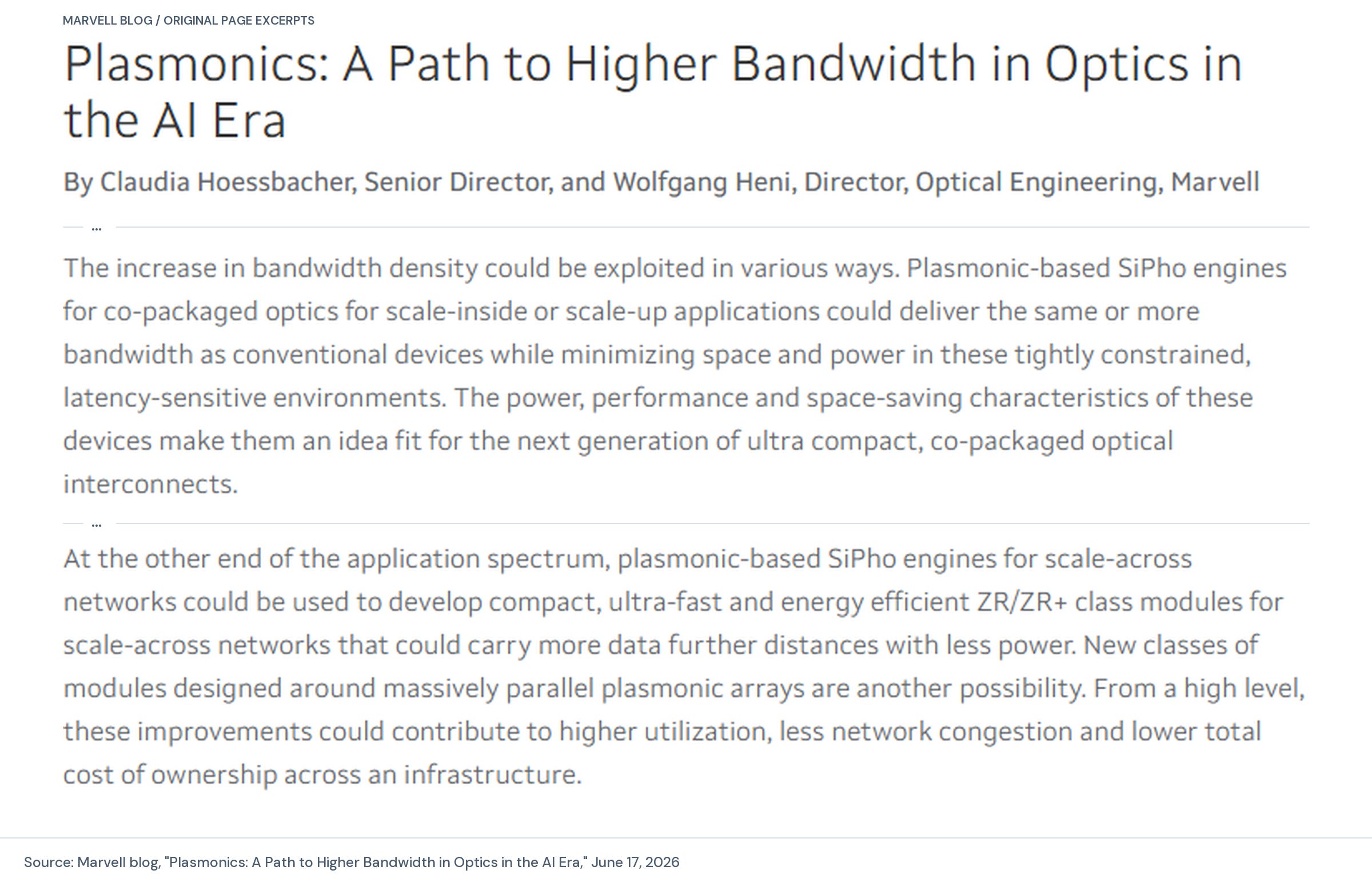
On June 17, a post explaining plasmonic technology went up on the Marvell blog [3]. Two authors: Claudia Hoessbacher and Wolfgang Heni, listed as Senior Director and Director of Optical Engineering at Marvell. The Polariton founders writing a technical document on Marvell letterhead.
The device description is specific. It explains compressing light below the diffraction limit at a metal-dielectric interface, and states that prototypes measure roughly 10 micrometers in length, 300x to 500x shorter than existing silicon photonics devices, and operate at 1 THz [3]. There is a line on manufacturing too: modified silicon processes with the metal dielectrics added toward the end of production.
Then come the applications. This is the part that matters.
“Plasmonic-based SiPho engines for co-packaged optics for scale-inside or scale-up applications could deliver the same or more bandwidth as conventional devices while minimizing space and power...”
“plasmonic-based SiPho engines for scale-across networks could be used to develop compact, ultra-fast and energy efficient ZR/ZR+ class modules...”
The same technology gets placed on co-packaged optics inside the package and on coherent links between campuses. The April acquisition release named only scale-across, DCI and the ZR family [2]. Two months on, the technical document widened the range upward. It also adds a new class of modules built around massively parallel plasmonic arrays as a possibility, and mentions modules at 3.2T and beyond [3].
The tenses tell you something else. Every sentence describing an application uses could. Able to, not doing. One sentence is in the past tense.
“High-speed SiPho devices capable of operating at 400G/lane containing plasmonic transponders were delivered to customers in 2026.“
400G per lane plasmonic transponders shipped to customers in 2026 [3]. No customer names, no volumes, no distinction between samples and production units. But it is the one completed event sitting among the conditionals.
The same post also sums up what is left.
“The technology is still in the early days of development for commercialization. In the next phase, the focus is on improving the reliability and performance of the devices as well as manufacturing methodologies to make the devices at scale.”
The company calls its own technology early stage for commercialization, and puts reliability first among the next-phase problems. That the company picked that word itself comes back later
3. What 1,400 meters proved and what it did not
With the map in hand, back to the paper. What the April result actually proved is narrower than it looks.
The application is different. The paper states its target as fronthaul and backhaul for 6G mobile networks [1]. Linking base stations over radio instead of fiber. Not datacenter interconnect, and there is no passage in the paper that frames DCI as the target.
The role the device plays is different too. Here the modulator is not loading data onto light at the transmit end. It is an up-mixer at the receive end, lifting an incoming radio carrier into the optical domain. Which changes the drive conditions completely. The paper puts the voltage amplitude at the modulator input at 0.3 V, with the sub-THz power reaching the modulator at minus 5.6 dBm [1]. With a Vpi of 12.3 V, that is small-signal operation at less than a fortieth of Vpi.
This distinction matters because taking Vpi 12.3 V and turning it into “the drive voltage is high, so the power budget is bad” gets it wrong. In this experiment the device was never swung anywhere near Vpi. Receive sensitivity was the thing that mattered. Try to use the same device as a transmit-side data modulator and Vpi comes back as a real burden. Change the role and the number means something else.
Insertion loss is 17.5 dB fiber to fiber [1]. Optical power drops to roughly a sixtieth. The paper reports this as a total and does not break it into components. Metal absorption in the plasmonic structure and the coupling loss of pushing light from a fiber into a slot tens of nanometers wide are both in there somewhere, but how much each contributes is not something this paper answers. In the lab you cover that with optical amplification. In a product, that amplifier shows up on the bill as cost, power and noise.
One comparison deserves care. This paper says thin-film lithium niobate gives low optical insertion loss but that its electro-optic bandwidth drops beyond 100 GHz [1]. That is the plasmonics camp talking, and there is work pointing the other way. A November 2025 paper in the same journal, on thin-film lithium niobate over a quartz substrate, reported 145 GHz at 3 dB and 310 GHz at 6 dB [4]. So 100 GHz is not a wall that cannot be crossed.
Which puts plasmonics somewhere other than winning a bandwidth race. Its claim is the same bandwidth in a far shorter device. The company blog saying 300x to 500x shorter is pointing at exactly that [3].
That is as far as public material takes us. But once the June blog widens the applications in both directions, the targets start to overlap with the other optical platform this company bought four months earlier for considerably more money.
4. So where does Celestial AI’s SiGe stand
Put Marvell’s optical acquisitions in order and there are two inside ten months.
Celestial AI was announced on December 2, 2025, structured as roughly $3.25B upfront with up to $2.25B in earnout [5], and closed on February 2, 2026 [6]. The object of the release headline is scale-up connectivity. Then Polariton on April 22, 2026 [2].
The modulation methods are genuinely different.
Celestial AI’s Photonic Fabric does not use micro-rings. The company-side paper writes down why: narrow optical bandwidth and too much temperature sensitivity to sit next to a hot chip. It uses germanium-silicon electro-absorption modulators instead [7]. Apply a voltage and the material changes how much light it swallows. Simple structure, small footprint, easy to pack densely inside a package. I followed how far that company has actually gotten through two of its papers in Marvell Bought Celestial AI. How Far Along Is Photonic Fabric?.
Polariton’s POH does not swallow light. It rotates phase. Light is confined in a narrow gap between metal walls and that gap is filled with an organic electro-optic material working through the Pockels effect.
So the two platforms run on different physics. Celestial AI has nothing to do with plasmonics. No organic slot, no Pockels effect.
What overlaps is the target application rather than the technology. Marvell bought Celestial AI for scale-up connectivity, per the release headline itself [5], and the June blog places plasmonics on scale-inside and scale-up CPO as well [3]. Two technologies built on entirely different physics have both become placement candidates for the same scale-up slot.
One caution here. Do not shrink the acquisition down to a modulator. Celestial AI came with an optical fabric architecture, packaging, system IP and a team. Reading this overlap as “one of them gets dropped” is premature, because the system layer and the device layer are separate problems.
Three things are still worth recording.
One. The two technologies get explained separately. The June plasmonics post never mentions Celestial AI or Photonic Fabric [3], and the Photonic Fabric material shown at FMS in August talks about package, server and rack scale [9]. Reach figures differ between company documents, so I will leave those numbers out here. Product blogs sticking to their own subject is ordinary, so the silence itself should not carry much weight. What remains is that the two ranges the company drew for itself meet at scale-up.
Two. The August 27 earnings release contains none of the words optics, photonics, plasmonic, Celestial AI, scale-up, scale-across or coherent [8]. The quarterly report filed the next day reads differently. Listing what drove data center revenue growth, it puts electro-optics first, and it describes the Celestial AI acquisition as a Photonic Fabric technology platform purpose-built for next-generation scale-up interconnect [10]. So the optical business is already inside the consolidated statements. The same document also says this.
“Revenue and earnings of Celestial since the acquisition date were not material”
Revenue and earnings since the acquisition were not at a level worth calling out. The precise reading is that it came into the consolidation but was not large enough to break out. Writing that it does not touch the income statement gets it wrong, and reading a revenue figure out of it gets it wrong too. Polariton and plasmonics, meanwhile, appear nowhere in that same quarterly report [10].
Three. The timing guidance has a different character on each side. For Celestial AI the company guided meaningful revenue contribution to the second half of FY2028. On the plasmonics side there is no such guidance, and instead there is a completed sentence about customer deliveries in 2026 [3]. Since that delivery is not described as samples or production units, and not dated relative to the acquisition, the two cannot be lined up to say which came first. What can be said is that one side has a shipment on record and the other has a revenue date.
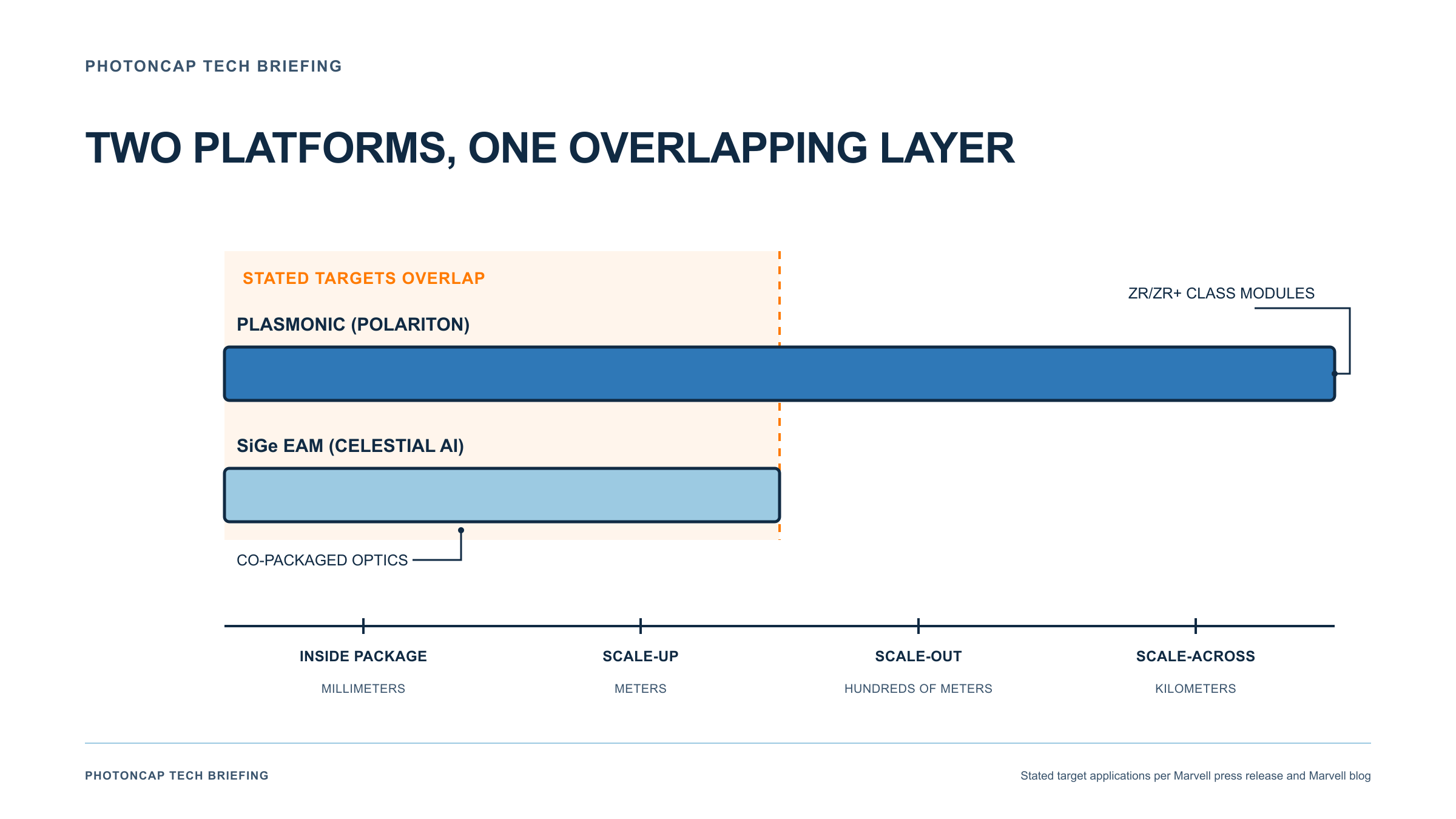
Put those three together and a picture of layers divided by design does not emerge. It looks more like something not yet settled, and where it gets settled is not bandwidth.
