TL;DR
Lumentum’s OCS (optical circuit switch) revenue went from zero to more than $100 million a quarter in one year, counting from August 2025 when it recognized its first OCS revenue.
And yet an OCS is a million times slower than an electrical switch. It doesn’t convert light into electricity and only turns its direction with mirrors, so half the transceivers and the switch chip drop out of the spine tier.
Google has used these mirrors for a decade in two places, the spine and the TPU pod, and per its paper cut capex by 30% and power by 41%.
Two Google papers give an arithmetic that could explain why vendors these days all seem to converge around 300 ports, as if by agreement. In patent gazettes and company materials I also found traces of a hyperscaler outside Google and a company from an adjacent industry entering this market.
To note only the direction up front, I think today’s MEMS mirrors are enough for training, and so I think the contest for the next generation of SiPh switches lies in size and integration more than in speed.
Abstract
Lumentum’s OCS (optical circuit switch) revenue went from zero to more than $100 million a quarter in one year, counting from August 2025 when it recognized its first OCS revenue. And yet this product is a million times slower than an electrical switch. In February I wrote a piece introducing how OCS works and who the players are, and this time I wanted to layer cost and demand on top of it. So this article follows two threads. The first is how much removing the electrical conversion really saves, and whether a mirror that moves in ms (milliseconds) is enough for AI training. The second is how far this demand spreads beyond Google and how high the market forecasts have climbed. While lining up the sources, interestingly, I think I found something. Two Google papers give an arithmetic that could explain why vendors these days all seem to converge around 300 ports, as if by agreement. And while digging through patent gazettes and company materials, I also found traces of companies that looked far removed from OCS entering this market. To note only the direction up front, I think today’s MEMS mirrors are enough for training, and so I think the contest for the next generation of SiPh switches lies in size and integration more than in speed.
Contents
$100 Million a Quarter in One Year: Lumentum’s OCS Numbers
From Port N to Port M: What a Switch Does, and OEO
Where Google Put the Mirrors
The Cost Arithmetic of Removing OEO
Is a Millisecond Mirror Enough?
Loss Budget and Port Count: Why 300 Ports
Where a Slow Mirror Is Enough, and Where It Falls Short
After MEMS: A Question of Size and Integration
A Company Crossing Over from an Adjacent Industry
Demand Outside Google
Market Size Forecasts and Listed-Company Exposure
Conclusion and the Dates to Check
1. $100 Million a Quarter in One Year: Lumentum’s OCS Numbers
On its August 11 earnings call, Lumentum said its guidance for the current quarter (FQ1 27) includes the company’s first “triple-digit” OCS revenue quarter. The unit is millions of dollars, so that means more than $100 million in a quarter, and the CEO added that it would come in “meaningfully above” that level [1]. The guidance came after OCS shipments doubled quarter over quarter in the prior quarter [1].
When was this product’s first revenue? On the August 2025 call, Lumentum said it recognized its first OCS revenue with shipments to two hyperscale customers [2]. So it took one year to go from zero revenue to $100 million a quarter. Connecting the dots in between through the disclosures looks like this. The February results release this year carried the sentence that OCS backlog had gone “well beyond $400 million” [3], and on the May call the company referred to a multi-year, multi-billion dollar purchase agreement and said it has three customers, two of which make up the majority of the volume [4]. On the August call it confirmed that the plan for $400 million of OCS revenue in the second half of this year is “tracking,” though it “would not say tracking ahead” [1].
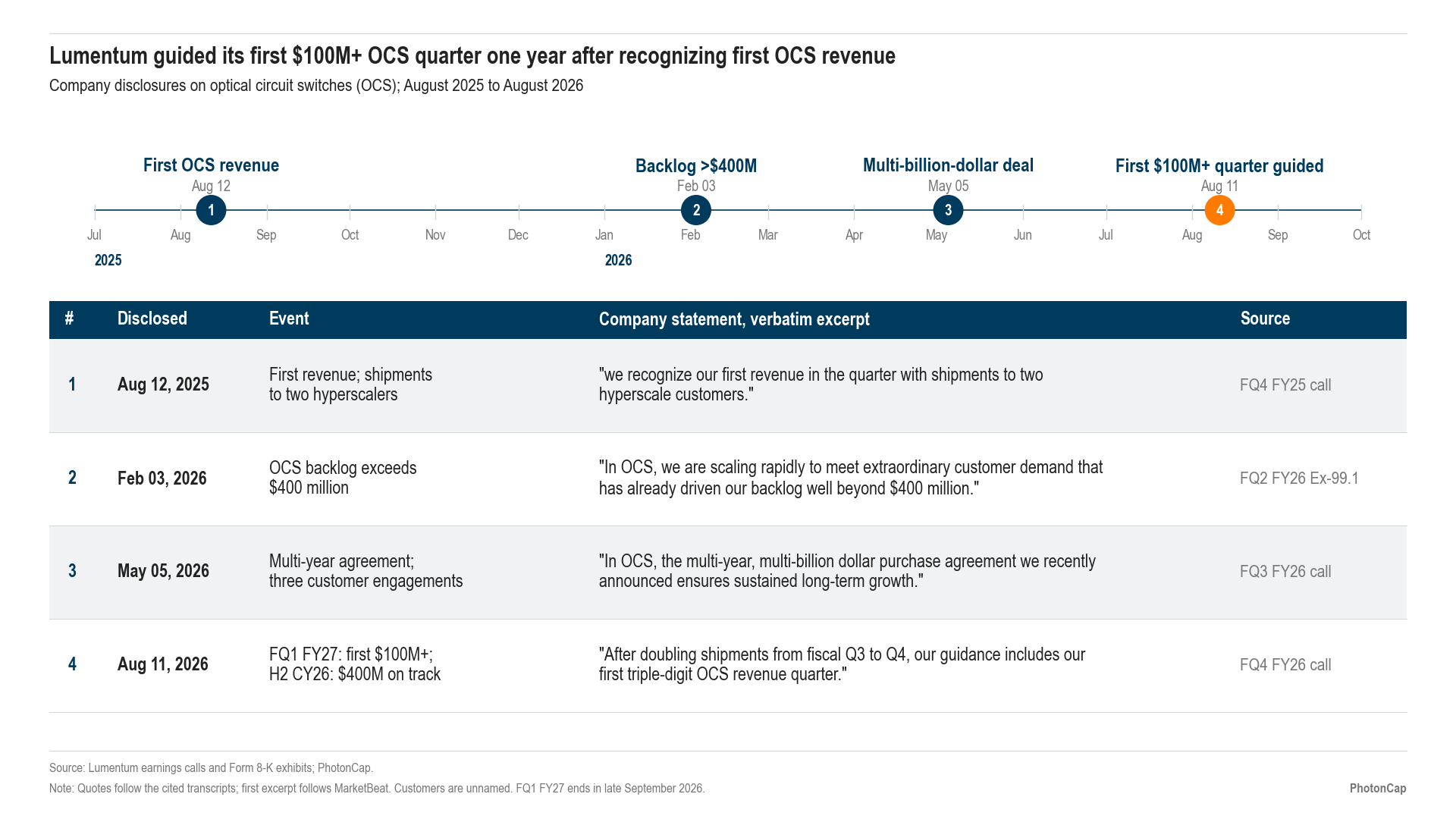
Lumentum OCS disclosure timeline, from first revenue in August 2025 to the $100 million quarter guided for September 2026
I should note one thing I couldn’t confirm. The “multi-billion dollar agreement” from the May call exists only as a CEO remark, and I couldn’t find a separate disclosure even after going through the IR press release list and the SEC 8-Ks. The company has never said who the customer is either. In this article I accept only that the agreement exists and leave the customer’s name in the realm of estimation.
LITE closed at $893.61 on September 17, with a market cap in the $80 billion range and a one-year return of no less than +430% [5]. Most of that rise was made by the laser and transceiver cycle, and I covered that story in Lumentum’s First $1B Quarter: FQ4 2026 Earnings Analysis. In A Conversation with Lumentum, which I put out with Aurelion Research in July, Lumentum IR was asked about the company’s core competencies and ranked InP lasers first and MEMS and optical switching second, saying this side would become another pillar. Those aren’t verbatim remarks. They’re carried over from Aurelion’s meeting notes. Today I pull out only OCS from all of that. It’s the product the company calls a “key growth driver,” yet there doesn’t seem to be much explanation in the market of why this thing actually sells.
2. From Port N to Port M: What a Switch Does, and OEO
I’ve been interested in MEMS optical switches for a long time. Optical switches that work well already exist, but they are bulky, their insertion loss is unnecessarily high, they are expensive, and they operate in a more complicated way than you’d expect. Optical switches are essential not only in data centers but all the way to the lab. As port counts grow and systems get more complex, a switch is essential equipment, so I have high expectations for this optical switch and OCS market.
If you reduce what a data center does to its simplest form, it’s a repetition of sending data that came in on port N out on port M. With tens of thousands of servers, the combinations of N and M become astronomically many, and the equipment in the middle that decides the route is the switch. Until now this job has been done by electrical switches, more precisely packet switches. A packet switch receives data in small bundles (packets), reads the address on each one, and sends it to the destination port.
But the long links inside a data center are already optical fiber. To read the address of a signal that arrived as light, you first have to convert it to electricity (optical to electrical), process it on a chip, and then convert it back to light to send it out (electrical to optical). This is called OEO conversion for short. Every pass through a switch means two transceivers (optical-electrical conversion modules) and a switch chip drawing power, plus the cost of that equipment. With three tiers, this conversion repeats several times on every path.
An OCS skips this conversion. It doesn’t convert light into electricity. It only turns the direction of the light, as light, and sends it from port N to port M. The most proven approach tilts hundreds of tiny mirrors made with MEMS (micro-electro-mechanical systems) to reflect the light. The principles and the introduction by approach are in Mapping the AI Landscape with Light: How OCS Transforms the Data Center Physical Layer, which I wrote in February, so I won’t repeat them here.
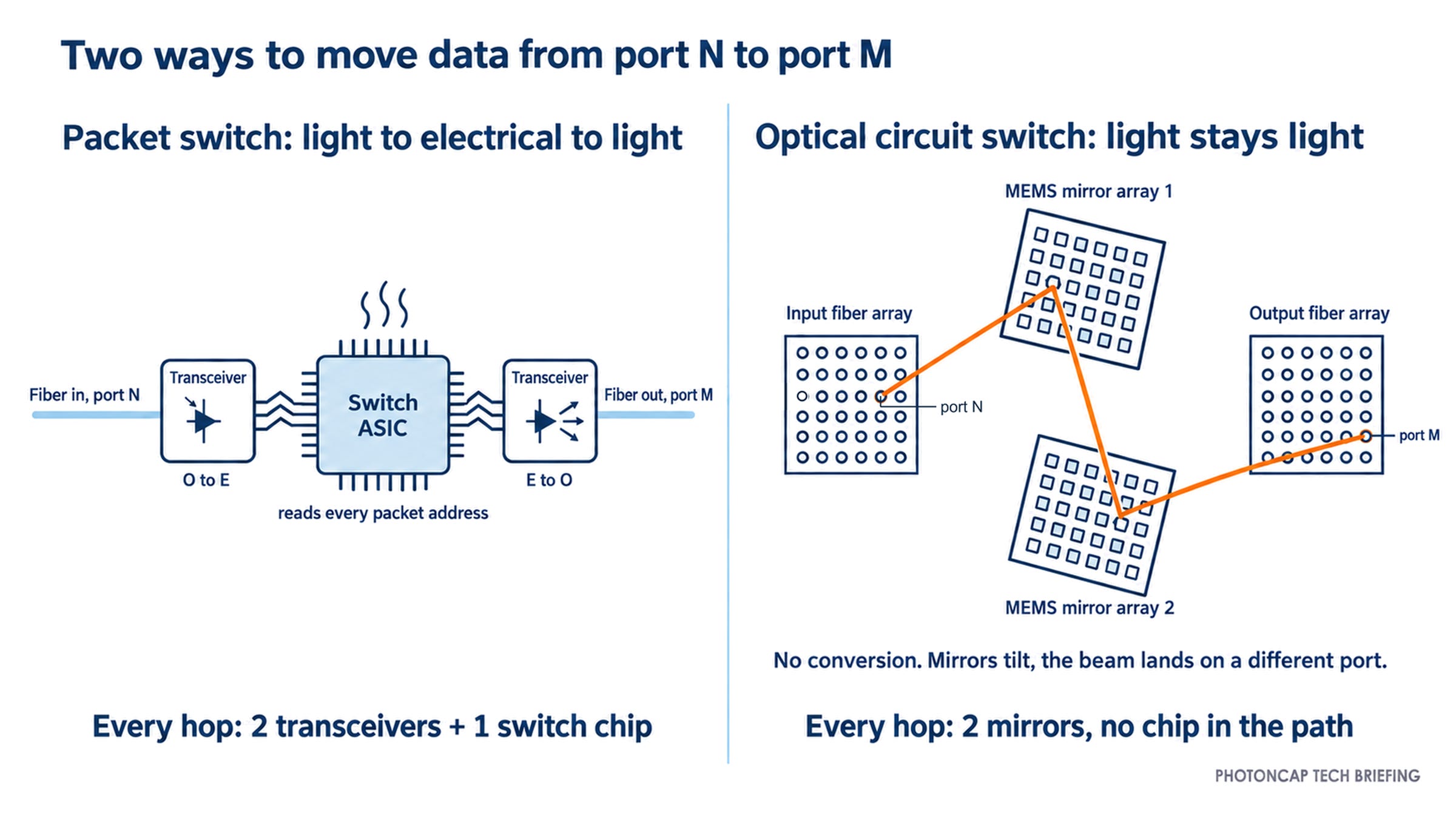
A packet switch converts light to electricity and back to light, while an OCS only redirects the light with two mirrors
What an OCS can’t do needs to be made clear instead. An OCS can’t read a packet’s address. It never converts the light to electricity, so that’s only natural. So an OCS is closer to equipment that lays down a circuit, saying “for the time being, port N and port M are tied together directly,” than to equipment that changes the route for every packet. Think of how a telephone operator used to plug in the cords. This difference keeps mattering later on.
Something in this picture changed as we moved to AI data. Unlike web traffic, AI training traffic is mostly decided before the job starts, in terms of who talks to whom and how much, and once decided, the same pattern repeats for hours. The volume is far larger too. If the amount of light that has to be delivered here and there inside the N x M matrix goes up while the pattern stays predictable, the reason to place expensive equipment that reads the address of every packet at every tier shrinks. I see this point as where OCS demand starts.
3. Where Google Put the Mirrors
The first to lay down OCS at data center scale was Google. In a 2022 SIGCOMM paper, Google disclosed its in-house OCS called Palomar. It has 136x136 ports (128 in use plus 8 spares), switching time on the order of ms, insertion loss (the amount of light lost passing through the switch) of 2dB in the worst case, and total system power of 108W, and the paper says tens of thousands were built and deployed over the past decade [6].
First is the top tier of the data center network, the spine. The Jupiter network paper from the same year reports the results of removing the packet switches in the spine tier and replacing them with OCS. The body of the paper states a 30% reduction in capex and a 41% reduction in power [7], and around the same time Google summarized it on its official blog as 30% higher throughput, 40% less power, 30% less cost, and 50x less downtime than the best known alternatives [8].
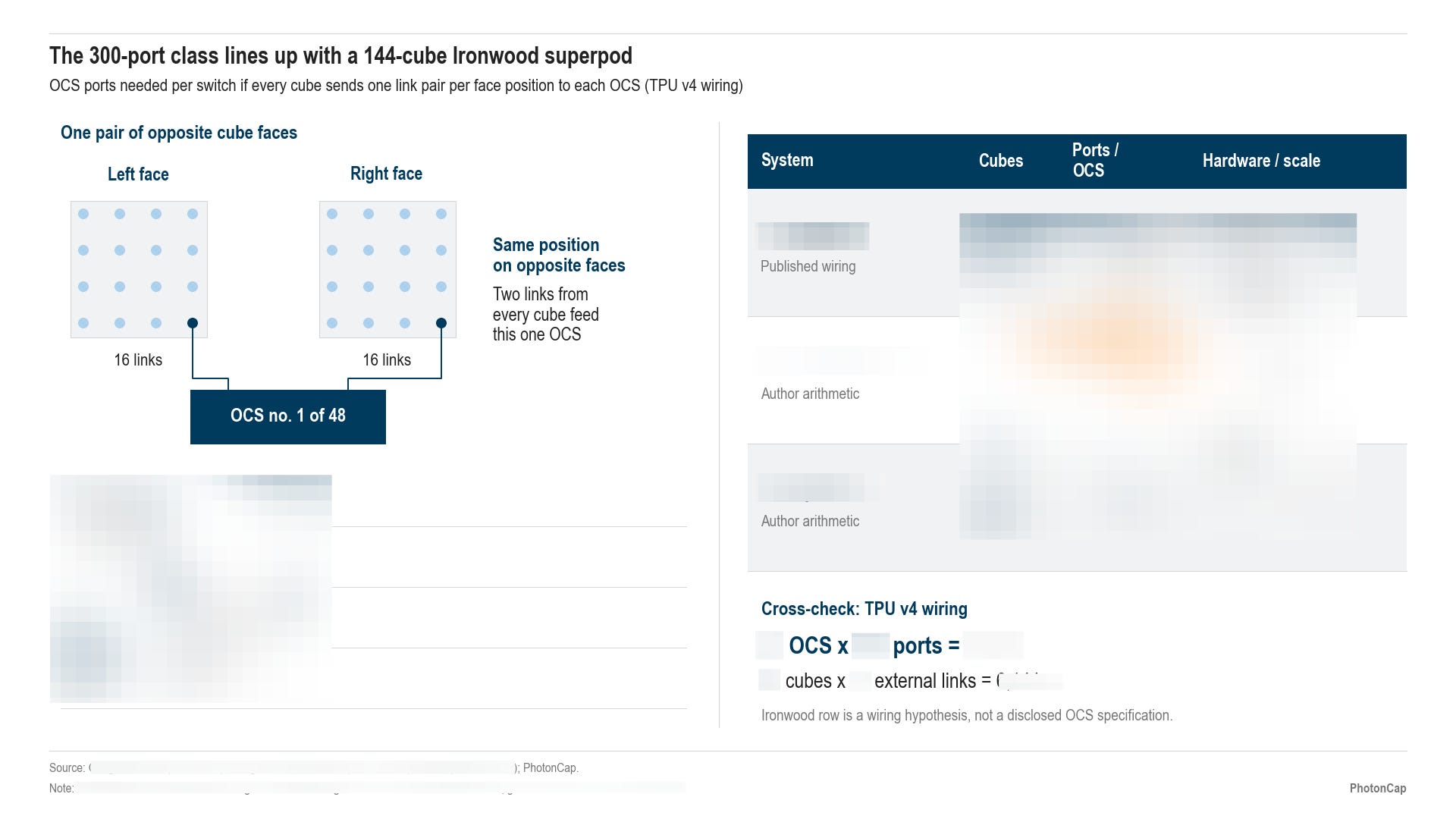
The other place is inside the TPU supercomputer. According to the 2023 TPU v4 paper, 64 chips are grouped into one block (a cube), and 64 cubes are connected by 48 OCSes to make a pod of 4,096 chips. Because the OCS decides with mirrors which face of which cube attaches where, the same hardware can produce a differently shaped topology (connection structure) for each job. The number I paid the most attention to in this paper is the passage saying OCSes and optical components are less than 5% of system cost and less than 3% of system power [9].
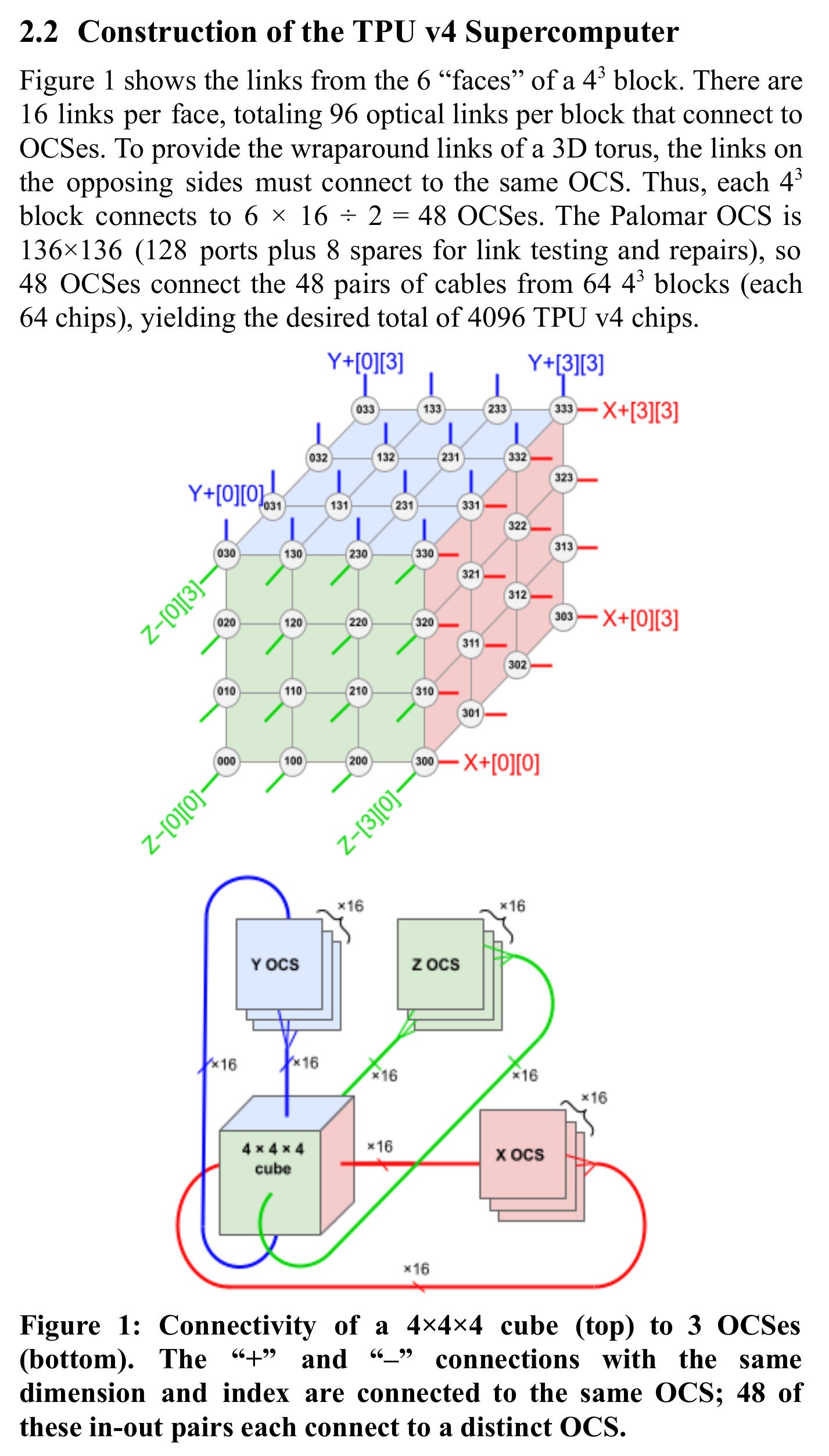
The cube-to-OCS connectivity figure from the TPU v4 paper. Source: Jouppi et al., ISCA 2023
This structure is unchanged in the latest generation. In its Ironwood (TPU v7) post last November, Google Cloud said the cubes are connected by an OCS network and that the largest configuration, the superpod, is 9,216 chips, or 144 cubes. It also explains that when one cube fails, the OCS management software optically bypasses that cube [10].
But why was it Google, of all companies, that went first? Reading the papers, the reasons overlap. In a typical Clos architecture the spine tier has to be pre-built at the scale of the whole building, and the Jupiter paper explains that this ties data center bandwidth to the speed available when the spine was deployed [7]. Google tried to avoid this problem by swapping the spine for mirrors that don’t care about speed, but there was nothing suitable to buy. According to the Apollo paper, the largest commercial OCS Google knew of at the time had a few tens to hundreds of duplex ports, and for the first several years of deployment it used an outside vendor’s product but decided on internal development because reliability and quality were hard to maintain at scale [6]. Software comes on top of this. An OCS can’t read packets, so someone has to decide centrally which ports to tie together and when, and Google already had its own SDN (software-defined networking) controller called Orion, along with traffic engineering [7]. One company held the need, the hardware and the software all at once. And having used it in production for nearly a decade [6] before publishing the numbers in papers, the perception that “OCS means Google” was bound to form.
That was long, so to sum it up a little, Google has used OCS for a decade for two purposes, as “cost-saving equipment” and as “topology reconfiguration equipment,” and the numbers for both uses are public in papers. That’s why any talk of the OCS market has to start with Google.
4. The Cost Arithmetic of Removing OEO
The money an OCS saves can be counted from structure alone, without knowing the price tags.
In a leaf-spine structure built with packet switches, for data from server rack A to reach rack B, it goes up from leaf switch A to a spine switch and comes down to leaf switch B. One transceiver at each end of the optical link going up and one more at each end of the link coming down add up to four transceivers and one pass through a spine switch chip. Put an OCS in the spine position, and the light from leaf A’s transceiver reflects off the mirrors and goes straight into leaf B’s transceiver. That’s two transceivers and zero passes through a switch chip. In that tier the transceivers are halved and the spine chip disappears altogether. Look at the orange path in the figure below.
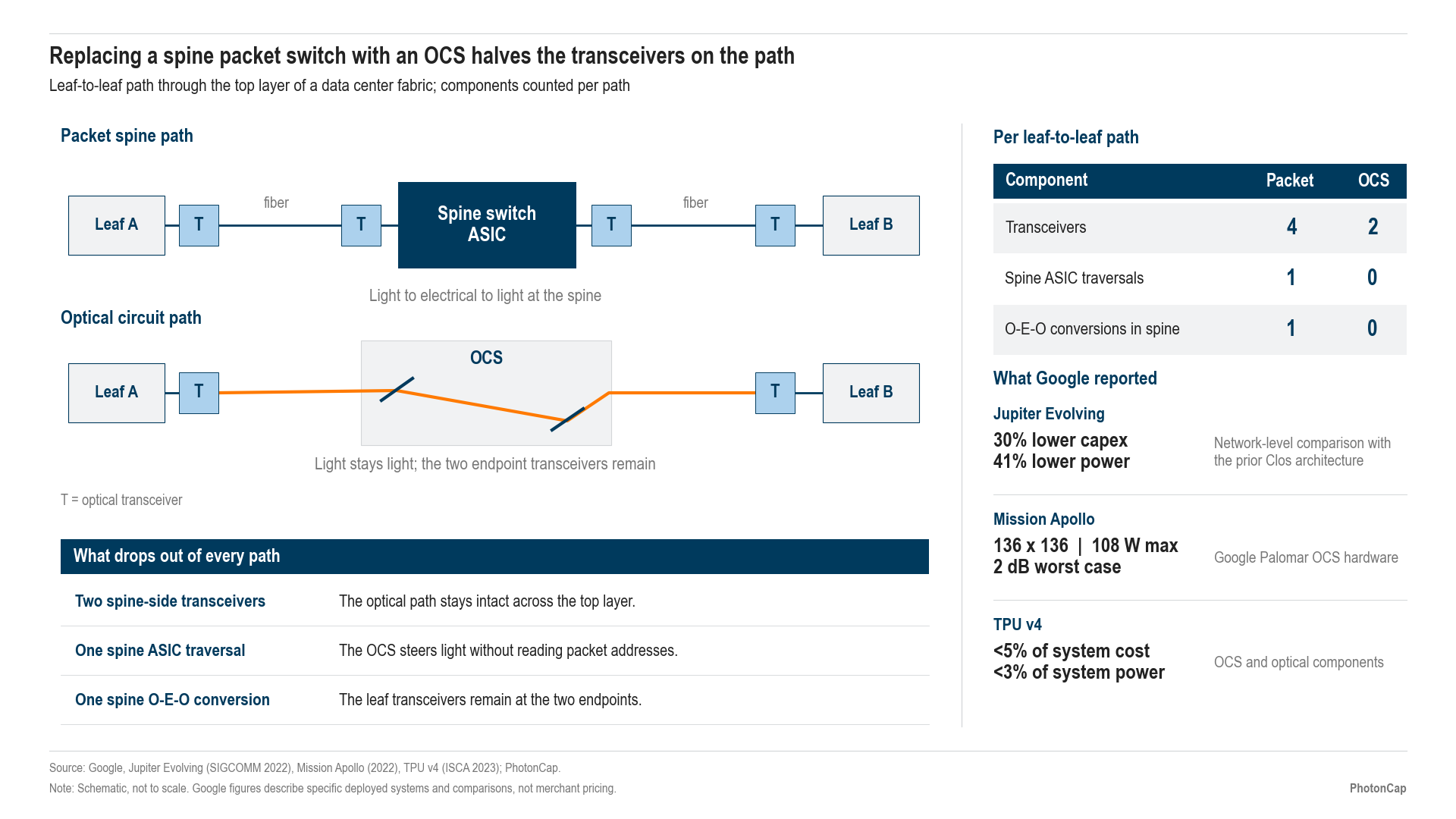
Transceiver count on a leaf-spine path versus an OCS path. Four versus two
This is where the 30% capex and 41% power reductions in Google’s Jupiter paper come from [7]. The power gap per box is large too. One Palomar is 108W [6], and Lumentum claims its 64-port product, the R64, is under 150W with 80% less power than a packet switch doing the same job [11]. The 80% is a vendor claim, so it’s hard to take at face value, but the power to tilt a mirror and hold it there and the power of a chip processing tens of Tbps differ by orders of magnitude to begin with, so there seems little reason to doubt the direction.
The item I consider more important in the cost arithmetic is the depreciation period. A packet switch bought in the 400G generation has to be replaced when moving to 800G and 1.6T, because the chip has to process that speed. A mirror doesn’t know whether the light it reflects is 400G or 1.6T. Change only the transceivers and the OCS stays in service. The Apollo paper makes this point as well. The optical switching layer becomes part of the building, like the power and cooling infrastructure, and capex can be amortized over the lifetime of the building, measured in decades, far longer than the few years of equipment life [6]. The Jupiter paper wrote that the 40G, 100G and 200G generations were incrementally mixed in on the same structure [7]. That said, the public papers don’t confirm how many generations an individual Palomar unit was reused across. The arithmetic that equipment replaced every 3-4 years and equipment used for 10 years differ two to three times in annual cost at the same price holds on that premise.
So here is how I read the “less than 5% of system cost” number [9] in the TPU v4 paper. It’s a trade where, in a supercomputer worth hundreds of billions of won, less than 5% of the money buys topology reconfiguration and failure bypass. If, when one chip dies, the pod keeps running minus one cube instead of stopping entirely, 5% is cheap even as an availability insurance premium. This calculation has a limit, though. The 5% and 3% are based on Palomar, which Google built itself, and there’s no public source that redoes the calculation at the price of buying from outside vendors.
5. Is a Millisecond Mirror Enough?
The cost logic is this clear, but one question arises here. A mirror that is tilted mechanically moves in ms. An electrical switch processes packets in ns (nanoseconds). Equipment a million times slower is sitting in the middle of the most expensive computers in the world. Is this a sufficient speed or an insufficient one, and what could the answer be?
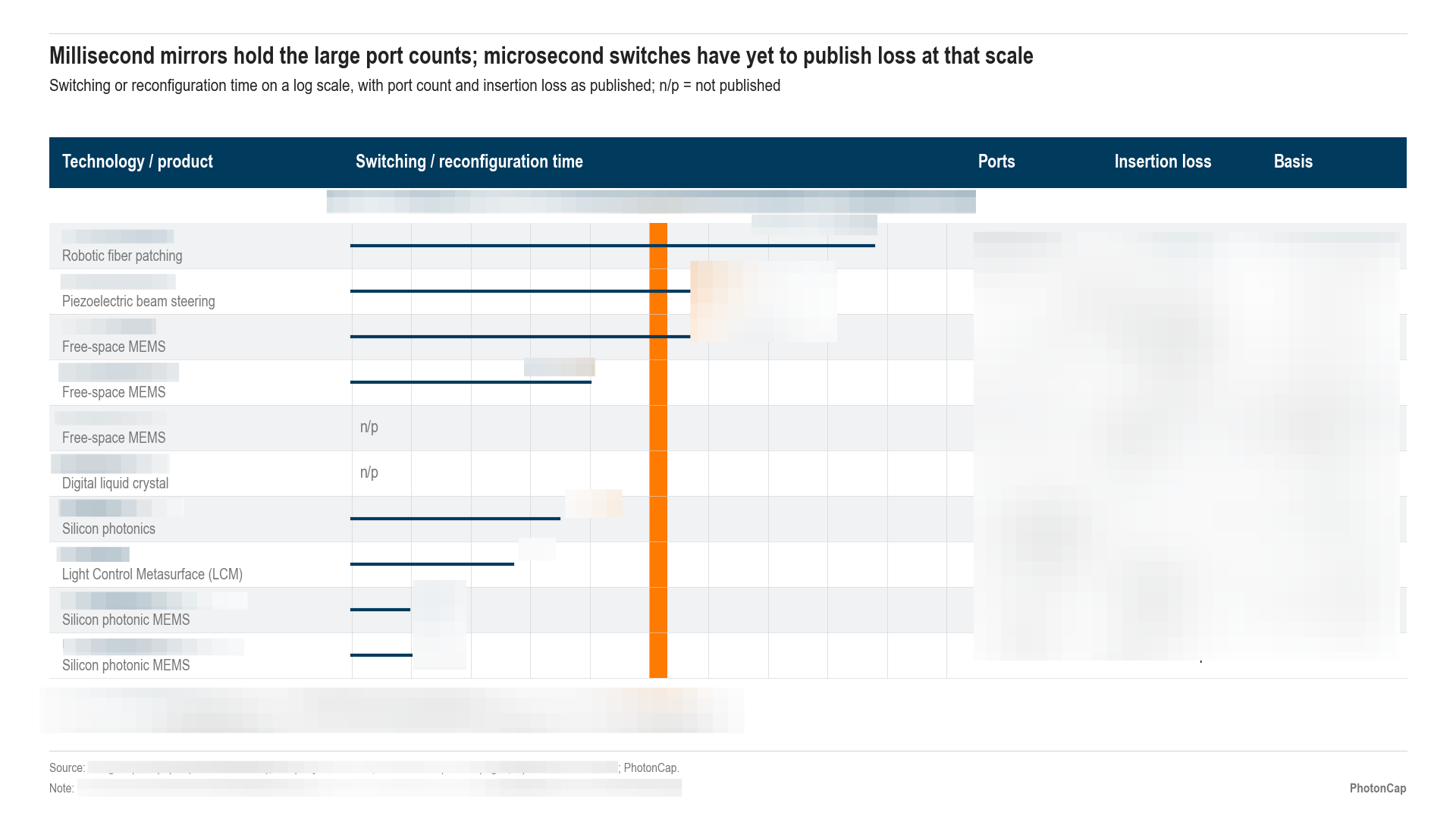
This question matters because the market’s next stage depends on it. This year alone, big money went into startups building SiPh (silicon photonics) based fast switches. iPronics announced a $125 million Series B with NVIDIA participating on September 2 [12], and nEye took an $80 million Series C in April, with Alphabet’s CapitalG and Microsoft’s M12 on the investor list [13]. One thing these companies put forward is switching speed tens of times to, at the high end, more than ten thousand times faster than a MEMS mirror. If the ms mirror is already enough, who is this speed being sold to? And if it isn’t enough, Lumentum’s $100 million quarter becomes revenue from a transitional product.
Google wrote down its own answer to this question in one paragraph of the Apollo paper.
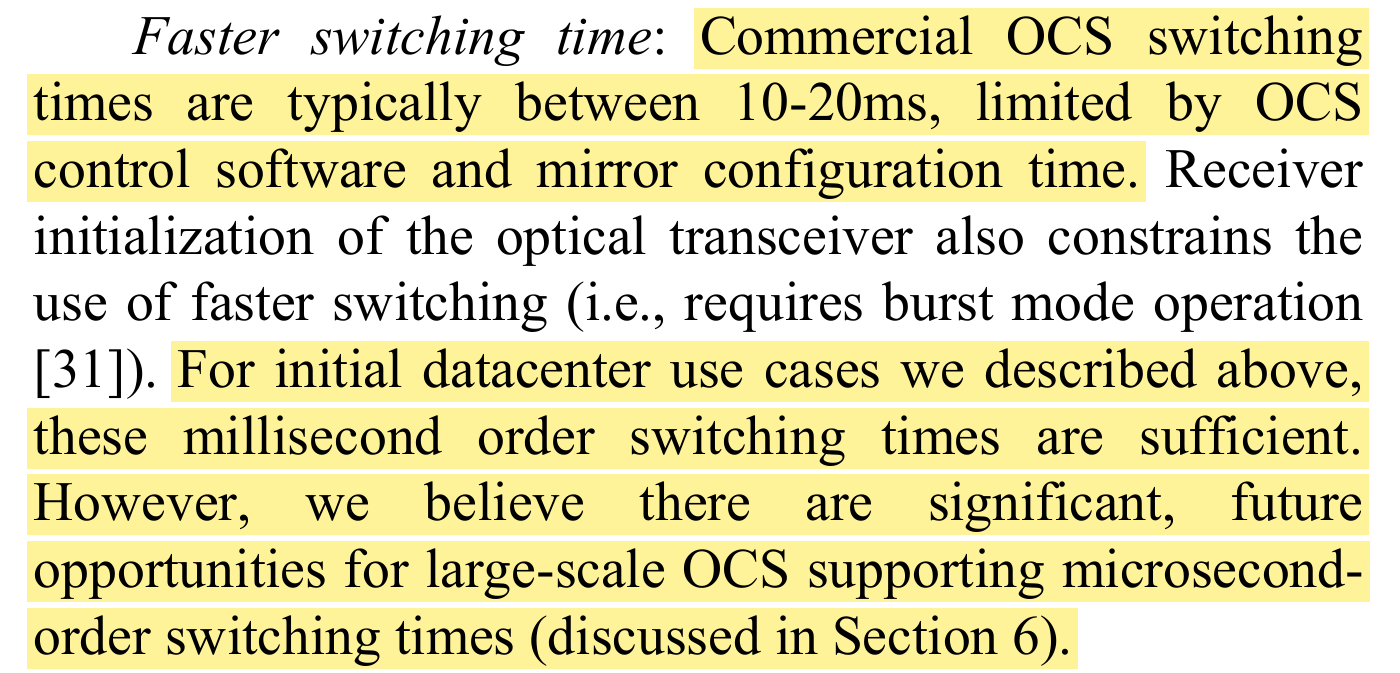
The paragraph in the Apollo paper on ms switching and the future opportunity for faster switching. Source: Urata et al., SIGCOMM 2022
But while preparing this article and digging through patent gazettes and company materials, things I didn’t expect turned up. On September 17, the US Patent Office published an application in which a hyperscaler other than Google describes a design that ties 10 buildings together with OCS. That’s quite a different picture from the conventional wisdom that nobody besides Google takes OCS seriously. One company that made chips for autonomous-driving LiDAR has turned the same chip toward OCS and opened a product page. I’ll name the companies in the paid section.
The paid section below starts with the loss of light, which is the cost an OCS pays, and the arithmetic that could explain why 300 ports of all numbers, then continues through the reading of the Apollo paragraph, the technology after MEMS and the identity of the companies above, and on to demand outside Google, the market forecasts, and which listed company has the larger OCS exposure.