
Abstract
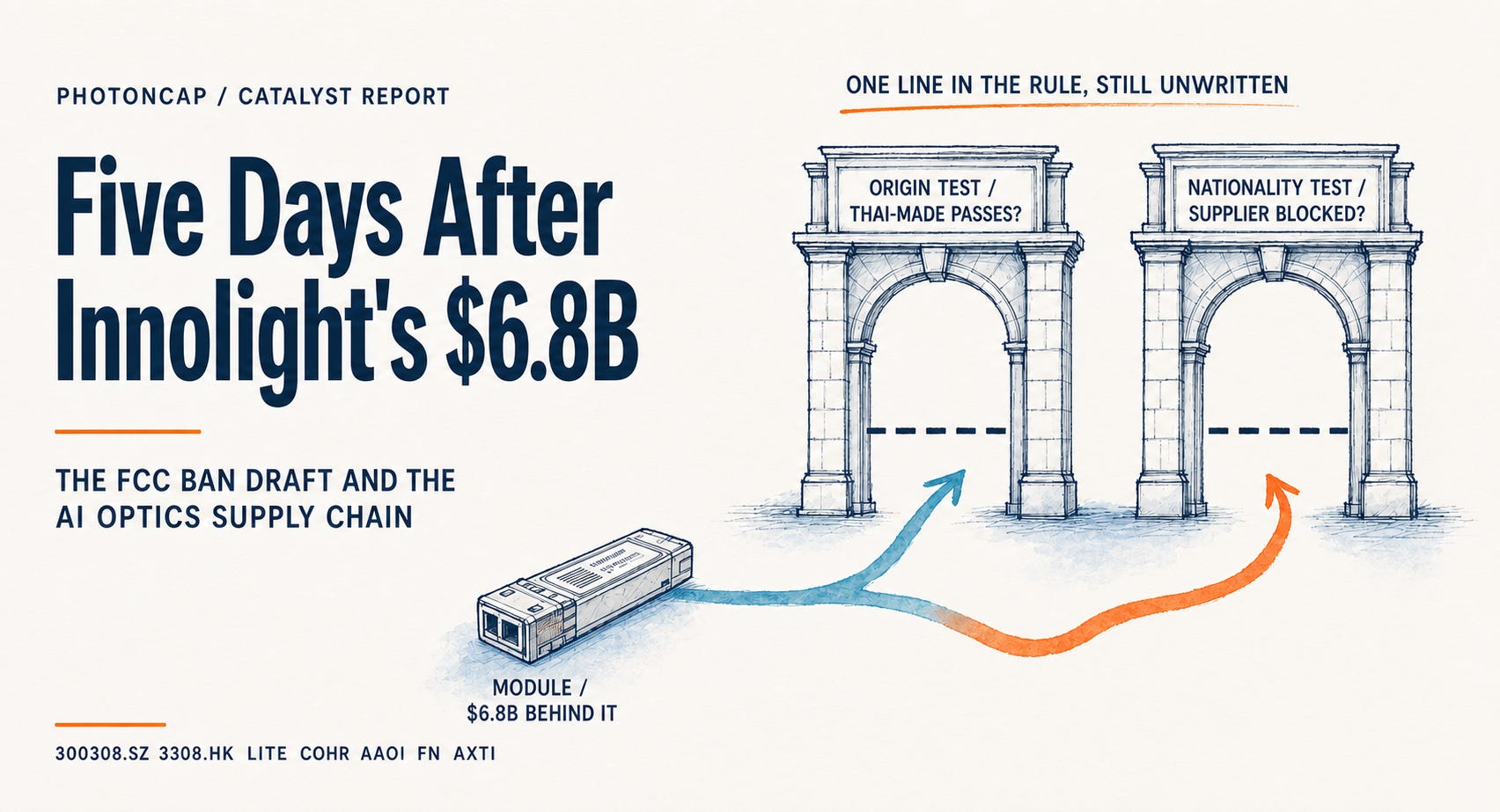
The Trump administration suddenly came out saying it would block Chinese transceivers. In the early hours of August 4, Reuters reported the FCC’s import ban draft, and communities everywhere got excited. And as you’d expect, US optical stocks rose double digits intraday. In the market, an interpretation was going around that AXTI gets hurt if China retaliates, and I think that’s a one-dimensional reading. Then a few days later, commentators like Jukan, separately from this news, started talking about a short-term short memory, long optical trade based on NVIDIA’s roadmap, so regulation and architecture are pointing at optics for different reasons. This article checks the disclosure documents of Innolight, which raised $6.8B five days earlier, to see how much of its volume is actually US-bound, and works down through capacity and the InP substrate chain to ask whether US-made supply can absorb that demand. To note my direction up front, I think the essence of this regulation is that it exposes the fact that without transceivers, even the US cannot build AI data centers.
Contents
A Draft Out of Nowhere
The $6.8B Five Days Earlier
The US-Bound Volume in the Disclosures
A One-Line Fight over the Text: Nationality or Origin (Paywall)
Can US-Made Supply Absorb the Demand
Going Down to InP: AXTI
Can You Build an AIDC Without Transceivers
1. A Draft Out of Nowhere
The Trump administration suddenly came out saying it would block Chinese transceivers. It was a Reuters exclusive on the morning of August 4 (US time): the FCC is drafting an import ban on Chinese data center equipment including new Chinese optical transceivers, aiming for publication within the year and immediate effect [1]. The stated grounds are concerns over data theft, malware, and remote service disruption. I remember people getting very excited. Especially on X, saying that because of the FCC event, US optics-related stocks, for example AAOI, COHR, LITE, would be the beneficiaries.
Reuters exclusive headline, FCC drafting ban on Chinese data center devices, 2026-08-04
Let me start with the market reaction. AAOI rose around 20% intraday, Coherent and Lumentum double digits, and Corning around 8% (intraday figures that vary by when you sampled them) [2]. The Chinese side reacted a day late since the report came out after their market close: on August 5, Innolight’s A-shares fell as much as 16% intraday before closing down 7%, the H-shares fell 5.2%, and the next day they bounced right back to near record highs. The swings continued after that, and on August 10, the same day as a broad optics pullback ahead of earnings season, it closed down 6.9% at HK$1,033. Still 5% above the offer price [3].
And there was one more interpretation people attached to this news. That if China retaliates by squeezing InP exports, AXTI, which makes substrates in China, gets hurt. I think this is a one-dimensional reading, and why becomes visible only once you go down the InP chain, so I’ll write about it later.
What to look at first is the company that is number one in the transceiver industry and sits right in the middle of the ban’s target. This company, of all times, had just raised money in Hong Kong five days earlier.
2. The $6.8B Five Days Earlier
A few days before the FCC event, on July 30, Zhongji Innolight listed its H-shares in Hong Kong. At an offer price of HK$980, it raised HK$53.4 billion (about $6.8B), the largest in Hong Kong since Alibaba in 2019 [4][5]. The Hong Kong retail tranche was 16.8x subscribed and the international tranche 9.7x, and 33 cornerstone investors including Temasek, ADIA, BlackRock, Alibaba, and Tencent took half of the offering (about HK$26.7 billion worth) under a six-month lock-up [4][5].
The ten days around the listing were noisy in the headlines. When the offer price printed around 11% below the A-shares (per press reports), the A-shares plunged 15.7% on the pricing disclosure day [6][7], and on debut day, sitting on top of a chip selloff week, the stock fell as much as 9.8% intraday before closing 2% below the offer price [8][3]. But look at the closing-price chart and there is no stretch you could call a crash. It recovered the offer price the next day, and through the swings since, it sits at HK$1,033, 5% above the offer price even as of the August 10 close [3]. One fact remains. The world’s largest optical module company is holding net proceeds of HK$52.9 billion [5].
How they should use this money, honestly, is the part I’m most curious about. The uses listed in the prospectus are R&D, overseas production capacity expansion, supply chain strengthening, M&A, and general working capital [9]. Five items, and where the weight lands is open, and the FCC draft that came five days later added a variable to that answer. The meaning of the overseas capacity item now changes completely depending on the regulatory text.
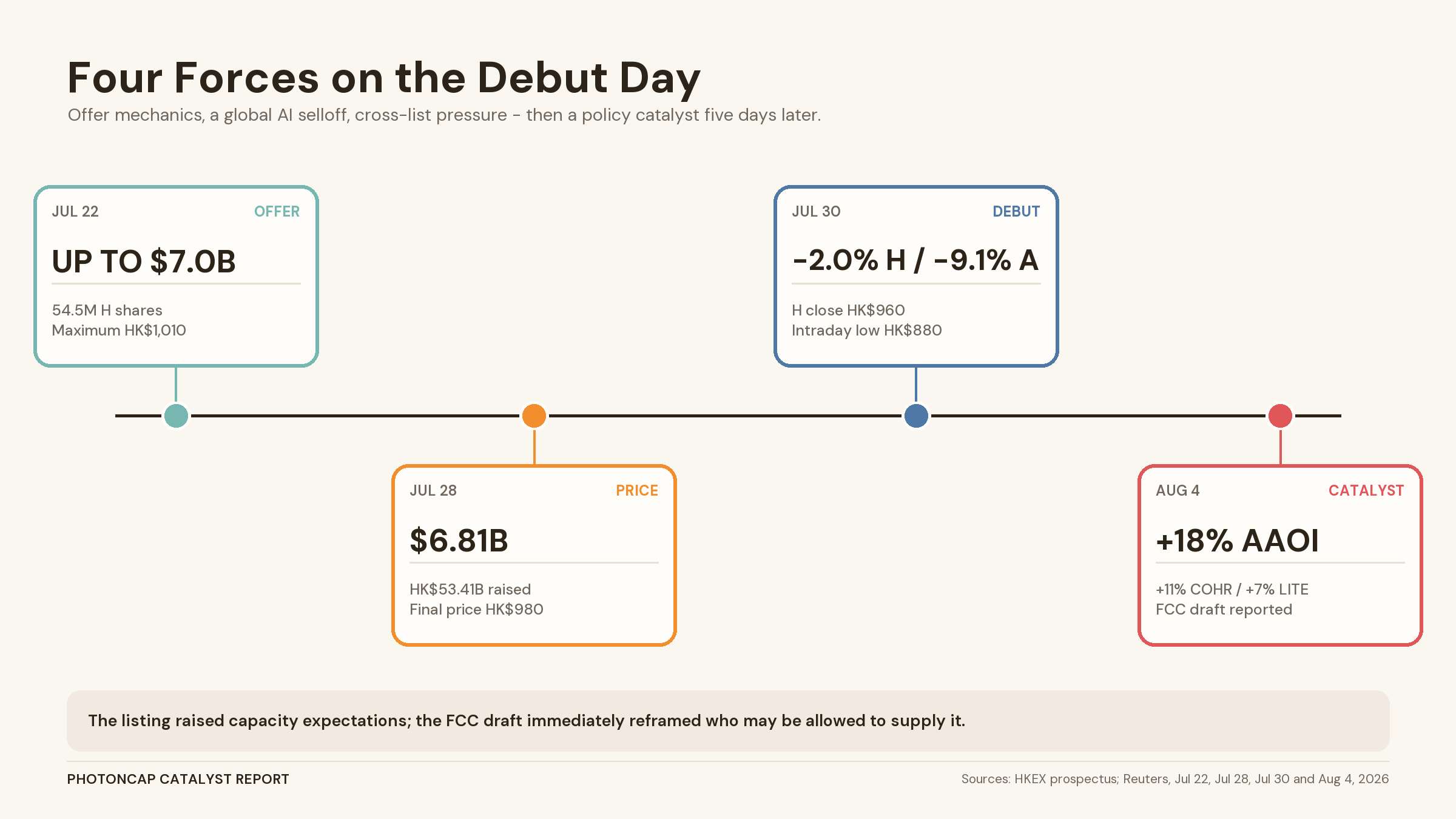
Figure: Four forces on the debut day
3. The US-Bound Volume in the Disclosures
Look at the disclosures and quite a lot is US-bound. US customer revenue was 75.9% in 2023, 57.3% in 2025, and 61.7% in Q1 2026 [9]. Overseas revenue overall is above 90% as of Q1. So this is a Chinese company where 60% of revenue comes from the US. This is exactly where the FCC draft is aiming.
But the same disclosures carry numbers pointing the other way. Goods made in mainland China and sold to the US were under 1% of total revenue throughout the track record period. By year: 0.3%, 0.9%, 0.2%, and 0.0% in Q1 2026 [9]. Which means the US-bound volume has effectively already been moved entirely to offshore production. The Singapore entity TeraHop Pte is the hub of overseas production, and the main base for North America-bound goods is Thailand [9][10]. The way Chinese vendors have been adding capacity in Thailand and Indonesia is exactly the layout we covered in April in Chinese Optical Modules Own 7 of the Top 10 Seats.
US revenue is 60%, but mainland-origin US-bound is around 0%. The gap between these two numbers decides the entire effectiveness of this regulation. As the optical communications research firm Cignal AI pointed out, the draft does not yet have a definition of “Chinese” [10]. Do you look at the company’s nationality, or the place of production. The question Cignal posed compresses this ambiguity. Is a module that combines Marvell’s DSP and Lumentum’s optics, assembled in Malaysia, Chinese [10]?
Why does the definition matter this much: because the same module from the same company is a legal import under one criterion and a banned item under the other. Unlike routers or drones, transceivers sit on a layout that a definition clause is perfectly positioned to split: the top suppliers are Chinese by nationality and Southeast Asian by production. One sentence in the Federal Register will decide whether billions of dollars of volume crosses the border.
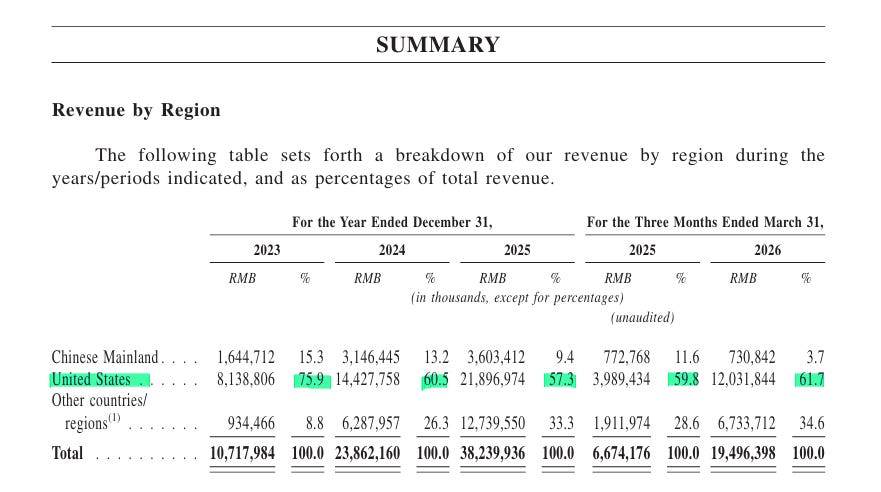
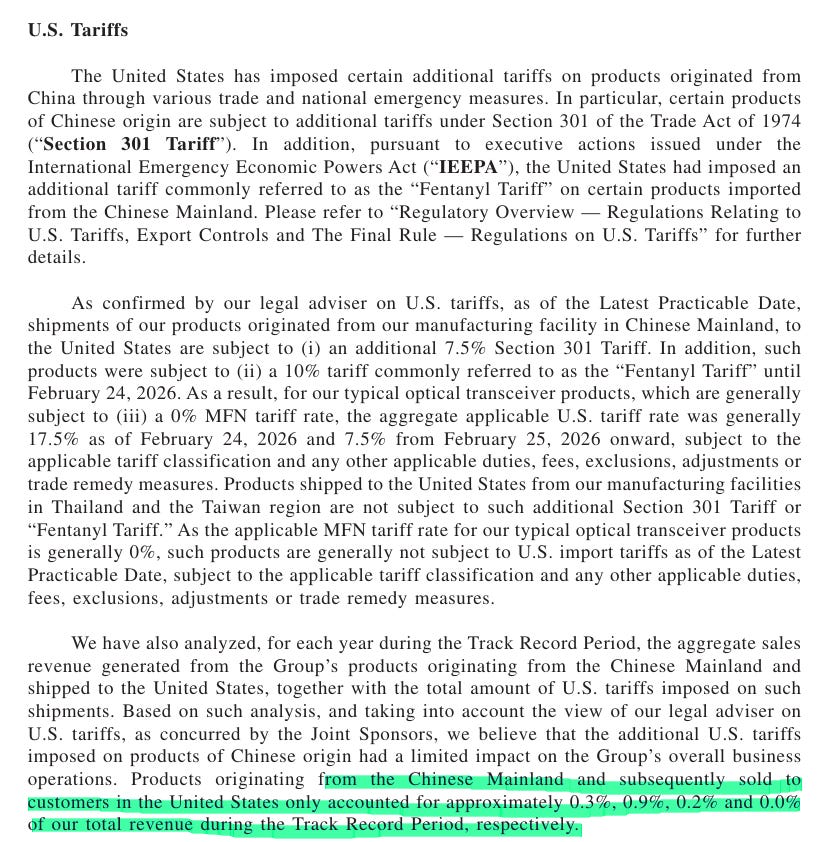
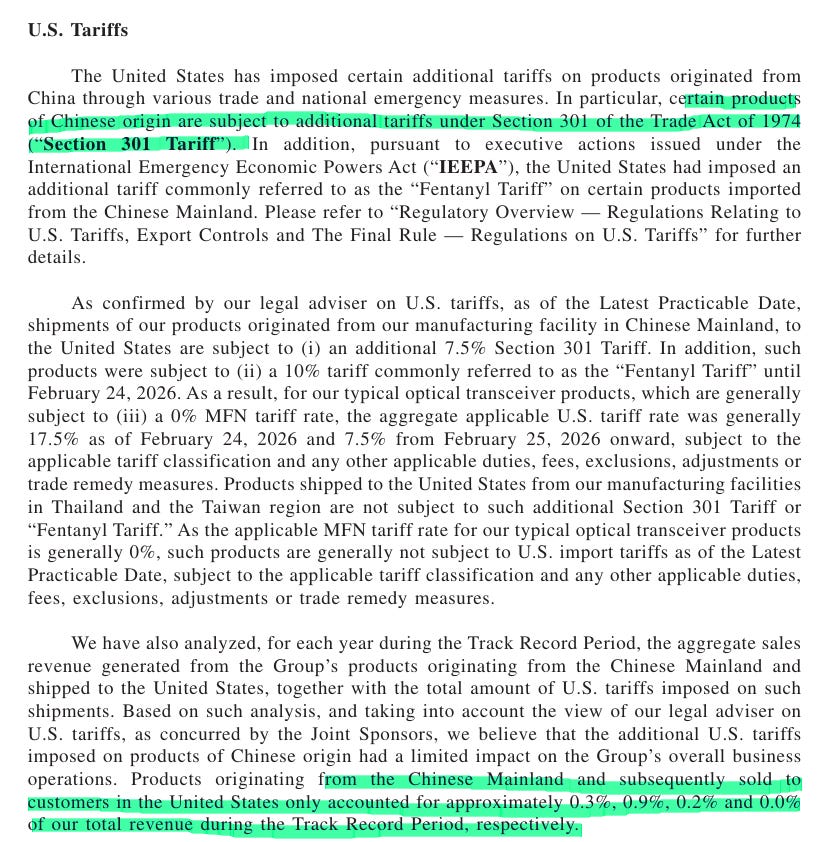
Prospectus, origin of US-bound shipments and regional revenue pages, 2026-07-22
