
Abstract
POET dropped 47.35 percent on April 27. The surface reason is an NDA breach, but the real question this piece raises is different. Why did Marvell, the day after announcing the Polariton acquisition, claw back every purchase order POET had received from Celestial AI in a single stroke? And why did the cancellation reach all the way back to the initial production order first disclosed on April 25, 2023? Pure retaliation would only have required cutting the recent batch. The 24-hour gap and the three-year-deep PO recall together look closer to a layer-cleanup signature.
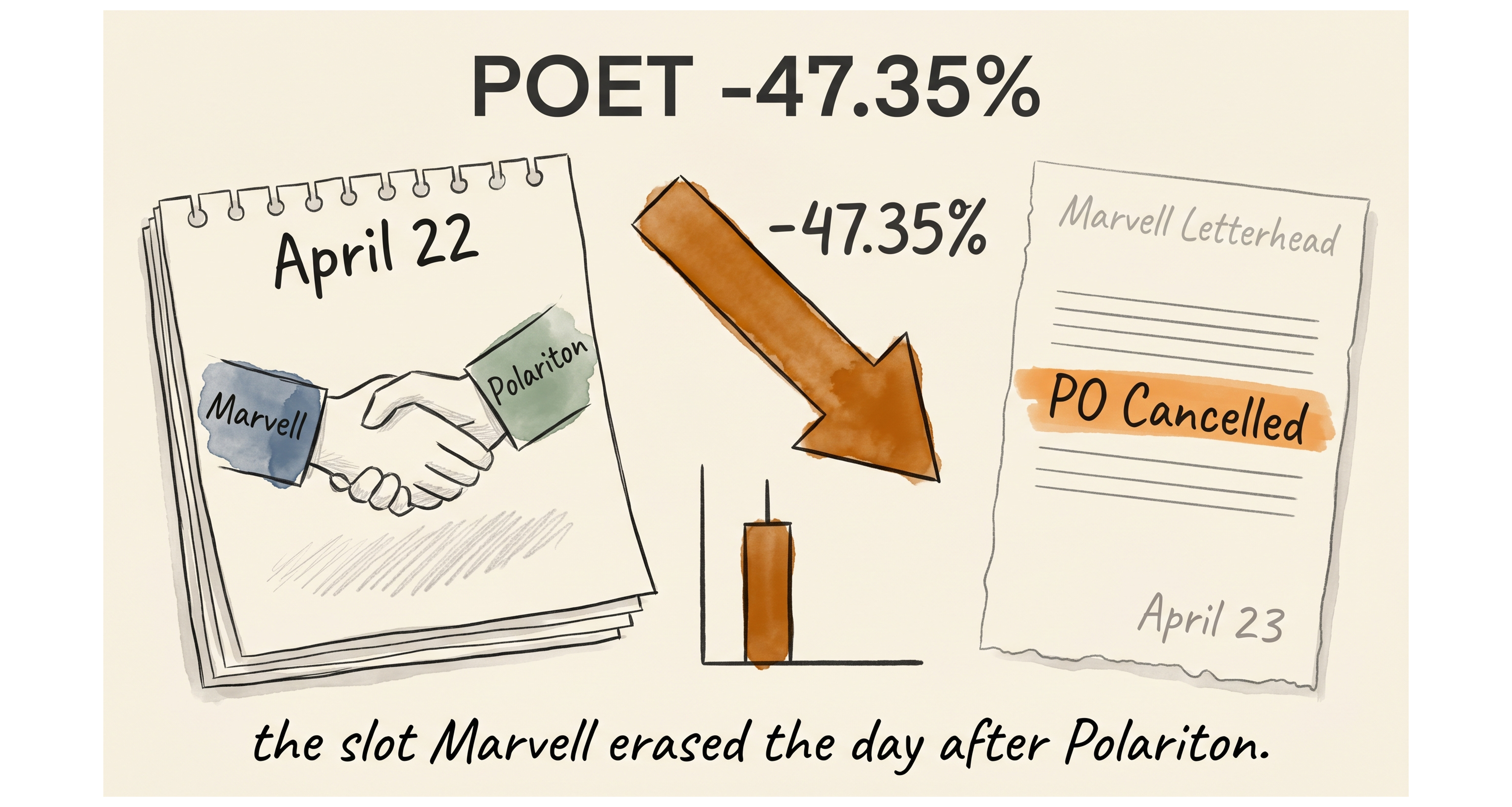
This piece breaks the event apart through the lens of optical-stack realignment. The free section unpacks the following:
§1 7 days in April: the timeline from the Polariton acquisition announcement (4/22) to the written notice to POET (4/23) to the -47.35% move (4/27). Combined with the Celestial AI acquisition close (2/2), the sequence shows modulator IP being pulled inside Marvell’s stack.
§2 Why μm is the key: the POH (Plasmonic-Organic Hybrid) modulator has an active section of 4 × 25 μm × 3 μm. A device capacitance of about 3 fF is what produces the sub-fJ/bit and 1 THz bandwidth values. This is a fundamentally different length scale from the sub-mm to mm-scale InP DFB light source.
§3 Why μm devices cannot be chiplet-bonded: bond-pad capacitance, RF interconnect parasitics, electrode transition, and organic-chromophore reliability are four reasons monolithic or BEOL integration is the natural fit. POET’s pick-and-place + passive-alignment paradigm has little obvious room here.
§4 Same polymer family, different integration schemes: the chromophore linkage between LWLG and Polariton, and the structural reason POET, being modulator-material agnostic, never locked in to any one camp.
Core thesis: this event is not a simple customer dispute. It is the first signal of a cycle where Marvell aligns which layers it pulls inside and which layers it leaves outside.
That is the surface of the event. The real divide starts in the paid section. The mechanism-level reason Ge EAM and POH do not collide inside the same stack (Franz-Keldysh vs Pockels), the multi-vendor POH ecosystem confirmed in the Nokia ECOC 2023 paper as a primary source (the Polariton-LWLG-Nokia link plus the Aref Chowdhury Nokia → LWLG CTO move plus the Karin Raj Nokia CTO Europe ↔ Sivers board concurrent seats), why SIVE escapes the same pressure, POET’s path forward and the cumulative disclosure-pattern risk, a 7-ticker + Polariton-internal positioning map, and a 3-scenario benefit/loss matrix are all unpacked in the paid section.
Table of Contents
Timeline: 7 days in April
Plasmonic-Organic Hybrid modulators: why μm is the key
Why μm devices cannot be chiplet-bonded
Same polymer family, different integration schemes
Why SIVE is not in the same layer
Celestial Ge EAM and Polariton POH: two modulators, two layers in the same stack
Nokia ECOC 2023 and the multi-vendor POH ecosystem
POET’s light-source integration was a strength. Why did it fail to land at Marvell?
POET’s path forward
Closing
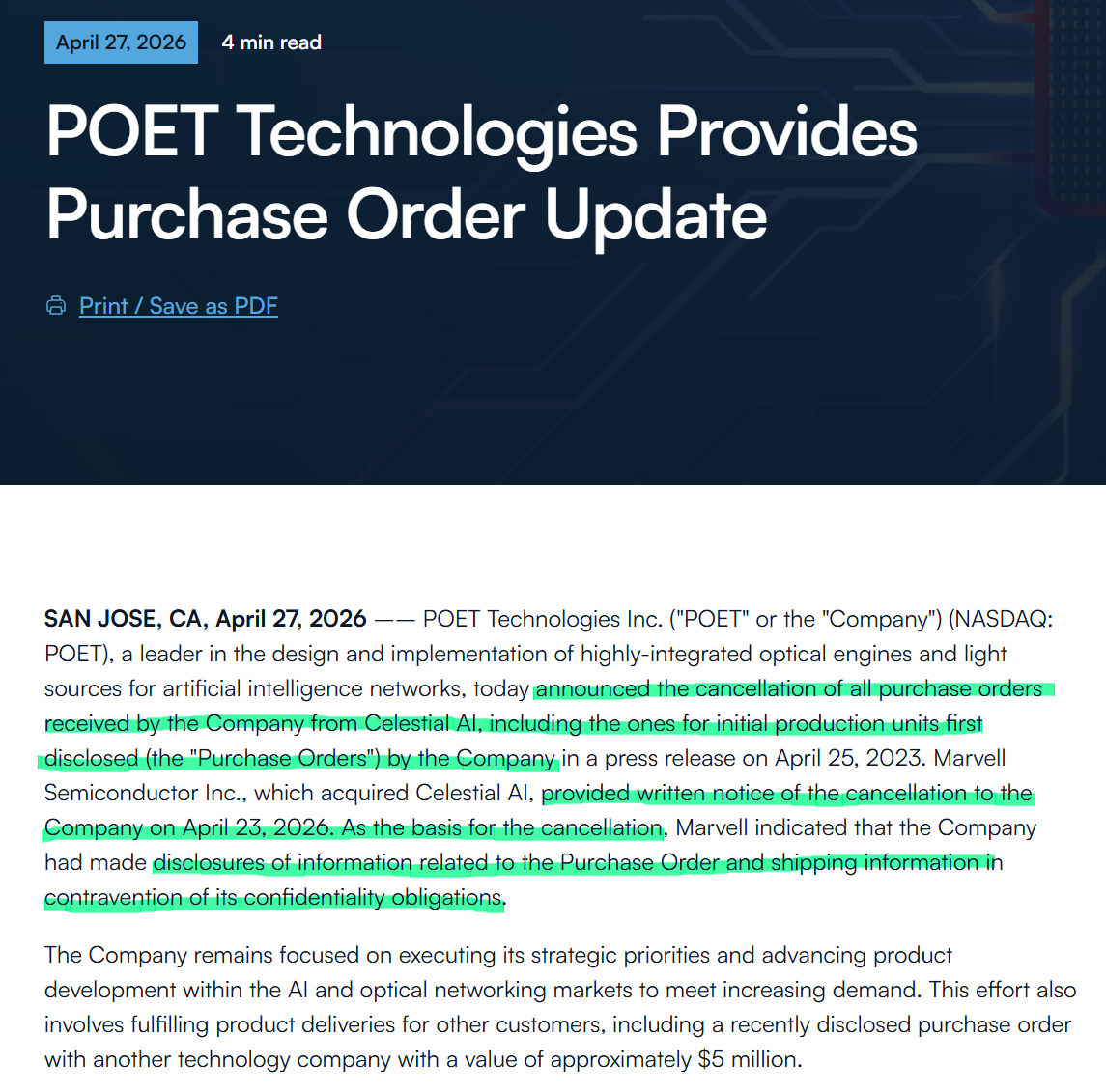
POET dropped 47.35 percent on April 27, closing at $7.95.[1][2] The surface reason is an NDA breach. POET CFO Thomas Mika went on Stocktwits TV and publicly disclosed both the Marvell purchase order and the state of Foxconn/Luxshare negotiations, and Marvell labeled this a violation of confidentiality obligations regarding the purchase orders and shipping information, then issued written notice on April 23 canceling every purchase order POET had received from Celestial AI.[1][3][4]
That is the official explanation.
But the question investors should be asking is different.
Why was every PO canceled, all the way back to the initial production order first disclosed on April 25, 2023, instead of just the recent batch? Pure retaliation would only have required cutting recent orders. Marvell reached back three years to wipe the entire history. Stranger still is the timing. Marvell announced the Polariton Technologies acquisition on April 22. Marvell issued written notice to POET on April 23. One day apart.[1][11]
The core hypothesis of this piece starts here. POET cancellation is hard to read as just an NDA breach. It looks more naturally as an external optical-engine slot being cleared right after Marvell brought modulator-and-system stack in-house through Celestial AI (closed 2026.2) and Polariton (announced 2026.4.22).
The official cause is the NDA breach. The reading below is PhotonCap’s inference based on the timing, scope, and technology layer in public materials. We have not seen Marvell’s internal decision memo.
So this piece narrows to two questions.
One, Celestial AI already had Ge EAM, so why did Marvell pay for another modulator? Aren’t they overlapping? Two, is this POH platform really Marvell-only, or was it already in the Nokia ECOC 2023 paper?
Once those are answered, the LWLG and SIVE optionality expands one notch beyond the prior PhotonCap take. And the real alpha here is not a single PO cancellation. It is which layers of the optical stack Marvell pulls in-house and which it leaves outside. The 12-month winner-and-loser line will fall along that boundary.
Summary: The official reason is an NDA breach. The timing (one day after Polariton) and the scope (entire history including the 2023 PO) are hard to read as simple retaliation. The framing of this piece is which layers Marvell is erasing from its optical stack.
1. Timeline
Marvell’s optical asset acquisition timeline, laid out in order:
2021: Inphi $10B (coherent DSP plus SiPh full stack) [5]
2021: Innovium $1.1B (Ethernet switch silicon) [6]
2024.10: Celestial AI absorbs Rockley Photonics IP, including over 200 patents on EAMs and optical switching [7]
2025.08: Celestial AI publicly discloses Photonic Fabric Module Gen1 with OMIB packaging at Hot Chips 2025, naming GeSi EAM as its chosen modulator [8][9]
2025.12 announce / 2026.2 close: Celestial AI $3.25B plus $2.25B milestone (Photonic Fabric, scale-up optical interconnect) [10]
2026.4.22: Polariton Technologies (undisclosed terms, Swiss POH modulator, ETH Leuthold spin-off) [11][12]
2026.4.23: Marvell sends written notice canceling every purchase order POET had received from Celestial AI [1]
2026.4.27: POET 6-K disclosure, stock down 47.35 percent, closes at $7.95 [1][2]
The interval between the Polariton acquisition announcement on April 22 and the PO cancellation written notice on April 23 is exactly one day. Two modulator IP acquisitions in eight months, on two different layers, paid for separately, followed immediately by clearing an external optical engine vendor. The sequencing is too clean to read as random.
Summary: Across eight months, Celestial (Ge EAM, intra-package) and Polariton (POH, transceiver/coherent) were absorbed as two separate modulator-IP layers, and POET’s entire PO history was canceled in the 24-hour window between them. The surface is NDA breach. The sequencing reads more like layer cleanup.
2. Plasmonic-Organic Hybrid Modulators: Why μm Is the Whole Point
This is the technical anchor. The plasmonic-organic hybrid (POH) modulator developed by the Polariton / ETH Leuthold lineage has an active region measured in micrometers. The numbers:
Heni et al., Nature Communications 10:1694 (2019)[13]
Active section 4 × 25 μm × 3 μm
Sub-1V driving electronics
0.07 fJ/bit at 50 Gbit/s
0.3 fJ/bit at 200 Gbit/s
2 fJ/bit at 400 Gbit/s
Device capacitance about 3 fF
Melikyan et al., Nature Photonics (2014)[14]
29 μm long plasmonic phase modulator
65 GHz bandwidth
Foundational POH paper
Haffner et al., Nature Photonics (2015)[15]
10 μm long all-plasmonic Mach-Zehnder
Microscale optical communication demonstration
Burla et al. / Ummethala et al., 500 GHz and THz plasmonic series[16]
Plasmonic modulation pushed into the sub-THz / THz domain
Horst et al., Optica (2025), Polariton + ETH joint[17]
3-dB EO bandwidth 997 GHz
6-dB EO bandwidth above 1 THz
Frequency response measured up to 1.1 THz
Wiley Advanced Materials Technologies (2025), silicon MRM comparison[18]
Conventional silicon micro-ring modulators bottleneck around 42.5 to 54 GHz EO bandwidth. Order-of-magnitude gap to POH.
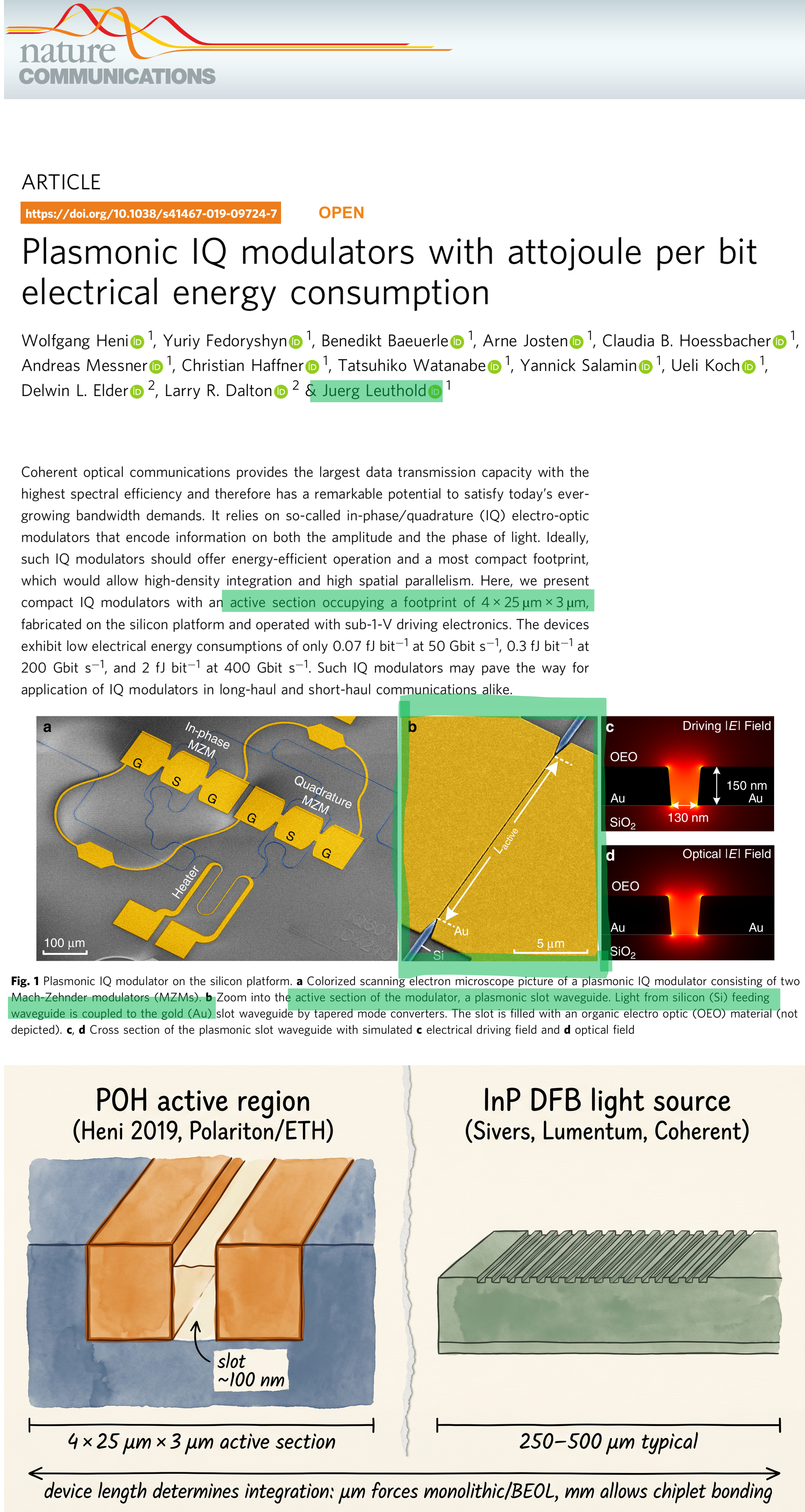
[Figure 1: POH μm active region vs InP DFB sub-mm/mm-scale light source, RF parasitic contrast]
The point is not the headline numbers. The point is that the active region is in the micrometer scale. Conventional silicon Mach-Zehnder modulators need millimeter-scale length. Thin-film LiNbO3 also needs millimeter scale. POH puts an EO chromophore inside a metal slot. The electromagnetic field is squeezed into a slot tens of nanometers wide, and the EO efficiency rises sharply. The same input produces a much larger output.
This architecture is the result of fifteen years of continuous work in the Leuthold group: plasmonic absorption modulator at KIT in 2011 (Optics Express), the 2014 Nature Photonics phase modulator at ETH, the 2015 Nature Photonics all-plasmonic MZM, the 2018 Nature low-loss plasmon-assisted modulator, the 2019 Nature Communications IQ modulator, and the 2025 Optica 1 THz result.[13][14][15][17][19]
Summary: The core POH value is sub-fJ/bit and 100 GHz plus bandwidth from a 4 × 25 μm active region. The device length scale is fundamentally different from mm-scale silicon and TFLN, and that fact dictates the integration scheme.
3. Why μm Devices Cannot Be Chiplet-Bonded
POET’s core IP is the combination of Optical Interposer, elastic averaging passive alignment, and Laser-Assisted Bonding (LAB). Mohamed et al. in JLT 2023 reported, on a 100-sample basis, post-bond X 0.09 μm, Y 0.39 μm, θ 0.0002° at 3σ using a triangle slide-stop geometry.[20] At ECOC 2025, POET demonstrated a 1.6T 2xFR4 PIC with S_sd21 of 53.7 GHz, 8 dBm per channel at 100 mA, 4 dB ER, and 2 dB TDECQ at 106 Gbaud PAM4 SSPRQ.[21] The equipment stack is ASMPT AMICRA NANO (±0.2 μm), Vanguard FaML (Mycronic), and SMBI wafer-level burn-in.[22]
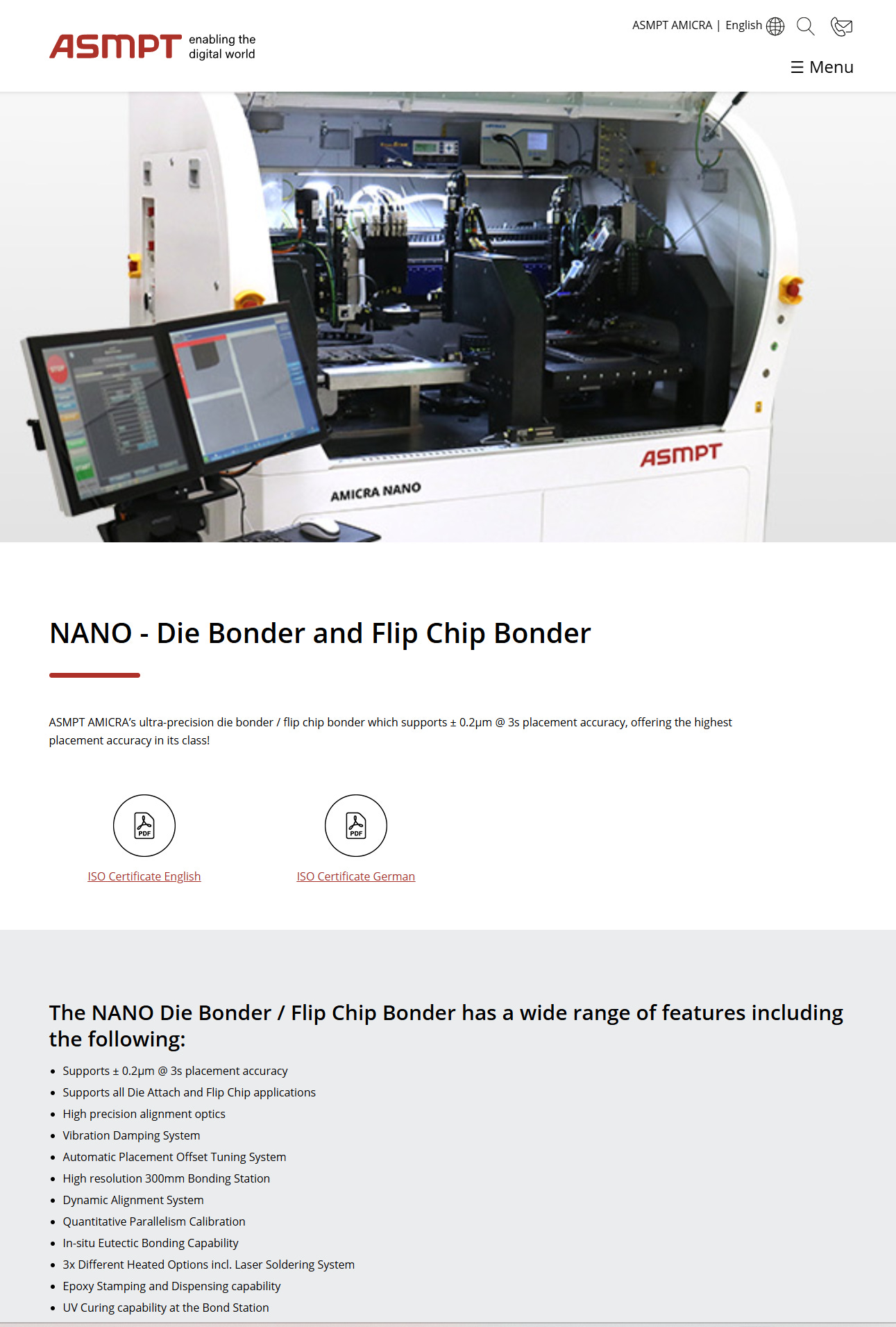
This paradigm fits mm-scale devices very well. Sivers DFB lasers and Mitsubishi dual-facet EMLs are millimeter-scale, so the interface loss from bonding is small relative to device loss itself. The full equipment-and-paper analysis was covered in the prior PhotonCap POET deep-dive piece.[22]
$1.1M Revenue, $1.1B Market Cap: The “Assembly Stage” POET Is Actually Holding

POET generates $1.1M in TTM revenue. Its market cap sits at $1.1B (as of April 17, 2026). PSR of roughly 1000x. What the market is pricing is not revenue. It’s the “stage” POET is holding. This article starts with the actual equipment POET showed in its 12-month review video (June 2025), works through six peer-reviewed papers, and traces the four-company supply chain (Marvell-Celestial-POET-Sivers) that formed between Celestial AI’s April 2023 advanced purchase order and Marvell’s Celestial acquisition closing in February 2026. Three conclusions: (1) POET is not a SiPh chip maker. It builds the “assembly stage” for optical modules. (2) The core technology, elastic-averaging-based sub-micron passive alignment, has been validated at the academic level. (3) RIN, post-bond noise, and production yield remain undisclosed territory.
The same paradigm becomes much less natural for μm-scale POH. There are four reasons.
1. Bond-pad capacitance can easily overwhelm device capacitance. The Heni 2019 POH device capacitance is around 3 fF. Once the device is attached as a discrete chiplet, the bond pad, solder bump, wire, redistribution metal, and package trace can add tens to hundreds of fF of parasitic capacitance. The driver is no longer charging a 3 fF modulator. It is charging the package interface as well. That erodes the sub-fJ/bit value proposition at the interface.
2. RF interconnect parasitics can become larger than the device parasitics. A μm-scale modulator only preserves its advantage if the RF path stays extremely short and well controlled. Chiplet bonding introduces pads, bumps, short traces, vias, and package transitions. Their impedance discontinuities, reflections, and losses can dominate the high-speed signal. Even a device with THz-class EO bandwidth loses much of its system-level value if the package transition becomes the bandwidth bottleneck.
3. RF launch and electrode transition enter the same length scale as the active device. When the POH active section is roughly 25 μm long, the bond pad, electrode taper, and nearby signal-line transition are no longer remote packaging details. At that length scale, the modulator response is no longer determined by the active slot alone. The RF launch and electrode geometry must be co-designed with the device. That makes monolithic or BEOL co-design much more natural than a discrete chiplet path.
4. Organic chromophore reliability requires package-level co-design. EO chromophores can be sensitive to humidity, UV exposure, thermal cycling, and long-term poling stability. BEOL-level integration lets passivation, encapsulation, and thermal path be designed together with the device process. Chiplet bonding adds underfill, edge sealing, and CTE-mismatch failure modes. This is one reason the Polariton/ETH lineage repeatedly emphasizes CMOS-compatible BEOL integration.[23]

The implication: when Marvell acquired Polariton, the modulator IP at minimum will be processed inside monolithic SiPh, not through an external packaging house. POET’s pick-and-place plus passive-alignment paradigm therefore has little obvious entry point at the device level for this specific asset.
📊 Summary: A 25 μm device routed through a millimeter-scale bonding infrastructure loses its value proposition to bonding parasitics. Monolithic or BEOL-level SiPh integration is the structurally natural fit, far more than an external packaging-house path.
4. Same Polymer Family, Different Integration Schemes
This is where the LWLG bet and the Polariton bet diverge.
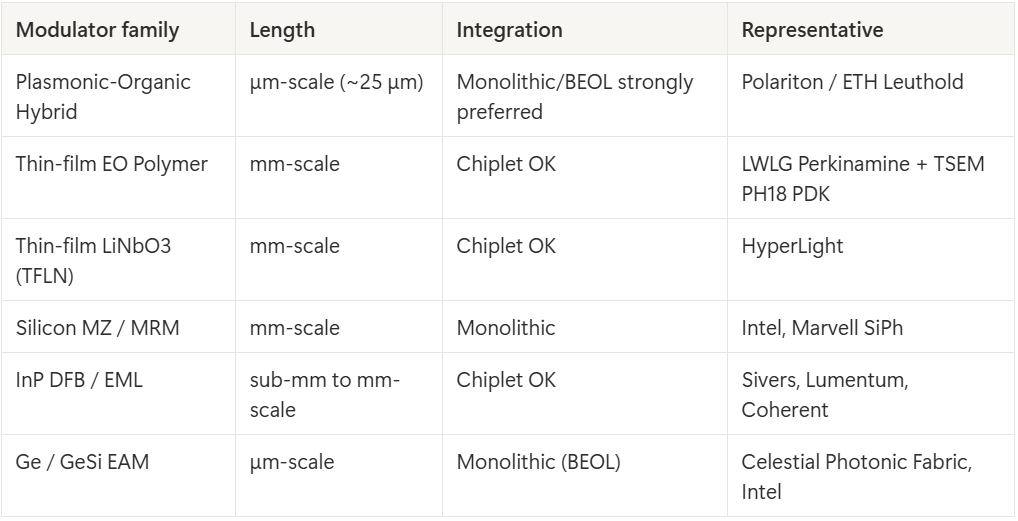
When the modulator is millimeter scale, the bonding interface loss is tolerable. LWLG and TFLN families have die-level heterogeneous integration as a viable production path. POET should have aimed at the thin-film EO polymer slot, but its InP DBR plus interposer model is modulator material agnostic, so it never locked into any single material camp.
EO polymer chemistry exists at multiple suppliers, including Lightwave Logic, NLM, and others. POH does not differentiate at the polymer molecule. It differentiates at how that polymer is placed into the slot. Polariton’s integration recipe with Perkinamine series 3 is ten years of accumulated work from the Leuthold group at ETH Zurich. The March 2025 expansion of the LWLG-Polariton partnership was specifically about taking that recipe into a 200 mm foundry PDK.[24]
The Polariton acquisition created Marvell’s indirect exposure to LWLG. That topic was covered in the prior Polariton acquisition piece.[23] If the chromophore inside POH is the Perkinamine family, LWLG holds an indirect supplier position into the Marvell stack as the modulator material vendor. (This hypothesis is then confirmed at primary-source level in §7 via the Nokia paper.)
📊 Summary: Device length determines whether chiplet bonding is viable. POH naturally favors monolithic or BEOL integration. EO polymer thin films and TFLN allow chiplet. InP DFB at mm scale also allows chiplet. The integration architecture is dictated by device length, not material chemistry alone.
This is where the surface of the event ends.
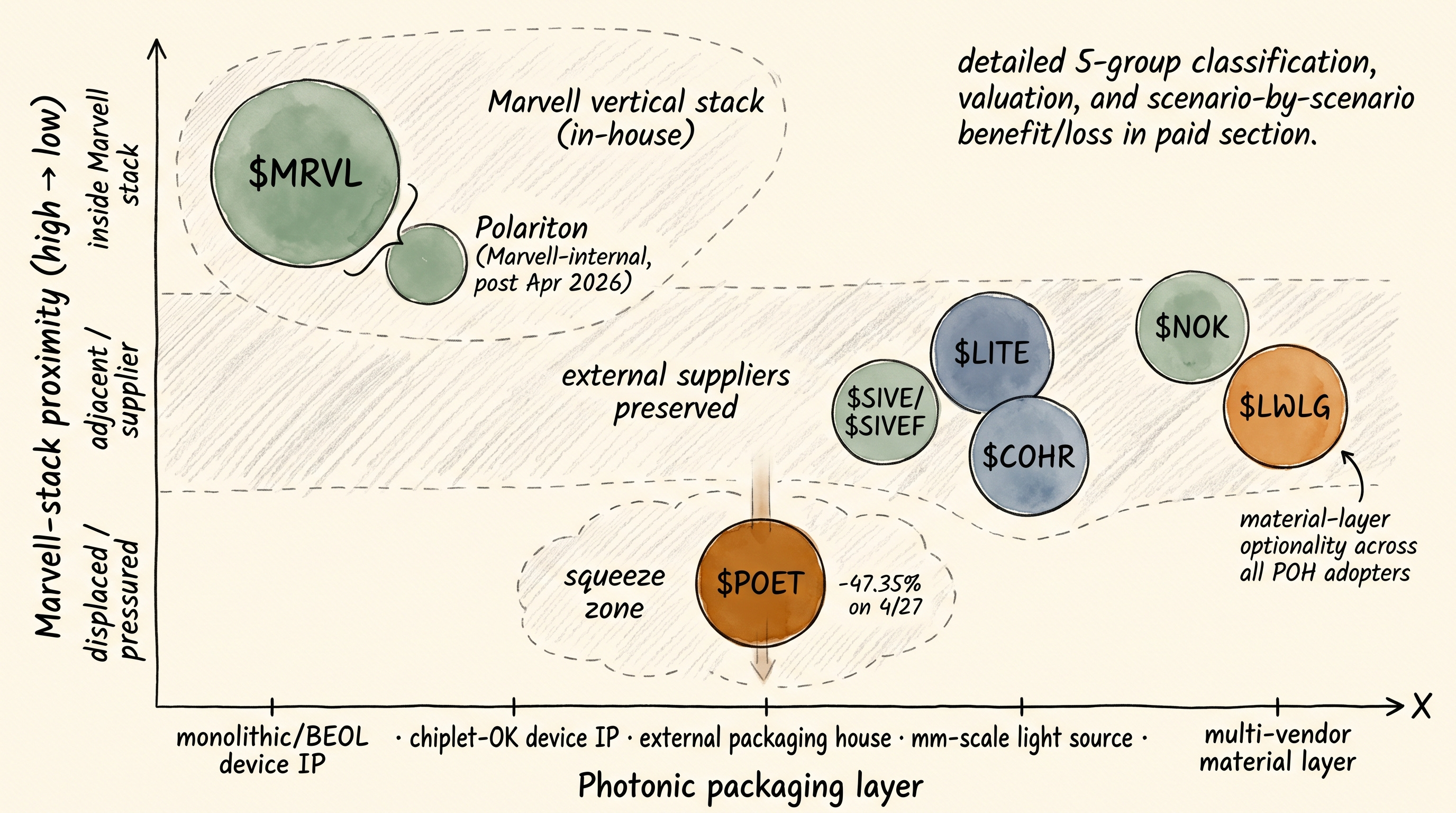
[Figure 2: 7-company positioning matrix, photonic packaging layer × device material layer]
What we have unpacked so far:
Marvell canceled every POET PO the day after announcing Polariton (timing + scope)
POH’s μm device + sub-fF capacitance value is preserved by monolithic/BEOL integration (chiplet is possible but RF parasitics erode the value)
POET, being modulator-material agnostic, did not lock in to any one camp
The real divide starts here. The seven tickers (POET, SIVE, LITE, COHR, MRVL, NOK, LWLG), plus Polariton as a Marvell-internal asset, all sit on the same event, but they split into four distinct groups: the company already pushed out of the packaging layer, the company on a different layer that escapes the pressure, the company carrying multi-OEM material optionality, and the company that sits on both ends of the two acquisitions. Their risk/reward profiles diverge sharply.
Two Hidden Cards live in this cycle. One is the mechanism-level reason Ge EAM and POH do not collide inside the same stack. The other is the multi-vendor POH ecosystem confirmed in the Nokia ECOC 2023 paper as a primary source. These two are the asymmetry-position variables for the next 12 months.
The whole question reduces to one line.
Which layers is Marvell pulling inside, and which layers is it leaving outside?
— PAID SECTION begins —
The paid section unpacks that question into a layer-realignment map across the seven companies.
What the paid section covers:
§5 Why SIVE is not in the same layer: what it means that Marvell absorbed modulator IP while leaving light-source IP outside
§6 Celestial Ge EAM and Polariton POH mechanism split: the mechanism-level reason the two modulators do not collide inside the same stack (Franz-Keldysh vs Pockels)
§7 Nokia ECOC 2023 + multi-vendor POH ecosystem: primary-source confirmation of the LWLG-Nokia-Polariton link, plus the Aref Chowdhury personnel move
§8-§9 The nature of POET’s layer pressure and its path forward: why POET’s strength in light-source integration did not land at Marvell, and the MSA pluggable + module-vendor pivot
Additional analysis: 7-ticker identification table plus Polariton-internal mapping, 5-group classification, Ge EAM vs POH wavelength mapping, 3-scenario benefit/loss matrix (Polariton in-house success / TSMC COUPE fallback / integration delay), Hidden Card events (256 GBd PAM trade-off, Polariton price estimate + LWLG royalty scenarios, Nokia next-gen coherent POH adoption odds), quarterly monitoring points
§10 Closing: thesis wrap-up
