
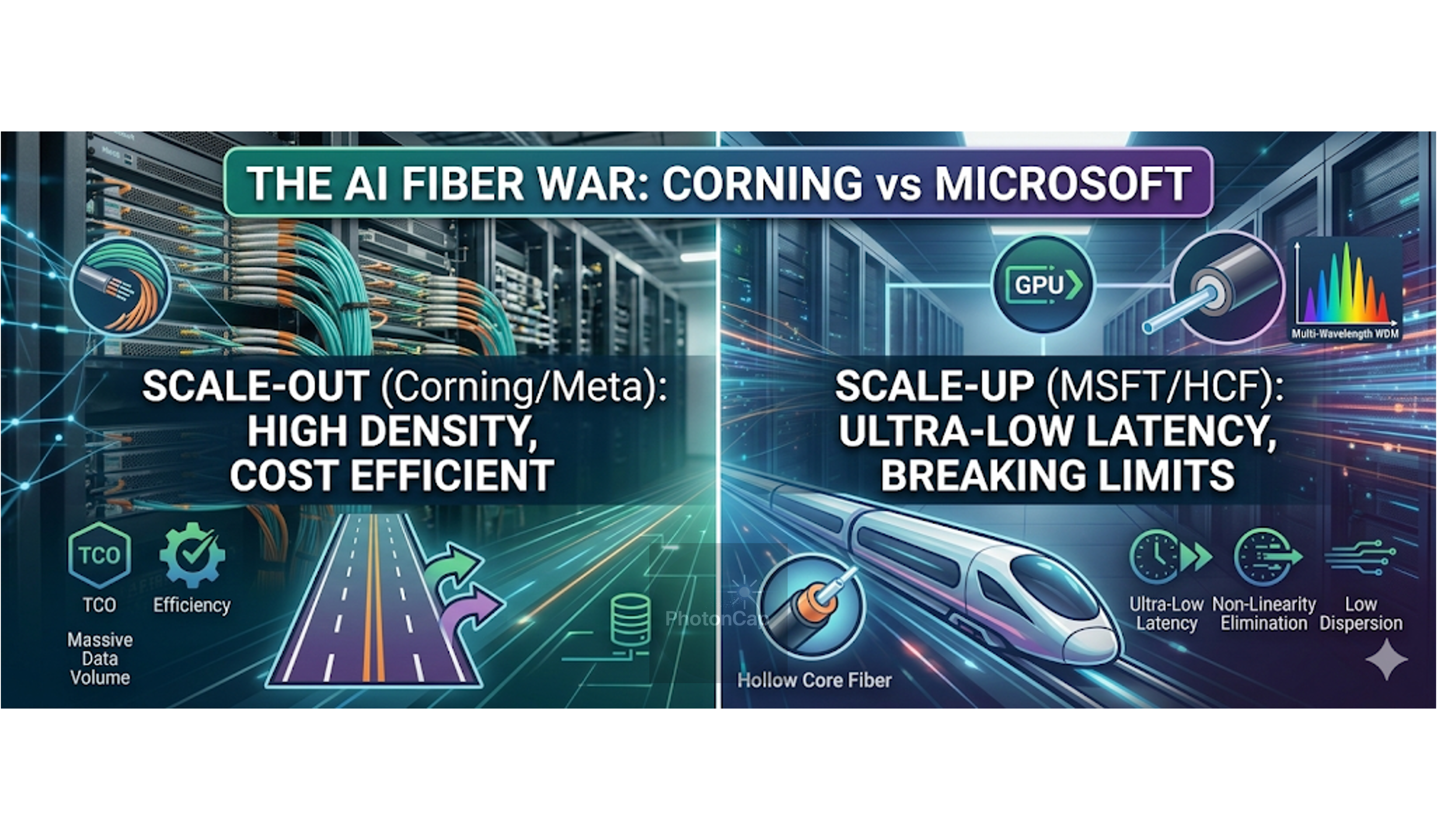
Recently, the news that Meta is deploying Corning’s optical solutions on a massive scale to build its next-generation AI data center infrastructure has captured the industry’s attention. On the surface, this might look like a simple vendor selection announcement, but beneath it lies a philosophical divide in how big tech companies are solving the ‘AI Connectivity’ bottleneck.
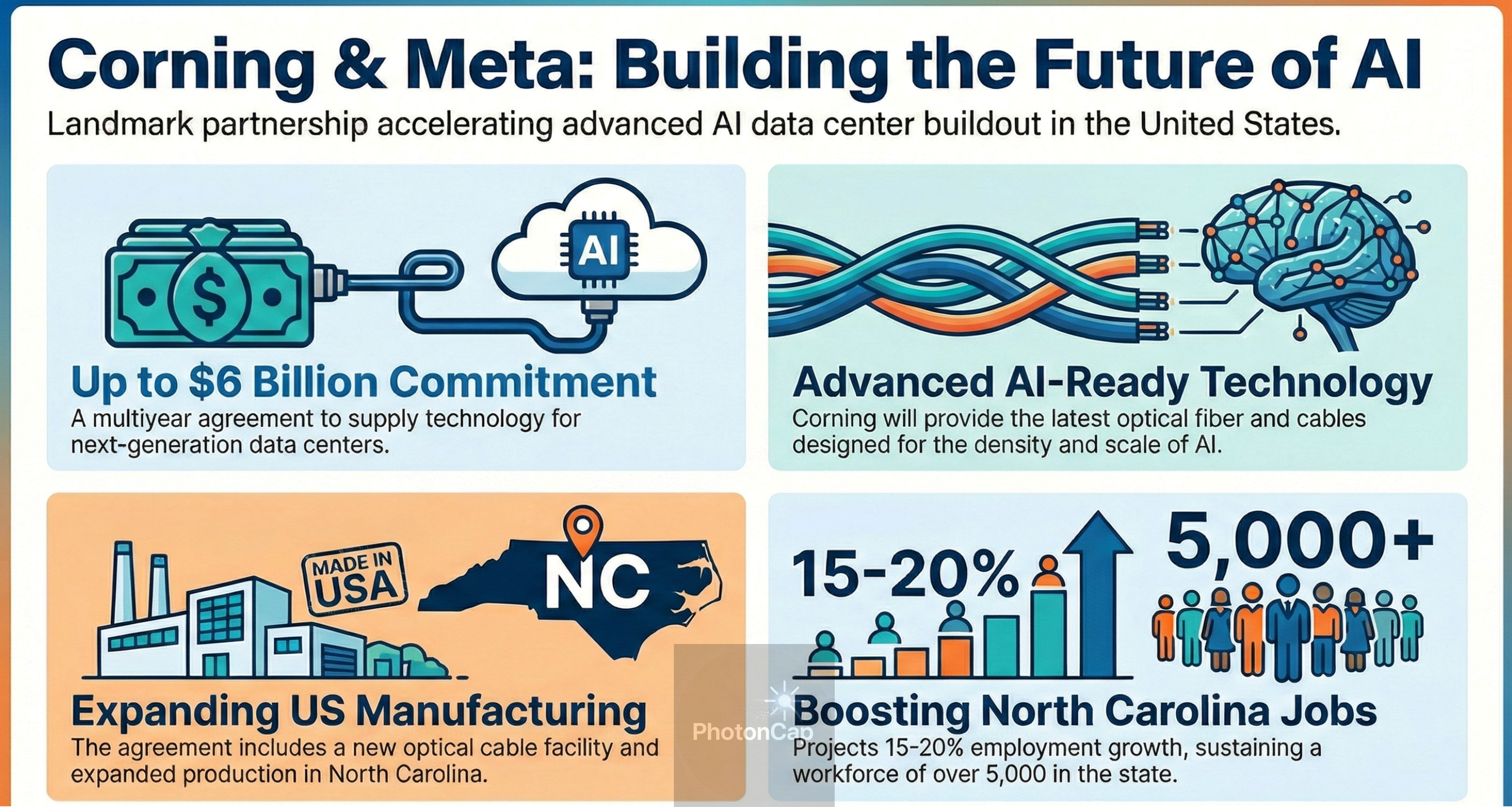
Following up on my previous deep dive, [Beyond Loss Records: Microsoft’s Hollow-Core Fiber as a Foundation for Scale-Up CPO], I wanted to further explore how these different philosophies—Corning’s high-density scaling and Microsoft’s physical limit breakthrough—are shaping the future of AI. My analysis of the recent Nature Photonics (2025) paper by the Microsoft (MSFT) Azure Fiber team reveals that we are witnessing a transition from purely logical networking to a new era of “Physical Scale-Up.”
Beyond Loss Records: Microsoft’s Hollow-Core Fiber as a Foundation for Scale-Up CPO

(⚠️ This article reflects personal opinions based solely on reading the paper.)
The piece astutely analyzes the Hollow-Core Fiber (HCF) research recently published in Nature Photonics (2025) by the Microsoft ($MSFT) Azure Fiber team, accurately capturing the undercurrents of the optical communication market.
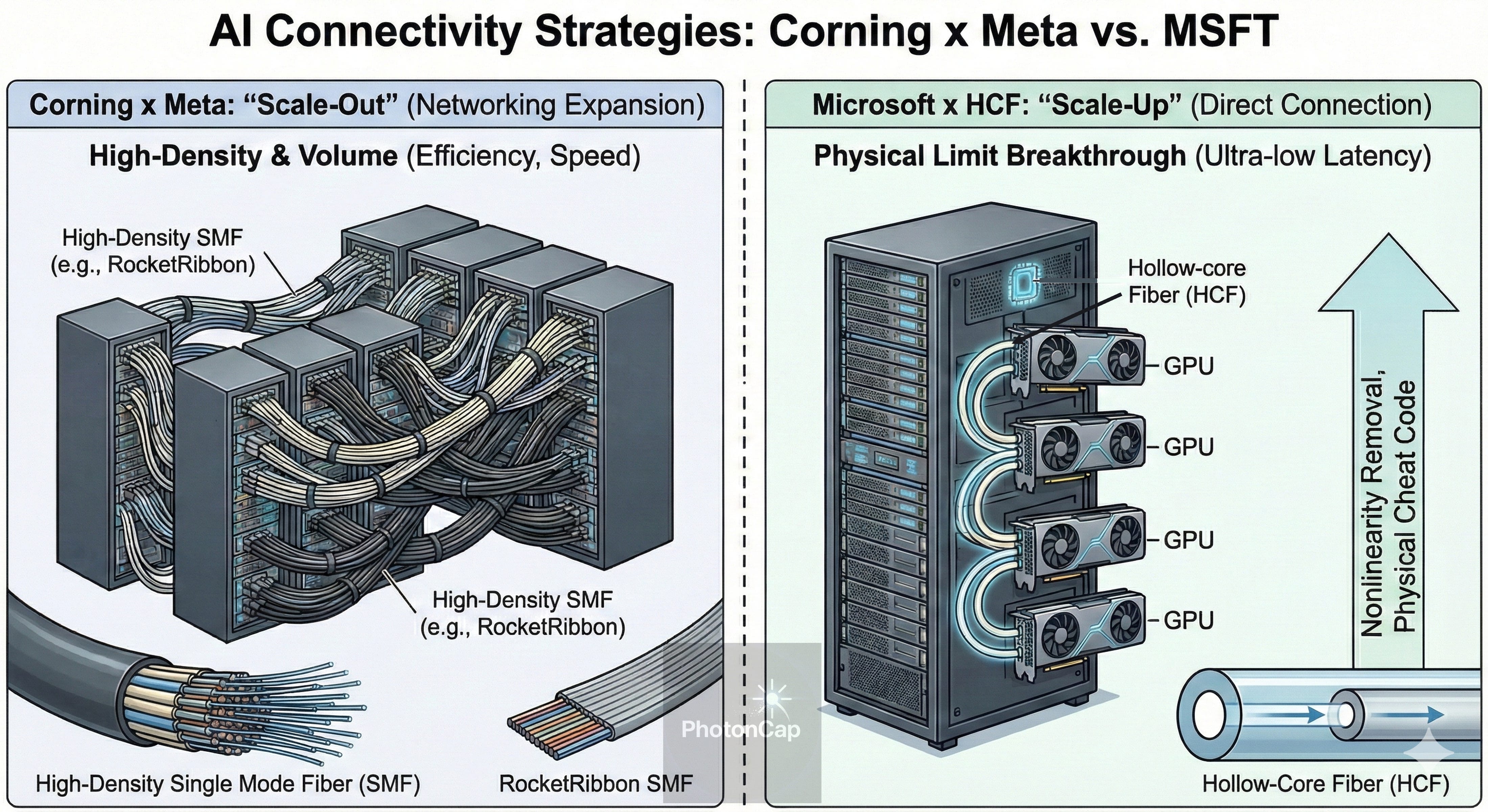
Today, borrowing key insights from that article, we will conduct an in-depth comparative analysis of the “Scale-Out” strategy demonstrated by Meta and Corning, versus the future of “Scale-Up” that MSFT envisions through Hollow-Core Fiber (HCF).
1. The Era of SMF-28: “Great, but Hitting Limits in AI Clusters”
Optical communication technology was born in the 1960s from the proposal of Professor Charles K. Kao (who won the 2009 Nobel Prize in Physics), and fully blossomed in the 1970s when Corning successfully commercialized it.
Among these advancements, SMF-28 (standard silica optical fiber) has been the backbone of the telecommunications industry for decades. It enables hundreds of Tb/s of transmission via DWDM (Dense Wavelength Division Multiplexing) and is optimized for telecommunication backbones spanning thousands of kilometers.
However, the specifications required by AI Data Centers (AIDCs) are fundamentally different. While traditional telecom networks target ‘long distances,’ the core requirements for AIDCs are ‘short distances, ultra-low latency, and high power density.’ Although legacy SMF-28 boasts low loss rates, it faces a fatal physical limitation known as Non-Linear Effects when attempting to scale up WDM to handle the explosive traffic inside AI clusters.
When high optical power is concentrated in silica (glass) fiber, the refractive index changes slightly, causing inter-channel interference and distortion (FWM, XPM, SPM, etc.). To suppress this, the wavelength spacing must be widened or dispersion increased, which directly leads to a drastic reduction in bandwidth efficiency, massive DSP (Digital Signal Processing) power consumption, and increased latency.
2. Corning x Meta: Breaking the Traffic Jam with High-Density “Scale-Out”
In this context, the realistic and immediate solution chosen by Meta and Corning is Scale-Out (expanding inter-rack connectivity).
The biggest bottlenecks in Scale-Out are TCO (Total Cost of Ownership), power efficiency, and the limited conduit space (I/O Space & Fiber Real Estate) inside the data center. As AI clusters grow massive, the number of cables connecting racks has exploded to the point where there is simply no physical room left to lay more fiber.
The core of the solution Corning is providing to Meta lies in overcoming this ‘space limitation.’ Corning’s ultra-high-density SMF technologies, like RocketRibbon®, pack thousands of optical fibers inside a single cable while maintaining standard cable dimensions.
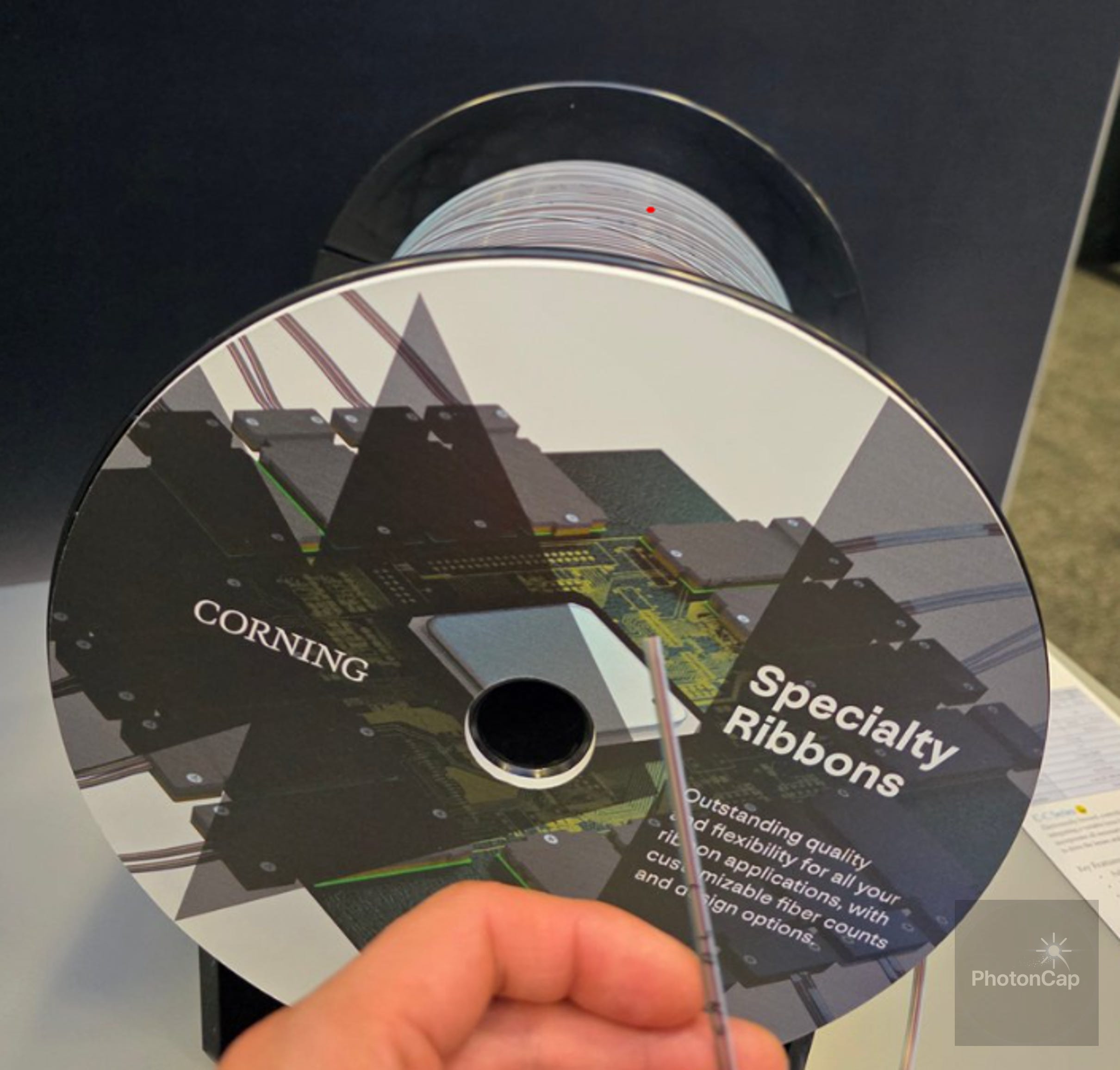
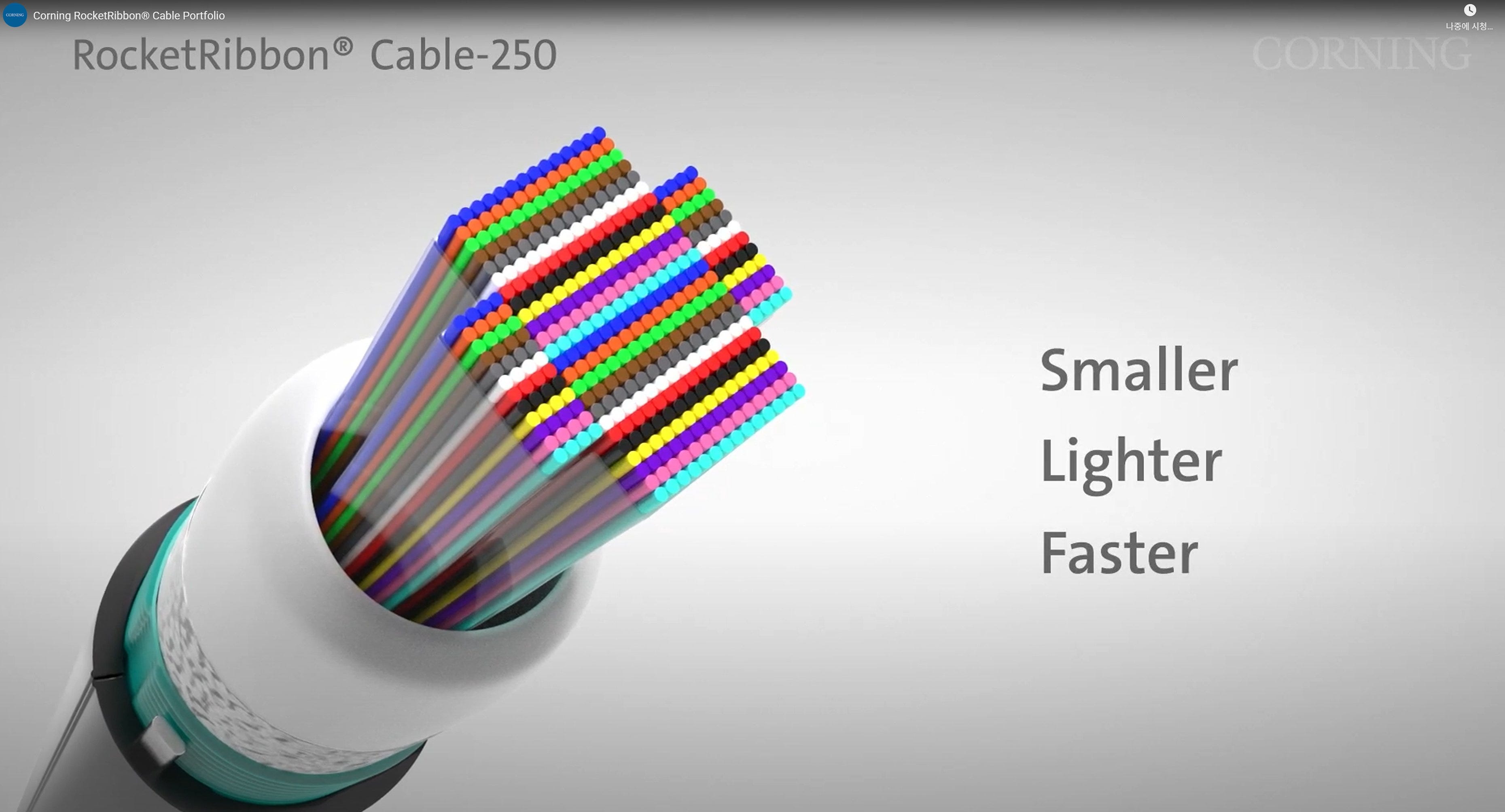
This is the most realistic and powerful ‘brute-force’ strategy, maximizing the manufacturing scaling of legacy silica-based optical fibers to multiply the fiber density per area. Through this, Meta is shortening installation times and completely bypassing the spatial constraints of the data center.
3. MSFT x HCF: The Blueprint for “Scale-Up” to Break Physical Limits
On the other hand, Microsoft’s (MSFT) approach is focused on breaking optical limits by completely overhauling the transmission medium itself.
Around 1985, NTT and Corning developed pure silica core fibers with a loss of 0.154 dB/km, reaching the physical limit of glass known as ‘Rayleigh scattering’ (approx. 0.14 dB/km). This record remained unbroken for nearly 40 years, until recently, when the MSFT Azure Fiber team achieved a staggering loss rate of 0.091 dB/km using Hollow-Core Fiber (HCF), publishing their results in Nature Photonics (2025).
By forcing light to travel through the ‘air’ (near vacuum) inside the core rather than solid glass, HCF offers a physical cheat code that goes far beyond simple loss reduction:
Zero Nonlinearity: The nonlinear coefficient of an air core is approximately 1,000 times lower than that of silica.
Ultra-Low Dispersion: At 1/7th the dispersion of SMF, it drastically reduces the power consumption of DSPs required for signal recovery.
30% Latency Reduction: Due to the difference in the refractive index of the medium (Air 1.00 vs. Glass 1.44), the propagation speed of light itself becomes significantly faster.
4. Reading Between the Lines: MSFT’s ‘True Intent’ and Direction
The author of the aforementioned Substack article offers a highly intriguing interpretation. While MSFT’s paper superficially emphasizes “breaking the loss record” over long distances, the true target is securing a WDM Scale-Up platform via ‘zero nonlinearity + low dispersion + ultra-low latency.’
Of course, MSFT is not going to fully deploy HCF for direct GPU-to-GPU connections (Scale-Up) in AI data centers tomorrow. There are still commercialization hurdles to overcome, including mass production yields, complex splicing processes, and coupling loss (approx. 0.5~1 dB) when connecting with SMF-28.
However, MSFT’s long-term direction is already crystal clear. MSFT didn’t just write a paper and stop there; in 2022, they acquired Lumenisity, a spin-off from the University of Southampton (ORC) in the UK and a leading startup in HCF.
This means they have internalized an entire ecosystem: ‘Foundational Research (ORC) → Process & Manufacturing (Lumenisity) → Hyperscale Implementation (MSFT Azure).’ While it may be applied in pilot forms for campus-to-campus data transmission or Metro DCI (Data Center Interconnect) in the short term, the ultimate destination is highly likely to be the GPU-to-GPU direct connections (Optical Package) inside AI clusters, where ultra-low latency is critical.
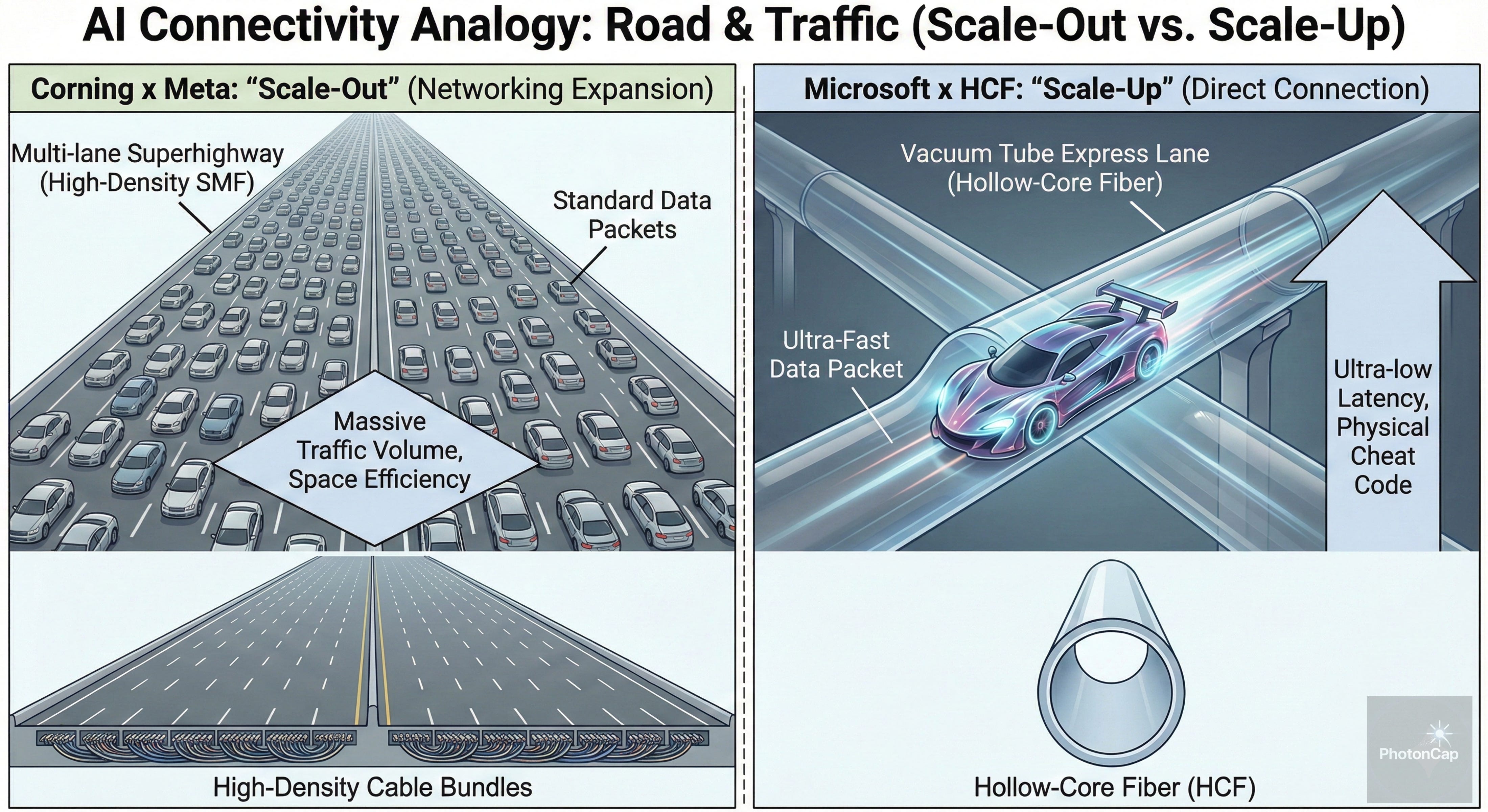
As the analogy in the attached infographic illustrates, if Corning’s strategy is to widen an existing road into a 64-lane ‘High-Density Superhighway’ to handle massive traffic, MSFT’s HCF is the task of building a ‘Vacuum Tube Express’ that completely eliminates the physical speed limits and resistance of the cars themselves.
5. Conclusion: The Hybrid Topology Future of AI Infrastructure
Currently, the scale-up of AIDC infrastructure is happening at the logical (network topology) level, while true ‘optical physical Scale-Up’ remains in the research and early commercialization phase.
The partnership between Meta and Corning is the most definitive, logical Scale-Out approach to solving the immediate problems of ‘volume and space.’ Conversely, MSFT’s HCF research and corporate acquisitions are strategic moves to preemptively break through the physical limits that next-generation AI infrastructure will inevitably face.
The data centers of the future will be a convergence of these two technologies. We are on the verge of a ‘Hybrid Optical Network Era,’ where the data center backbone is firmly supported by Corning’s high-density SMF, while the core nervous system of ultra-high-performance GPU clusters is connected at lightning speeds by HCF.
References:
Inspiration & Core Analysis: PhotonCap Substack: “Motivation for Writing This Article... Scale-Out vs Scale-Up”
Academic Paper: Nat. Photon. 19, 1203–1208 (2025). Microsoft Azure Fiber & ORC University of Southampton. (DOI: 10.1038/s41566-025-01747-5)
Technical References:
Corning Official Product Brief: RocketRibbon® & Specialty Ribbons (Corning YouTube Video)
Microsoft’s Acquisition of Lumenisity (Dec 2022, Microsoft Official Blog)
Broadcom OCP SUMMIT 2025 Presentation: “Scale Out Networks and Scale Up Architectures with CPO”
Read more:

Disclaimer: This article is an independent, engineering-driven technical analysis published by PhotonCap. All content is based on publicly available information and is intended for educational and informational purposes only. Nothing herein constitutes a recommendation to buy, sell, or hold any security. The author may hold positions in securities discussed and may transact at any time without notice. Readers should conduct their own due diligence before making any investment decisions. #NotFinancialAdvice