SpaceX, the Secret Behind the $800 Billion Valuation: Space Connected by Lasers, and Finding Hidden Beneficiaries
Elon Musk denied the report, but the market's excitement is real. We dive into the '1550nm laser' technology connecting space and the hidden supply chain stocks
The Real Reason the Market is Obsessed with SpaceX (Despite Musk’s Denial)
Recent reports from the Wall Street Journal (WSJ) and others shook the market by stating SpaceX’s enterprise value reached $800 billion (approx. 1,100 trillion KRW).
However, Elon Musk immediately drew a line, dismissing it as ‘Inaccurate.’ He stated that SpaceX is already cash flow positive and has no reason to raise funds.
Nevertheless, why should we pay attention to this happening? Despite Musk’s denial, the important shift is that the market has begun to view SpaceX as a ‘Global Big Tech’ class company. The source of this massive expectation isn’t rockets, but the ‘Laser Link Technology’ connecting space with light.
1. Cash Cow: Why ‘Starlink’, Not Rockets?
SpaceX’s symbol is the massive rocket Starship bound for Mars, but the real breadwinner filling the company’s wallet is Starlink.
The Power of the Subscription Economy: Rocket launches are close to one-off events where revenue occurs per mission. Conversely, Starlink is a cash-generating machine with an estimated 8 million subscribers by the end of 2025 paying monthly subscription fees that flow in continuously.
Virtuous Cycle of Funds: The massive cash earned by Starlink through the space internet business is poured directly into the development costs of the next-generation launch vehicle, Starship. Essentially, Starlink’s success is the core engine guaranteeing SpaceX’s future.
2. Technical Analysis: The Backbone of Space Internet, ‘Laser Links’
The technical moat where Starlink overwhelms competitors like OneWeb or Amazon Kuiper lies in Optical Space Lasers.
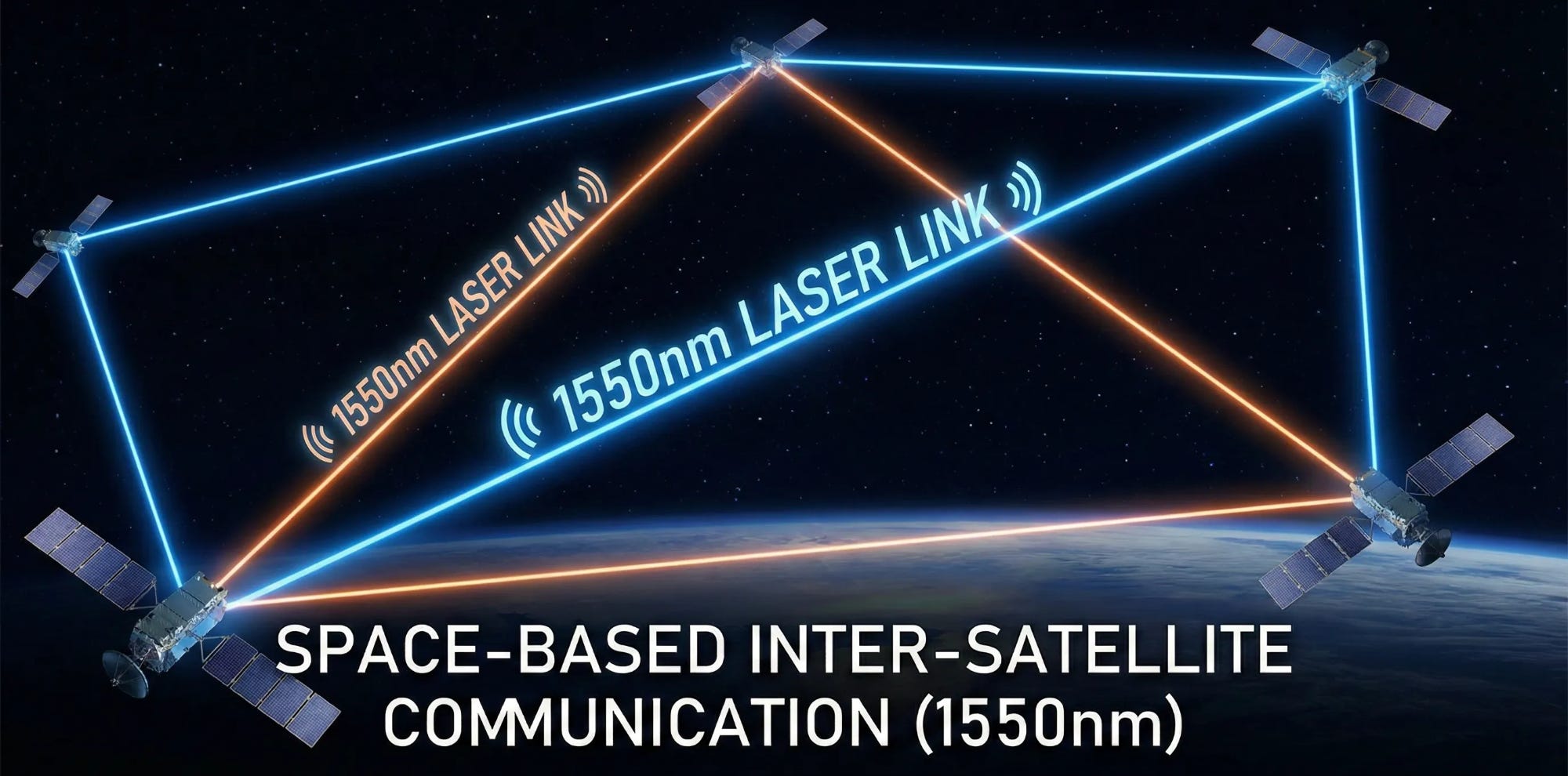
Unlike past satellite communications that required bouncing signals to ground stations, Starlink satellites exchange data via lasers in space. In the vacuum of space, there is no medium to obstruct light, so light travels about 30% faster than in optical fiber, and paths can be designed to be straighter, expecting a 20–40% reduction in latency for global communication. This becomes an irreplaceable advantage in financial trading or military operations where ultra-low latency is vital.
The Key is the ‘1,550nm’ Wavelength: The Secret of the Economic Moat
So, what lasers is SpaceX using? Technical analysis suggests they are using the 1,550nm (nanometer) band, not a proprietary standard. There are crucial economic and technical reasons hidden here.
Supply Chain Unification: 1,550nm is the standard wavelength (C-Band) used in terrestrial data centers and optical networks. Instead of developing new space-grade parts, SpaceX drastically cut costs by utilizing commercial off-the-shelf components already in the market.
Eye Safety: The 1,550nm wavelength is absorbed by the cornea and does not reach the retina. Therefore, it is harmless to the human body (eyes) when communicating with ground stations, making it far more advantageous for obtaining regulatory approval.
3. Fact Check: Evidence SpaceX Uses Commercial Off-The-Shelf (COTS)
SpaceX does not officially release detailed specs, but evidence found by industry experts and engineers points to the use of 1,550nm commercial components.
① Official Statement from Executives (SPIE Photonics West 2024)
The strongest evidence came from within. At SPIE Photonics West 2024, the world’s largest photonics conference, Travis Brashears, VP of Engineering at SpaceX, stated:
“We utilize off-the-shelf components, including sensors and actuators, to enable rapid production, manufacturing over 200 laser terminals every week.”
While 100G–400G commercial parts exist in various wavelengths like 850nm, 1310nm, and 1,550nm, the 1,550nm C-band has the thickest ecosystem and cost competitiveness when considering long-range, DWDM, and EDFA amplification.
Furthermore, looking at Proceedings Volume 12877, Free-Space Laser Communications XXXVI; 1287702 (2024) (referenced below), an EDFA appears. This is a Smoking Gun proving the use of the C-band (~1550nm wavelength).
② Physical Inevitability: ‘Eye-Safe’ and Atmospheric Absorption
Starlink operates thousands of satellites beaming lasers. If they used visible light or the 850nm band (Near-IR), it would pose a severe threat to human vision on the ground (Retinal Hazard) or be vulnerable to background light interference.
On the other hand, the 1,550nm wavelength belongs to the ‘Retina Safe Region’, absorbed by the cornea and lens without reaching the retina. Physically, this band is the advantageous choice to satisfy safety standards (Class 1) while using high-power lasers.
③ The Economics of Cost and Efficiency
The core of SpaceX is ‘cost-performance.’ Other wavelengths like 1,064nm or 850nm require specialized space-grade parts, causing prices to jump tens of times. In contrast, thanks to the optical networks laid out worldwide, 1,550nm allows for the cheap procurement of high-performance parts like Erbium-Doped Fiber Amplifiers (EDFA). The speed of “producing 200 units per week” is impossible without the 1,550nm ecosystem.
4. Value Chain Analysis: Finding Hidden Beneficiaries
Since SpaceX is still a private company, direct investment is difficult. Therefore, smart investors should pay attention to SpaceX’s value chain, especially companies supplying indispensable components.
① Coherent (COHR): “Monopolizing the Materials Field”
Even if SpaceX assembles laser equipment in-house, external procurement of special materials is essential. Coherent dominates the field of materials such as SiC wafers, precision optical glass, and laser crystals. It is an infrastructure company whose revenue will most certainly rise as the number of SpaceX satellites increases.
② Lumentum (LITE): “In Charge of the Data Highway Engine”
As Starlink’s data transmission speeds speed up from 100G to 800G and 1.6T, the importance of high-performance laser chips (InP) grows. Lumentum is the strongest player in designing these high-speed chips. particularly in the segments connecting Ground Stations (Gateways) to the internet network, Lumentum’s technology holds an irreplaceable position.
③ Marvell (MRVL): “In Charge of the Optical Communication Brain”
The DSP (Digital Signal Processor) chip that controls the optical modules of Coherent or Lumentum and converts light signals into digital is handled by Marvell. As optical communication speeds increase, the unit price of DSP chips rises geometrically, making it a company that benefits from both AI data centers and space communications.
5. Conclusion: The Investor’s Stance Awaiting the IPO
The SpaceX IPO, predicted for around 2026, is not just a simple public offering, but a massive inflection point where the Space Age converts into a real business.
Right now, rather than being swayed by the numbers in news headlines, a strategy is needed to study and preemptively position in lasers—the essence of the technology filling Starlink’s orbit—and the supply chain companies hidden behind them. While SpaceX’s supply chain is kept secret, leaders dominating the 1,550nm ecosystem (such as Coherent or Lumentum) should be watched as likely candidates or expected beneficiary groups. In the Gold Rush era, the real gold mine was always where they sold pickaxes.
6. References
“A SpaceX IPO would include its Starlink business, which the company previously considered spinning out.”
“SpaceX has been cash flow positive for many years and does periodic stock buybacks twice a year to provide liquidity for employees and investors,”
““This week, by the way, we will pass 4 million customers for Starlink, which is quite exciting,” she said while testifying before a state House Appropriations Committee meeting. (The milestone was confirmed by SpaceX on Thursday.)”
““We see this as a way for SpaceX to generate revenue that can be used to develop more and more advanced rockets and spaceships,” Musk said.
“We believe we can use the revenue from Starlink to fund Starship,” Musk added.”
“Starlink offers highly reliable internet service, especially for users in remote areas. Reviewers worldwide have praised its high download and upload speeds, and users note that Starlink is a viable solution where traditional options are unavailable.”
“Since the successful launch and deployment of two prototype satellites in October 2023, Project Kuiper has been conducting extensive testing of its end-to-end communications payload and network.”
“Most Starlink satellites currently in orbit use a “Gen 3” laser link design. But recently the company upgraded the technology with a new “Gen 4” model. SpaceX can manufacture about 200 units per week, but to drive down costs, the company uses off-the-shelf components, including sensors and actuators. SpaceX also had to make sure all the components are “demisable” and will leave no trace behind for when a Starlink satellite retires and burns up in the Earth’s atmosphere. ”


Vietnam is one of the places I am watching - Coherent has a new SiC plant in Dong Nai province (in southern Vietnam) as of last year.