
Hollow-Core Fiber (HCF) has carried the label “someday technology” for years. Loss records were broken annually, and lab demonstrations piled up. But the mood at OFC 2026’s Th1J and W1F sessions is different. Microsoft, Nokia Bell Labs, and Sumitomo Electric are each answering the same question from different angles. What must be solved to deploy HCF in real networks?
For context, as of early 2026 Microsoft has deployed over 1,280 km of live Azure HCF with zero field failures [5][6]. AWS has also begun production HCF deployment across roughly 10 data centers [7]. The loss number race is over. YOFC has reached 0.04 dB/km [9], and Microsoft reported 0.091 dB/km operational loss (over 1,200 km of production fiber) in Nature Photonics [8]. However, the real significance of that paper may lie not in the loss record itself, but in securing a physical platform for WDM (Wavelength Division Multiplexing) scale-up through the combination of nonlinearity removal, ultra-low dispersion, and low latency [10]. The remaining hurdles are CO₂ gas absorption, inter-modal interference (IMI), manufacturing yield, and cost. The four papers reviewed here are the cards each organization has played against these four challenges.
Beyond Loss Records: Microsoft’s Hollow-Core Fiber as a Foundation for Scale-Up CPO

(⚠️ This article reflects personal opinions based solely on reading the paper.)
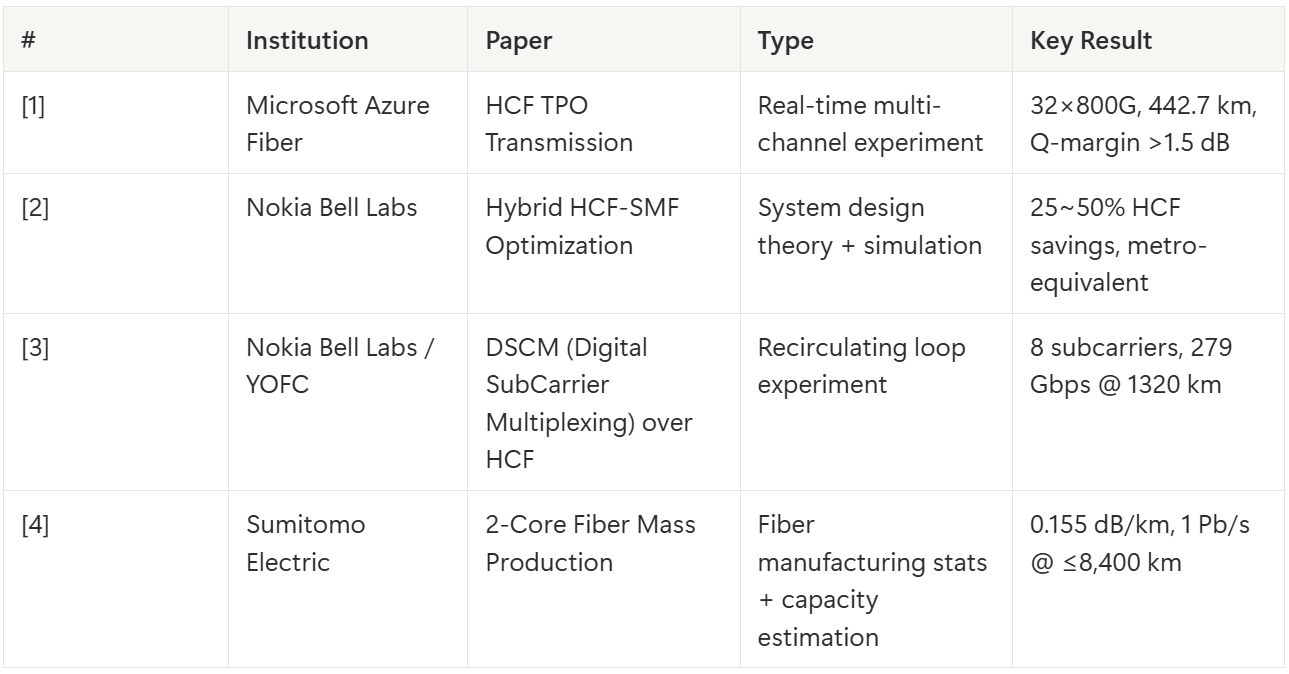
Four Papers at a Glance
HCF vs SMF: System Design Comparison
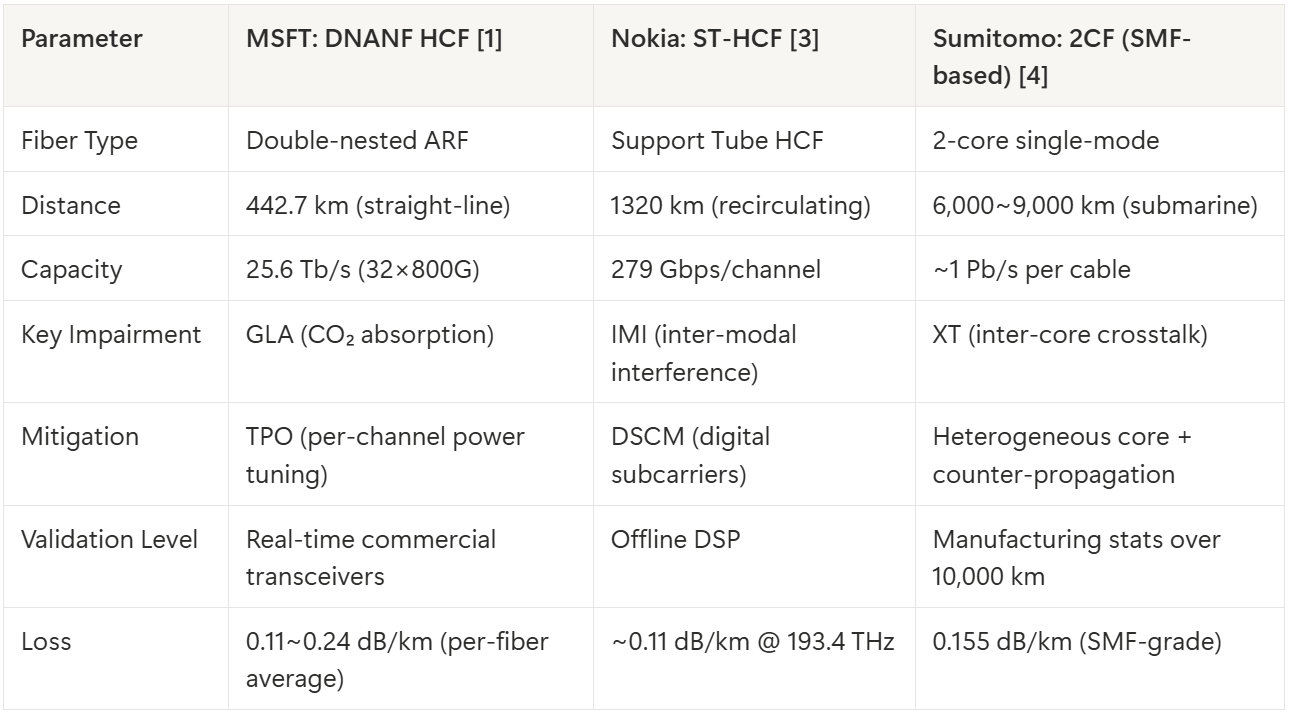
Note on measurement conditions: Distances and capacities are not directly comparable due to differing experimental methods (straight-line vs recirculating loop) and fiber types. All values are as reported by the respective authors.
From here, I examine what each paper actually demonstrated and what these results mean for HCF commercialization.
