
AI clusters are doubling in scale every year. Meta’s current ORv3 rack connects 72 GPU nodes over a copper backplane. The ORW rack, soon to be deployed, scales to 144 nodes. The next generation exceeds 256 nodes, pushing single-rack power past 1 MW [1]. At this scale, copper-based electrical interconnects hit walls simultaneously across power, bandwidth density, and routing complexity.
CPO (Co-Packaged Optics) as an alternative is not a new story. What is new is that Meta drew a public baseline at OFC 2026: “For optical technology to be compelling, it must be reliable and performant while offering comparable cost and power efficiency to electrical solutions.” All three conditions must be met, or it does not get used. This single framing defines the entire CPO session at OFC 2026.
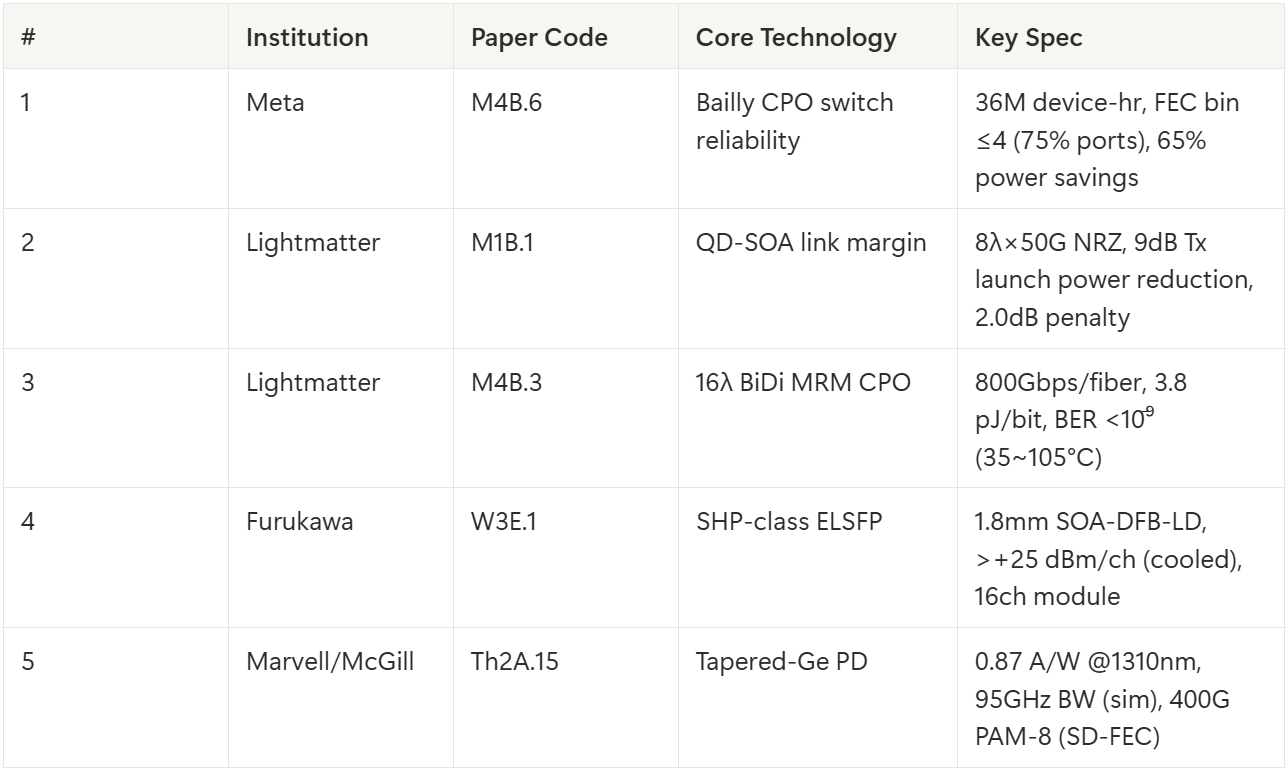
In Part 2, we examine five papers from OFC 2026 that cover four segments of the CPO value chain: external laser sources (Furukawa), link margin compensation (Lightmatter QD-SOA), transceiver systems (Lightmatter BiDi), field reliability (Meta/Broadcom), and photodetectors (Marvell/McGill). Each addresses a different layer, but they share one underlying question.
“CPO has entered the stage where it must prove operational viability, not just performance. And there are still significant gaps in that proof.”
Five Papers at a Glance
Cross-Comparison
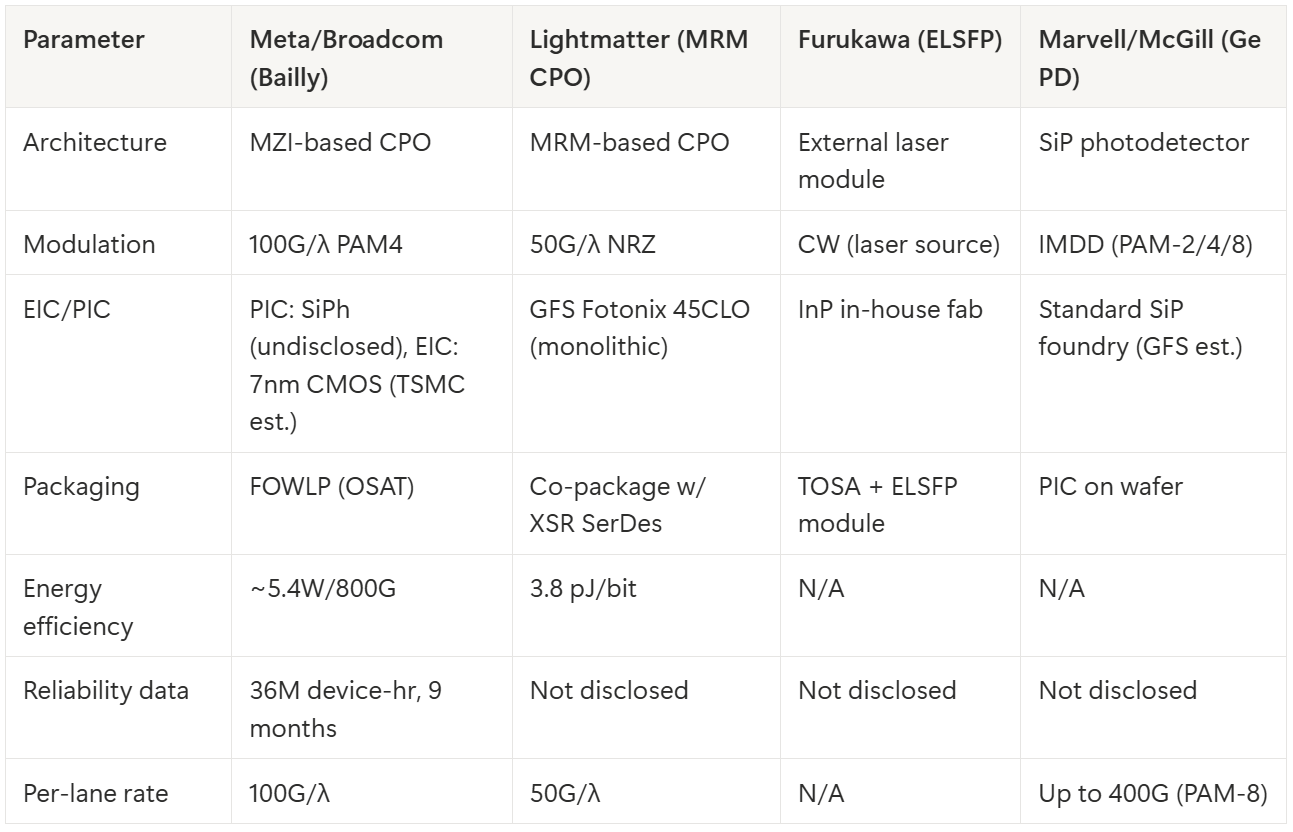
From here, we analyze each paper individually, examining where each technology sits in the CPO value chain, its limitations, and structural insights across the full chain.
