
On June 5, 2026, Jensen Huang came to Seoul. The market read the visit as an HBM4 and GPU event. Huang named Samsung, SK hynix, and Micron as HBM4 suppliers for Vera Rubin, and Hyundai’s 50,000-GPU Blackwell AI factory was back in the headlines. One thing to keep straight: that AI factory and the roughly $3B physical AI investment were already announced on October 31, 2025 at the APEC summit in Gyeongju, so the June 5 visit reads less like a new deal and more like a re-staging of those plans on the ground. The fresher signal was not GPUs. It was physical AI. NVIDIA opened hiring for a Seoul-based AI Technology Center, with roles in foundation models and physical AI, and Huang said robotics is going to be the next major sector. This piece does not re-score the entire humanoid supply chain. The earlier humanoid investment map did that. The question here is narrow: which layer of Korea’s physical AI cluster did the June 5 visit move forward?
Contents
Intro: the headline was HBM4, but the itinerary pointed at robots
Physical AI does not run on the model alone
Why Korea: physical AI needs a factory feedback loop
The layers the June 5 itinerary actually pointed at
What changes: speed of verification, not the announcement
Scenarios and monitoring
Closing
References and Sources
1. Intro: the headline was HBM4, but the itinerary pointed at robots
The market read Huang’s visit as an HBM4 and GPU deal. That is not wrong. Korea is still the core of NVIDIA’s memory supply chain, and Huang named Samsung, SK hynix, and Micron as HBM4 suppliers for Vera Rubin [4]. But read the visit only that way and you miss half of it.
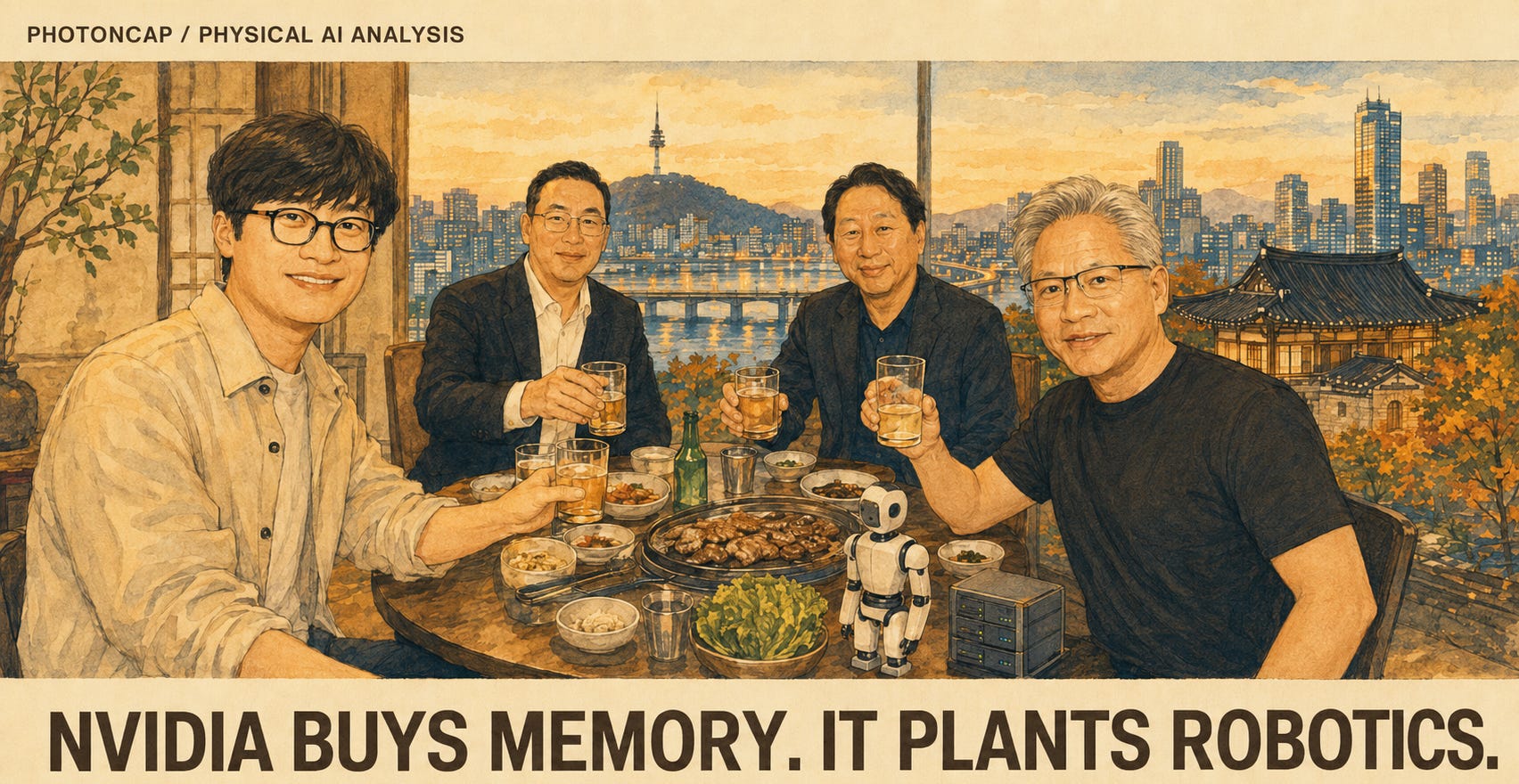
The trip was consumed less like a corporate visit and more like a national event. The motorcade was chased by press, and investors mapped each stop to a related stock into what some called an AI wealth map. The first dinner was a chimaek gathering with SK’s Chey Tae-won, LG’s Koo Kwang-mo, and Naver’s Lee Hae-jin, and on day three Huang threw a KBO ceremonial first pitch in a number 93 jersey, a nod to NVIDIA’s 1993 founding [10]. A peer analysis at SEMIVISION likened it to a K-pop superstar tour and argued Korea is less a single-component supplier than a national platform for AI industrialization. The point for an investor is not the spectacle. It is what NVIDIA planted in Korea in between.

GPUs and HBM are what NVIDIA buys from Korea. The Seoul AI Technology Center, physical AI, and robotics are what NVIDIA plants in Korea. The investment meaning of this event sits in the second half.
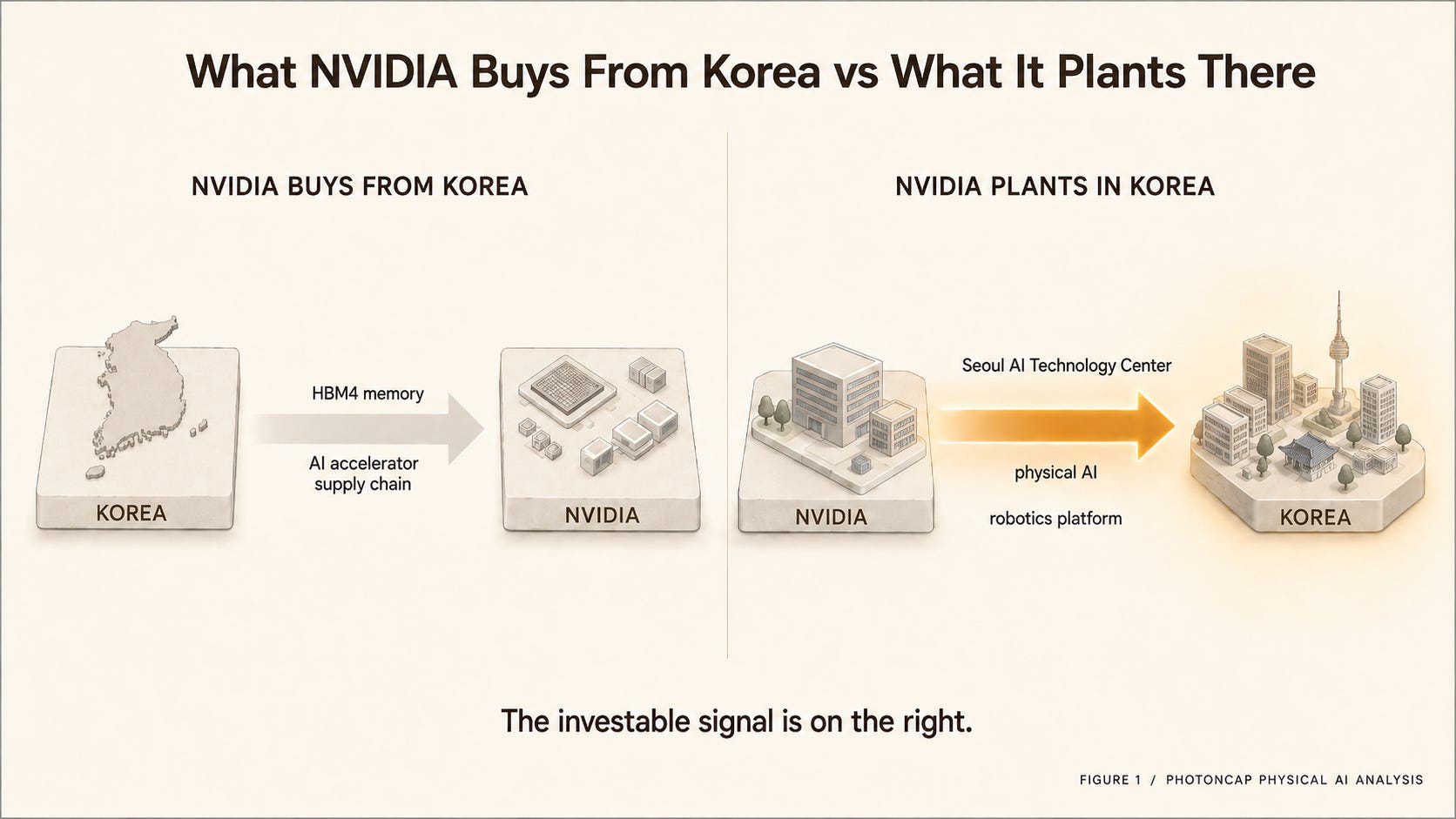
[Figure 1: What NVIDIA buys from Korea (memory, GPUs) vs what it plants there (robotics, R&D, software stack)]
One point needs to be precise. The Hyundai 50,000-GPU Blackwell AI factory, the roughly $3B physical AI investment, and the AI Technology Center and AI Application Center plans that came back into the headlines were not new on June 5. They were announced on October 31, 2025 at the APEC summit in Gyeongju [1][2][3]. The June 5 visit is best read as putting those plans back in front of the camera and pushing them forward. What was genuinely new this time was NVIDIA opening a Seoul AI Technology Center and starting to hire for it, at the PhD level, for foundation model and physical AI roles [5].
So the question is not how many more GPUs NVIDIA will sell in Korea. The question is narrower. Which layer of Korea’s physical AI stack did Huang’s itinerary move forward?
Takeaway: GPUs and HBM are what NVIDIA buys. The R&D center and robotics are what it plants. The investment signal is on the side it plants.
2. Physical AI does not run on the model alone
Physical AI takes a model trained on synthetic data in simulation and pushes it out to real machines. What NVIDIA holds is the training and inference, and the software control point: Jetson Thor for edge inference, GR00T VLA as the humanoid foundation model, and Cosmos as the world model that generates synthetic data. But a model alone does not move a robot. The bottleneck of the robot body comes down to actuators, precision reducers, and sensors, and there are separate companies that build those.
A humanoid has 25 to 30 major joints, more than 30 once you add hands and linear axes. Each joint needs a motor, a precision reducer, and a sensor. That is content a GPU box does not carry. Korea sits in both the component layer and the robot body layer. The full 20-company map across the cascade is in the earlier humanoid investment map, and this piece does not redraw it.
[Investment Map] 20 Companies in the Humanoid Cycle: From Rare Earth Magnets to Vision Language Action
![[Investment Map] 20 Companies in the Humanoid Cycle: From Rare Earth Magnets to Vision Language Action](https://substackcdn.com/image/fetch/$s_!KKa3!,w_1300,h_650,c_fill,f_webp,q_auto:good,fl_progressive:steep,g_auto/https%3A%2F%2Fsubstack-post-media.s3.amazonaws.com%2Fpublic%2Fimages%2F8f3c50a8-089d-4341-ab51-5557a56b3157_1704x923.png)
On May 13, 2026, two events landed on the same day in the humanoid cycle. Figure AI livestreamed Helix-02, three robots autonomously sorting 30,000 packages in 24 hours with zero failures. The livestream extended into a multi-day run. As of May 17, the counter showed 81 hours and 101,391 packages. The same day, Schaeffler announced two parallel deals with UK humanoid startup Humanoid AI, deploying up to 1,000 to 2,000 robots at Schaeffler global plants by 2032 plus a separate 5-year actuator supply agreement covering seven-digit (1M plus) joint actuators through 2031. This is an Investment Map of the 20 listed companies sitting on the cascade behind 11 humanoid makers globally. The thesis is that the cycle alpha is in the component cascade, not in the robot maker race. PhotonCap GVM (Global Value Map) scores 20 names across 5 axes (Technology Barrier, Supply Concentration, Bottleneck Value, Verifiable Incumbency, Catalyst Proximity) and reveals 2 Hidden Cards positioned for re-rating. Among the five tiers, Tier 2 Precision Components is the bottleneck where automotive valuations and humanoid component exposure intersect.
Takeaway: physical AI needs the brain (the model) and the body (robots and parts) together. A humanoid has many joints, and the more joints it has, the larger the reducer and actuator content. Korea sits on the body side.
3. Why Korea: physical AI needs a factory feedback loop
Step back for the bigger picture. Why is NVIDIA planting physical AI in Korea at all?
AI software itself is strongest in the US. But physical AI is not finished in software. It needs real machines and factory data. The shape is a loop. Build digital twins and synthetic data in Omniverse and Cosmos (simulation), train the model in an AI factory (training), push it to the floor on robots (deployment), and feed the data from that floor back into training (factory feedback). Physical AI works once that loop closes.
Korea is a good place to close that loop inside one cluster. Autos, memory, batteries, displays, factory automation, robot parts, and robot bodies all sit in one place. What NVIDIA wants is not a GPU buyer but this deployment loop. The picture is running Hyundai’s smart factory as an Omniverse digital twin, generating synthetic data with Cosmos, and applying the result back to real factory automation and robots.
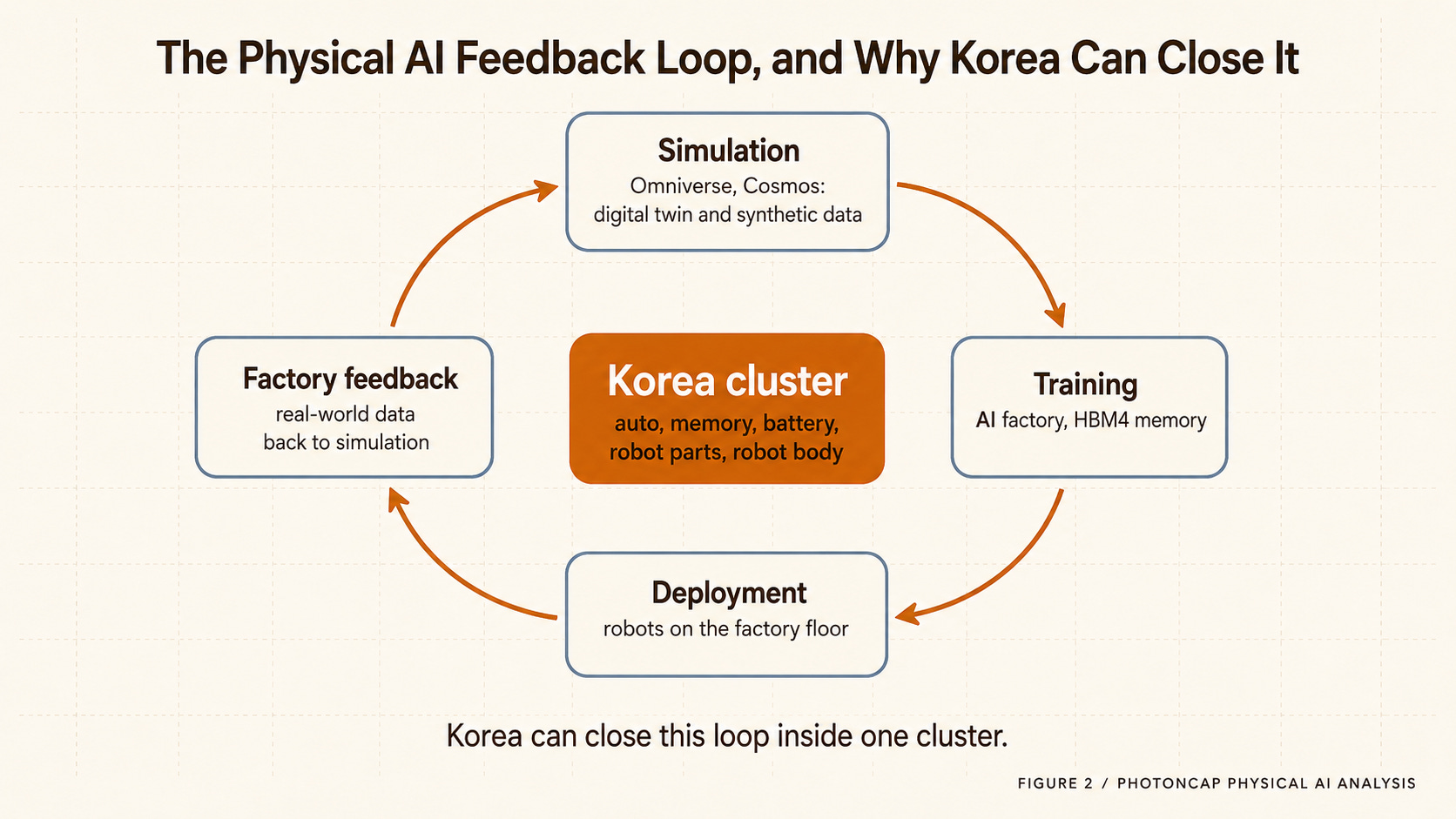
[Figure 2: Korea’s physical AI factory feedback loop. Simulation (Omniverse, Cosmos) to training (AI factory, HBM4) to robot deployment (OEM) to factory feedback, closing inside one cluster]
So this trip was not a memory procurement event. It was physical AI cluster positioning. Back to the title: NVIDIA did not come to sell GPUs. It came to position Korea as the manufacturing, robotics, and training-data cluster for physical AI. The next question is which card inside that loop had its verification timeline pulled forward by the visit, and by how much. That is where the analysis starts.
Takeaway: physical AI runs once simulation, training, deployment, and factory feedback close into one loop. Korea holds the parts of that loop in a single cluster, and what NVIDIA wanted was the loop, not a GPU buyer.
