
On July 29, the top and bottom of the semiconductor supply chain moved in opposite directions. SK hynix ($SKHY) printed a record 60.5 trillion won in quarterly operating profit and still closed down 9.6% in Seoul. That same night, FormFactor ($FORM) delivered a big beat, $258.2M in revenue and $0.82 in non-GAAP EPS, and jumped as much as 17% after hours. The divergence shows how supply expansion can pressure memory pricing while supporting wafer test volumes, and Tower Semiconductor’s ($TSEM) August 4 report is the next check on the foundry side. My lean has not changed: long the fab, packaging, and testing layers.
Contents
July 29
Where the Selloff Started
FormFactor’s Numbers
Same Money, Opposite Directions
Reviewing the Last Call (Q1 2026)
The Next Gate: Tower, August 4
Monitoring
1. July 29
July 29 produced two very different screens.
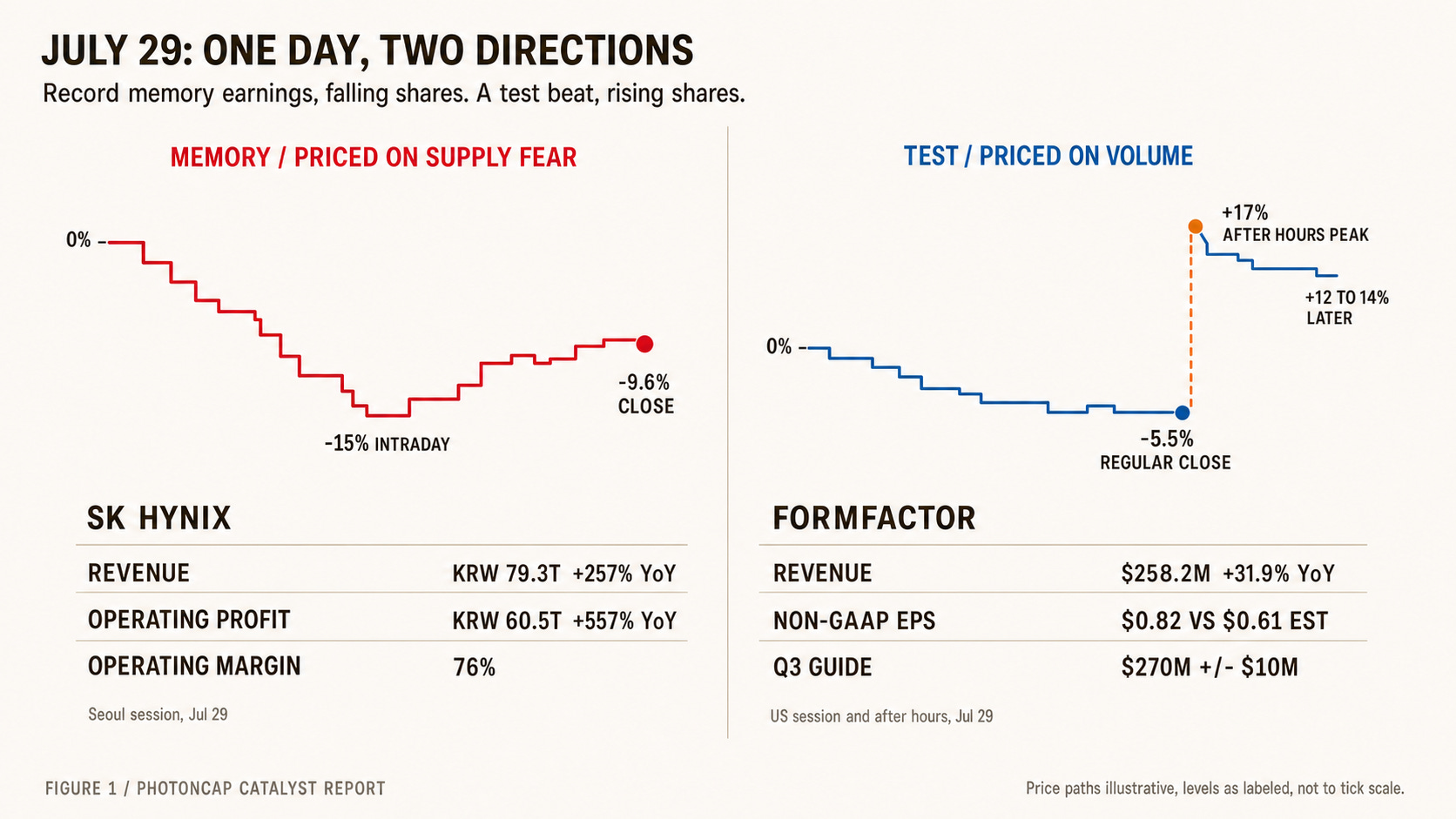
Figure 1: July 29 two screens. SK hynix record earnings and -9.6% close vs FormFactor beat and +17% after hours
Tuesday evening US time, SK hynix reported second quarter 2026 results. Revenue of 79.3 trillion won, up 257% year over year. Operating profit of 60.5 trillion won, up 557%. A 76% operating margin. By any measure, a quarter that belongs in semiconductor history.[1] The stock fell more than 15% intraday in Seoul before closing down 9.6%.[2]
The decline was not a one-day event. The day before, on the 28th, Samsung Electronics lost more than 13%, Tokyo Electron 11%, and Advantest more than 10%[3], and over $1 trillion of market cap evaporated from the world’s largest chip stocks in a single week.[2] One tally has the Philadelphia Semiconductor Index on pace for its worst month since 2008 (per secondary media compilation).[4]
Then on Wednesday after the close, right in the middle of all that, FormFactor reported. Revenue of $258.2M beat consensus, non-GAAP EPS of $0.82 cleared the $0.61 estimate by a wide margin, and the first Q3 guidance the company issued also came in above consensus.[5][6] The stock had fallen 5.5% with the market in the regular session, then reversed after the release, touching a 17% gain after hours before settling back to a 12 to 14% gain (as of 2026-07-29, after-hours basis).[6][11]
In a week when everything was falling, one earnings report produced a double-digit after-hours reversal. That was not random. The two stocks were reacting to different parts of the same cycle.
2. Where the Selloff Started
SK hynix’s numbers were records, but they fell short of the market’s bar. Operating profit of 60.5 trillion won missed consensus by roughly 6%[1][2], and on top of that sat worries about the durability of big tech AI spending and the absence of a shareholder return plan. The decline had more than one cause.
One variable stands out for this story, though. SK hynix said it would lift 2026 capex into the high 40 trillion won range, roughly $31B.[7] That is an increase of about 50% year over year. Capacity does not grow 50% overnight, but the market read it as a signal that medium-term supply expansion is speeding up.
Memory is a pricing business, and today’s record profits exist because supply cannot keep up with demand. When supply expansion accelerates, the shelf life of those profits comes into question. Investors who lived through the 2018 and 2022 downturns do not need much encouragement to sell. Add the capacity worries around China’s CXMT, which listed this week.[8]
Demand fear and supply fear are not the same thing. If demand breaks, every layer of the chain hurts together. Supply expansion hurts the companies exposed to pricing before it hurts the suppliers exposed to unit volumes.
3. FormFactor’s Numbers
Now FormFactor’s quarter, the fiscal second quarter ended June 27, 2026.[5]
Revenue of $258.2M, up 14.2% sequentially and 31.9% year over year, an all-time record. Non-GAAP gross margin of 53.3%, up 1,480bp from 38.5% in the same quarter a year ago. One caveat: that 53.3% includes one-time items such as tariff refunds and precious metal reclamation, and the CFO put the sustainable baseline at roughly 51% at current volumes and mix.[11] Non-GAAP EPS of $0.82 is more than triple last year’s $0.27, and free cash flow came in at $52.6M. Compared with negative $47.1M a year earlier, the improvement in cash generation is hard to miss.[5]
The first Q3 outlook the company has issued also landed well above consensus: revenue of $270M plus or minus $10M, non-GAAP gross margin of 54.0% plus or minus 1.5%, and non-GAAP EPS of $0.86 plus or minus $0.09, against street numbers around $247M and $0.63.[5][6]
The release named its growth drivers explicitly: High Bandwidth Memory (HBM, the high-bandwidth memory stacked next to AI accelerators) and Co-Packaged Optics (CPO, the approach that puts optical components into the same package as the processor), crediting them with driving sequential growth in the Probe Cards and Systems segments respectively.[5] CEO Mike Slessor pointed to four quarters of 30%-plus revenue growth, 1,500bp of non-GAAP gross margin expansion, and a tripling of EPS, describing the company’s position as sitting at “the intersection of high-performance compute and advanced packaging.”[5]
The numbers still leave the day’s question open. In a week when memory was breaking, why did a company whose largest customer was approaching 30% of revenue go up? What the same $31B that sank SK hynix means for FormFactor is the first thing behind the paywall.
Then comes the review of the last call: the gates set in May’s Q1 piece, where SK hynix’s 29.5% went, whether NVIDIA held above 10%, whether the CPO guide moved, all judged against this quarter’s data. Hits, holds, and retractions, on the same standard. And then Tower: where $TSEM sits ahead of its August 4 earnings, and which seat it holds in the long fab, packaging, testing thesis.
FormFactor Q1 2026: SK hynix 29.5%, NVIDIA 10.2%, and the First CPO Test Revenue Signal

Three cycles bent together in a single quarter at FormFactor (FORM) Q1 2026. SK hynix reached 29.5% of revenue (up from 23.3% a year ago), NVIDIA was disclosed as a 10%+ customer for the first time at 10.2%, and 2026 CPO revenue guidance was raised to the high end of the $10-20M range. Revenue hit $226.1M, an all-time record (+32% YoY), with Q2 guidance at $240M. The stock returned +361% over one year, roughly 2.7x the semiconductor index (SMH, +134%). The thesis the market had been pricing in for a year was confirmed in a single quarter’s numbers. This article breaks the earnings into three axes, HBM, CPO, and AI networking, and analyzes the alignment and risk across them.
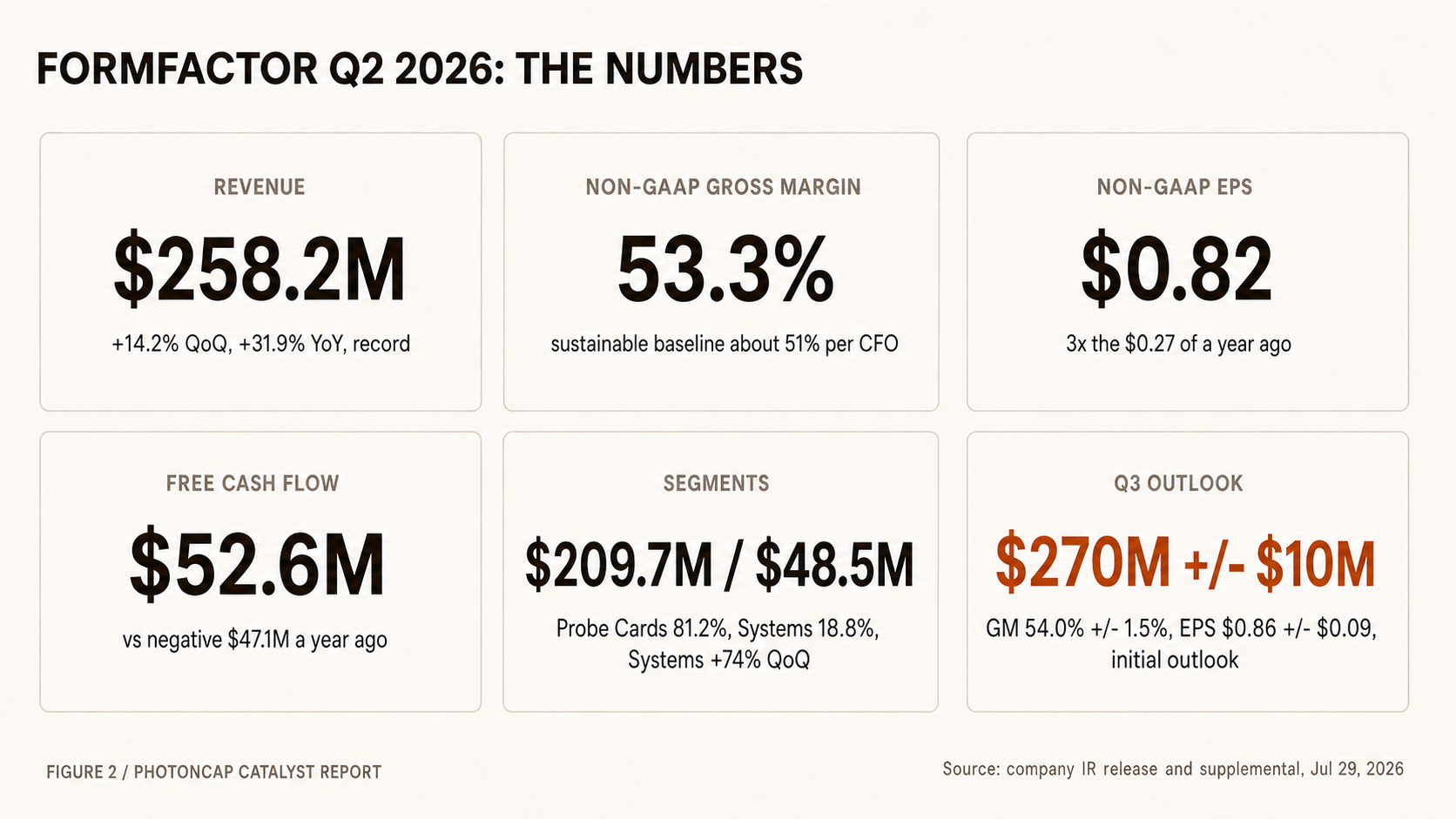
Figure 2: FormFactor Q2 2026 key numbers card. Revenue, margin, EPS, FCF, Q3 guide
Key point: A big beat, and a first-issued Q3 guide above consensus. HBM and CPO were named as growth drivers in the earnings release itself.
