
(⚠️ This article reflects personal opinions based solely on reading the paper.)
0. Motivation for Writing This Article
While reviewing papers, I came across an intriguing study in Nature Photonics and downloaded it to read. Research focused specifically on optical fibers themselves has been relatively scarce since 2015. (The trend is chip-scale photonics research) The authors’ affiliation with Microsoft (MSFT 0.00%↑ ) Azure Fiber was intriguing, and the co-author’s institution, the Optoelectronics Research Centre (ORC) at the University of Southampton, is a notable place doing excellent research in optoelectronics/photonics.
https://x.com/PhotonCap/status/1985830595990339915
It was intriguing that a private company was directly researching optical fibers, and I hadn’t known Microsoft was conducting research at the device level itself. I was well aware that ORC had been excelling in optical fibers and optoelectronics for over a decade. Curious about their relationship, I decided to look into it.
Paper: Nat. Photon. 19, 1203–1208 (2025).

https://doi.org/10.1038/s41566-025-01747-5
Moreover, the reason I decided to write this article is that while the paper emphasizes loss right from the title, I wanted to highlight what lies behind that loss: nonlinearity removal, low dispersion, and low latency. As you’ll see in the paper, even the figures are entirely focused on loss-related results. (It’s unclear if the authors intended to downplay these other aspects.)
1. Why did the MSFT Azure Fiber team conduct this research?
Optical fiber communication was born in the 1960s from Professor Charles K. Kao’s proposal, and in the 1970s, Corning (GLW 0.00%↑ ) succeeded in commercializing fiber by creating fiber with loss below 20 dB/km. (For reference, Professor Kao won the 2009 Nobel Prize in Physics).
Subsequently, around 1985, NTT and Corning achieved 0.154 dB/km (Pure Silica Core Fiber), which was near the physical limit of silica (glass) (Rayleigh scattering* ≈ 0.14 dB/km).
Rayleigh scattering is the phenomenon where electromagnetic waves undergo elastic scattering by particles much smaller than their wavelength. It occurs when light passes through gases, transparent liquids, or solids. Rayleigh scattering of sunlight in the atmosphere is the primary reason the sky appears blue.
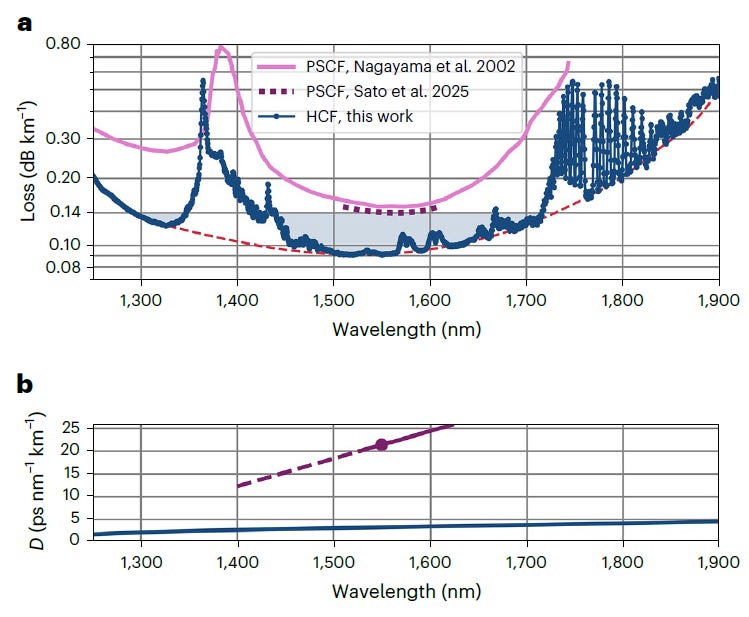
For 40 years, this barrier remained unbroken. However, the MSFT Azure Fiber team recently achieved a record loss of 0.091 dB/km using Hollow Core Fiber (HCF), with the results published in Nature Photonics.
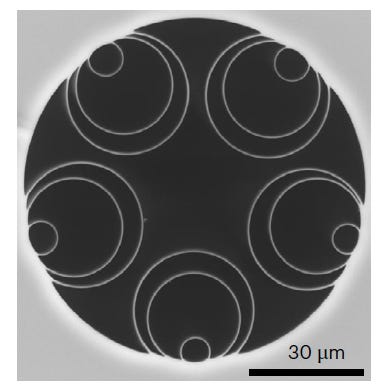
The figure below shows HCF. The black portion represents air.
Below is a graph comparing it to conventional fiber. HCF (blue) has lower loss and lower dispersion (D) compared to conventional pure silica core fiber (PCF, pink).
2. The SMF-28 era is still “good, but nearing its end”
SMF-28 (standard silica optical fiber) has been the mainstay of the telecommunications industry for decades.
It enables transmission at hundreds of Tb/s with DWDM and remains optimal for long-haul networks.
However, it is designed for networks spanning thousands of kilometers (telecom backbones).
AI data centers (AIDCs) present different challenges.
Now**, density, latency, and power** are key, not “distance.”
SMF-28 → Optimized for ‘long distance·medium latency’
AIDC → Requires ‘short distance, ultra-low latency, high power density’
3. Non-Linear Effects are the true limit of scale-up
When multiple wavelengths (WDM) are transmitted simultaneously in silica fiber, the refractive index slightly changes due to high optical power,
causing channel-to-channel interference and distortion like FWM, XPM, and SPM.
To suppress this, the wavelength spacing must be widened or dispersion increased, but doing so drastically reduces WDM efficiency and power efficiency.
Ultimately, this leads to increased DSP and compensation circuitry → increased delay and power consumption.
SMF-28: “Low loss, but unsuitable for high-power WDM scale-up due to nonlinearity limitations.”
4. Scale-Out vs Scale-Up
Scale-Out: Inter-rack connectivity (networking)
Bottlenecks: TCO (Total Cost of Ownership), Power Efficiency
Leading Technology: Parallel Optics
Related Companies:
,
Scale-Up: Direct interconnect between GPUs/XPUs
Bottlenecks: I/O Space (Fiber Real Estate), Latency
Leading Technology: Multi-wavelength WDM (Single-fiber Multi-channel)
Related Companies: Ayar Labs, Xscape Photonics, Celestial AI (All covered in the Silicon Photonics Company Exploration)
Bottleneck Description Impact
① TCO (Total Cost of Ownership): Overall system costs including optical cables, switches, transceivers, cooling, etc. A core driver of CAPEX and OPEX pressures in large-scale data center networking.
② Power Efficiency: Power consumed by optical transceivers, DSPs, and retimers. Limits bandwidth per watt (GB/s/W) in AI server racks.
③ I/O Space (Fiber Real Estate) Physical limit on the number of optical ports that can be placed on a package or board. Restricts the total bandwidth connectable to GPU chips.
④ Latency: Time taken for signal transmission/processing/recovery. Directly impacts synchronization efficiency in AI model training and inference.
5. HCF: The Physical Solution to the Scale-Up Dilemma
Nonlinearity effectively zero: The nonlinear coefficient n2 of air cores is approximately 1000 times lower than that of silica.
Ultra-low dispersion: 1/7th of SMF (≈ 3 ps/nm/km) → Drastically reduces DSP power.
Delay reduced by 30%: Air transmission (refractive index 1.00 vs 1.44) → Improved propagation speed.
Loss 0.091 dB/km: Breaking a 40-year technological barrier.
Consequently, HCF is the only physical fiber platform enabling “high-power, high-density WDM implementation without DSP for short-distance, low-latency applications. “
6. Connection loss issue with SMF-28 — Minimal impact in actual AIDC
HCF and SMF-28 have different core structures resulting in coupling loss (≈ 0.5–1 dB) when directly connected. However, the AI cluster interior can be designed as a closed optical ecosystem (Optical Package).
In other words, if HCF is used for direct chip-to-chip interconnects, it may not require connection to external networks.
Even in long-distance scale-out segments, once distances exceed 100 km, HCF’s low transmission loss offsets the connection loss.
Example (@ 100 km link): SMF-28 (14 dB) vs. HCF (11.1 dB) → Total loss reduction.
(Assuming 1 dB loss per connection: 0.14 x 100 = 14 vs. 0.091 x 100 + 2 = 11.1)
Campus/same site (≤10 km): SMF-28 remains better or comparable if connection loss is high.
Metro DCI (20–40 km): HCF gains a loss advantage if connection quality (total C ≤ 1 dB) is ensured.
Intercity/Long-Distance (≥50–80 km): HCF remains superior even with 2 dB connection loss.
7. Commercialization Prospects for Hollow Core Fiber
Mass production, connection processes, and standardization issues remain.
However, Microsoft is building an ecosystem through strategic partnerships (ORC Southampton) and acquisitions (Lumenisity, 2022) to bolster Azure infrastructure.
Note: Lumenisity is a spinoff company from ORC.
Short term (1–3 years): High potential for piloting ultra-low-latency links.
Mid-term (5–10 years): Scalability to AIDC and cloud-scale networks.
8. Interpretation – MSFT’s True Intent
While the paper superficially emphasizes “loss record renewal” (all figures focus on loss), the actual core appears to be eliminating nonlinearity + low dispersion + low latency → securing a WDM Scale-Up foundation. (This is purely my personal view.)
In other words, MSFT is laying the groundwork for an optical physics scale-up platform for AI clusters, using long-distance networking cost reduction (scale-out) as justification.
9. Conclusion
Current AIDC Scale-Up is at the logical (topology-based) level, while true ‘optical physical Scale-Up’ remains in the research phase. The HCF research by the MSFT Azure Fiber team is about preemptively breaking through the physical limits of the next-generation AI infrastructure.
Additionally, those interested in Scale Out and Scale Up CPO should check the video linked below. It features Rajiv Pancholy (Director, Hyperscale Strategy & Products, Optical Systems Division) from Broadcom presenting at OCP SUMMIT 2025 under the title “Scale Out Networks and Scale Up Architectures with CPO.”
Appendix
A1. ORC (Optoelectronics Research Centre, University of Southampton)
It is a world-leading optical fiber research institution.
It is also a co-author institution of this Nature Photonics paper.
ORC has conducted foundational research in the Hollow Core Fiber (HCF) field for over 20 years and previously established a startup called Lumenisity as a spin-off.
A2. Lumenisity
A startup founded in 2017 by researchers from the ORC at the University of Southampton, UK.
Its goal is to “commercialize Hollow-Core Fiber.”
It successfully conducted multiple field trials (e.g., with BT, Comcast, Verizon, etc.) demonstrating ultra-low-latency transmission using HCF.
In December 2022, Microsoft acquired Lumenisity.
A3. Microsoft’s Strategic Significance
This signifies that Microsoft has directly secured HCF core technology, personnel, and intellectual property (IP), going beyond mere joint research at the paper level.
Specifically: Southampton ORC → Foundational research Lumenisity → Process, manufacturing, and field test capabilities MSFT Azure → Practical hyperscale data center implementation
A4. Evidence Supporting HCF’s Commercialization Potential
HCF uses an air core instead of a glass core, leading to widespread assessments that it offers structural advantages over conventional silica fiber in terms of nonlinearity, dispersion, and delay.
Market research also indicates that the HCF market is expected to grow significantly over the next several years.
A5. Challenges remaining before commercialization
Scaling production and manufacturing: The HCF manufacturing process is highly precise and complex, making mass production and ensuring consistent quality challenging.
Installation and operational environment: Due to HCF’s structural characteristics, additional challenges remain regarding cabling, splicing, connectors, and field installation environments (bending radius, durability, etc.).
Standardization and Ecosystem Development: Compatibility with existing optical fiber infrastructure (cables, connectors, equipment) and the absence of industry standards are cited as obstacles.
Cost: Currently, manufacturing and installation costs are likely higher than those of conventional silica optical fiber, which could slow commercialization.
If I have time, I will simulate the coupling loss between a hcf and a smf.
Funny. I just published a similar article but covered Amazon’s approach to hollow core fibers. I spoke of a different approach regarding Microsoft. Didn’t dive deep, just shared my thoughts from my Friday readings.
Check it out :)
https://substack.com/@iamfabian/note/c-221653509