
Aehr Test Systems reported Q3 FY2026 revenue of $10.3M, down 44% YoY. But bookings hit $37.2M with a book-to-bill over 3.5x. The real signal for SiPh investors: Aehr now has at least two production-stage silicon photonics customers ordering wafer-level burn-in systems, up from one. This article breaks down why WLBI is structurally mandatory for SiPh devices heading into CPO/optical I/O packages, connects today’s results to the Three Pillars test infrastructure framework, reads the undisclosed customer identity signals, and examines the technical breakout on the weekly chart.

Contents
Why This Matters for the SiPh Thesis
The WLBI Logic for Silicon Photonics
Reading the Customer Identity Signals
Connecting to the Test Infrastructure Stack
The Financial Picture
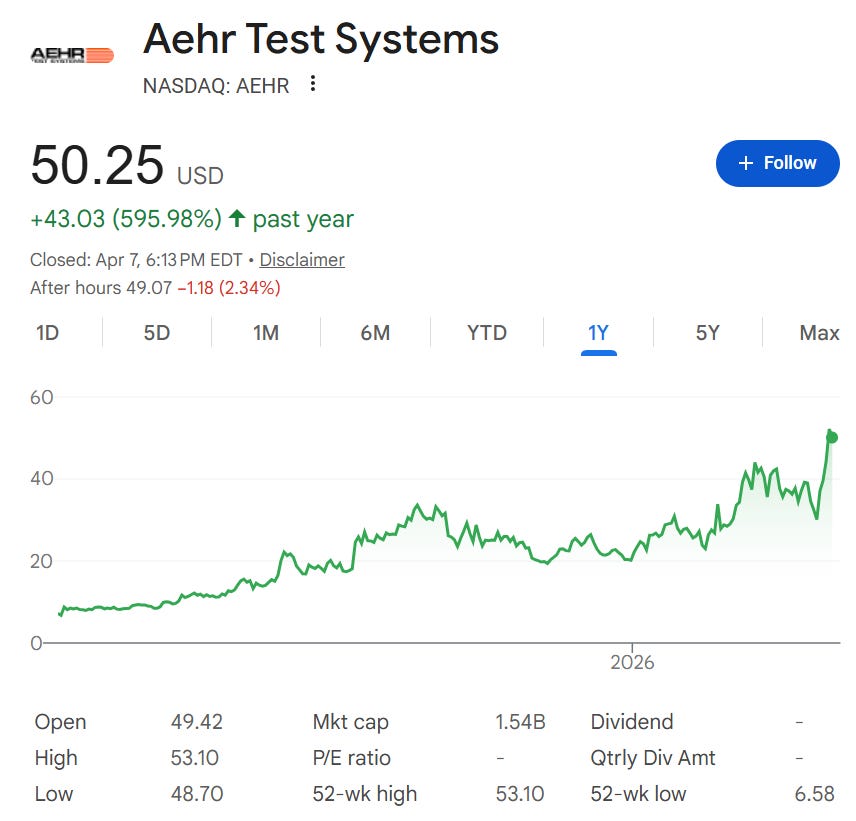
Chart: The Breakout
Bottom Line
Aehr Test Systems (NASDAQ: AEHR) just reported Q3 FY2026 results. Revenue was $10.3M, down 44% YoY. Net loss widened. On the surface, a forgettable quarter.
But the real story is in the bookings: $37.2M, book-to-bill over 3.5x. And within that number, silicon photonics is emerging as a structurally significant demand driver alongside AI ASICs.
Why This Matters for the SiPh Thesis
Aehr’s earnings call delivered two discrete silicon photonics data points that deserve close attention.
First, a new SiPh customer win. Aehr disclosed a major new customer order for high-power FOX-XP wafer-level burn-in (WLBI) systems targeting hyperscale data center optical interconnects. The customer is developing silicon photonics-based transceivers for data center networking and optical I/O. This was not a qualification unit. It was an initial order for multiple FOX systems covering both qualification and production, a distinction that signals commercial intent rather than exploratory evaluation.
Second, a follow-on order from the existing lead SiPh customer. This included both a new high-power FOX-XP system and an upgrade of an existing FOX system to the latest high-power, fully automated configuration. Upgrading existing installed base to higher-power specs is a capacity expansion signal, not a one-off purchase.
These two data points together suggest that at least two separate silicon photonics companies are now in volume or near-volume production trajectories requiring dedicated burn-in infrastructure.
